Lütticher Strasse 2nd BA
City of Aachen
Brief info
Phase 2: Between Limburger Straße and Amsterdamer Ring/Hohenstaufenallee
- Project phase: Preliminary planning
Current
The second construction phase (2nd CP) of Lütticher Straße between Limburger Straße and Amsterdamer Ring/Hohenstaufenallee has had functional deficiencies for many years. Therefore, a comprehensive renovation of the road and a redesign of the entire traffic area are necessary.
In order to decide on the next steps, it is necessary to analyze the parking survey conducted following the introduction of the "U" resident parking zone. This survey took place on July 8, 2025.
On July 9, 2026, the Mobility Committee decided that Options 2 and 5 should be developed into a site plan.
Work is scheduled on the utility lines and drainage systems, as well as a redesign of the street layout.
Map
Occasion
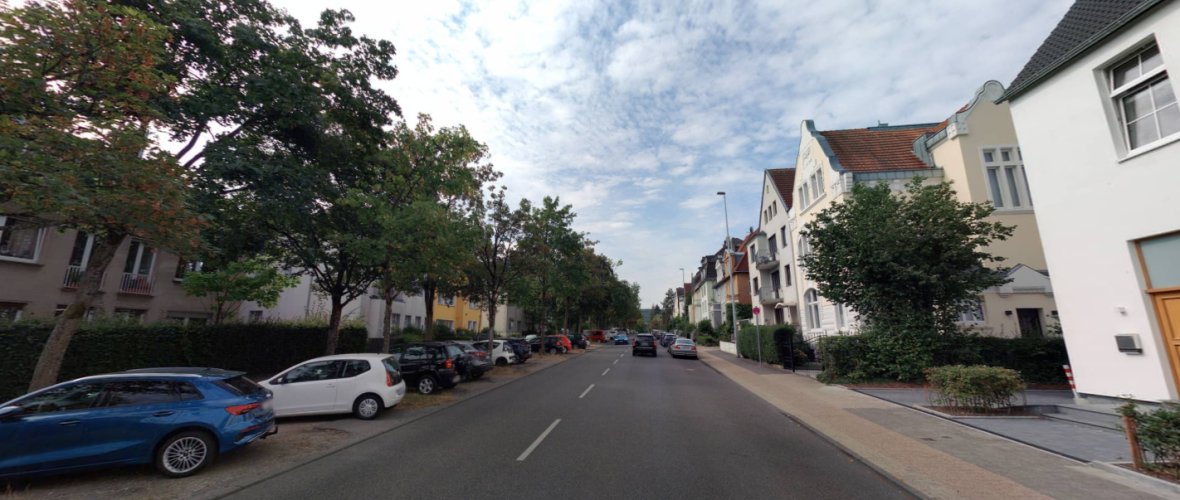
Lütticher Straße is part of the classified road network and main road network of the city of Aachen as federal highway 264. It leads southwest towards Belgium and connects to the Alleenring in the north. It forms a historic axis and, with its Wilhelminian-style buildings and old trees, represents a special urban situation that is to be taken into account in the planned full expansion.
In September 2013, a construction resolution had already been passed for the second construction phase (BA) of Lütticher Straße, specifically the section between Limburger Straße and Amsterdamer Ring (see proposal FB 61/0951/WP16). Among other things, the plan called for the marking of protective lanes on both sides of the road. Funding for the project was approved in 2018.
In 2019, the Aachen Cycling Referendum was adopted, prompting an assessment of which major thoroughfares (including Lütticher Straße) could be redesigned in accordance with Goal 3—that is, with 2.30-meter-wide one-way bike lanes. Since the approved preliminary design for Phase 2 of Lütticher Straße did not meet the requirements of the Aachen Cycling Plan, the revised tree protection requirements, or the planning guidelines now in effect, the plans for Lütticher Straße were revised.
The results of a public consultation were presented to political bodies in April 2021. Based on a wide variety of input from citizens, the existing options were refined into a new Option 5. This variant is characterized by wide bicycle lanes in the side streets, continuous parking spaces leading out of the city (longitudinal) and, in some cases, into the city (perpendicular), as well as trees on both sides of the street, some of which are arranged in three rows. The administration recommended the preparation of site plans in accordance with this cross-sectional Option 5. However, on April 22, 2021, the Mobility Committee instructed the administration to prepare site plans based on Options 2 and 5. It also requested an additional variant that takes into account the movement spaces for all modes of traffic and an optimal tree balance in the interest of a sustainable design (see proposal FB 61/0086/WP18).
In order to assess the impact of the plan on the parking situation, we should wait for the establishment of the “U” resident parking zone (Körnerstraße) and the follow-up survey. The zone was established on July 15, 2024. A follow-up survey was conducted in 2025, and the Mobility Committee took note of the corresponding report on December 18, 2025 (see document FB 68/0280/WP18).
Today's situation
With the exception of the outer ring offset between Brüsseler Ring and Amsterdamer Ring, Lütticher Straße is a relatively low-traffic radial road (as of November 27, 2025: approx. 5,500 vehicles/7 a.m.–7 p.m. at the Amsterdamer Ring/Hohenstauffenallee/Lütticher Straße intersection). In the section discussed here, between the Amsterdamer Ring and Limburger Straße, it provides access to, among other places, the Couvengymnasium and the Franziskus Hospital. The speed limit is generally 50 km/h (limited to 30 km/h during certain times in the area of the Couvengymnasium).
Foot traffic
Lütticher Straße is characterized by its tree-lined nature, high residential density, and very few commercial establishments. It is of great importance due to its numerous destinations for pedestrians. Pedestrians can reach the two premier pedestrian destinations, “Im Johannisbachtal” and “Hangeweiher,” via the Limburger Straße crosswalk. In addition to the Couvengymnasium, several kindergartens in the Lütticher Straße area are also accessible.
Cycling
Within the main bicycle network, Lütticher Straße is designated as a main route and, as such, an important corridor for bicycle traffic.
PUBLIC TRANSPORT
Lütticher Straße also plays an important role in public transportation. The affected section is served by buses on routes 4 and 24. On weekdays, there are generally 6 buses per hour.
Vehicle Traffic
According to the Guidelines for Integrated Network Design (RIN 2008), Lütticher Straße is part of the major road network and is classified as an urban major road (HS III) (see document FB61/0778/WP17).
Street greening
Of the 86 trees in the city, 67 are protected (as of 2021). Many of the trees show signs of declining vitality and should be replaced with new plantings that are forward-looking, uniform, and long-lasting. Twenty of the 86 existing trees are to be preserved.
Planning
The appendices show two selected cross-sections in the sections
- Limburger Straße - Klemensstraße ("cross-section 1" at the level of house no. 113 / 154) and
- Klemensstraße - Hohenstaufenallee ("cross-section 2" at the level of house no. 137 / 172)
shown.
In order to assess the impact of the plan on parking conditions, we should wait until the “U” resident parking zone (Körnerstraße) is established and a follow-up survey is conducted. This took place in July 2025.
Planning should then proceed based on two options:
Option 2 calls for structurally separated bike lanes in the side area and heading out of town as a Protected Bike Lane (PBL), although the PBL can also be constructed as a bike lane at sidewalk level. Parking would only be possible heading into town (partly perpendicular, partly parallel) between the trees. The landscaping is to be arranged in two rows heading into the city, partly between the parking spaces.
Option 5 is characterized by structurally separate bicycle lanes in the side streets, continuous parking spaces leading out of the city (longitudinal) and, in some cases, into the city (perpendicular), as well as trees on both sides, some of which are arranged in three rows.
The site plans that have been prepared will be submitted for review in due course.
Council info template
Search results are loaded
No templates found.
Continuation of the 2026 planning
Search results are loaded
No templates found.
Download
Contact us
Search results are loaded
No employees found.