© City of Aachen_c_Jane Kamier
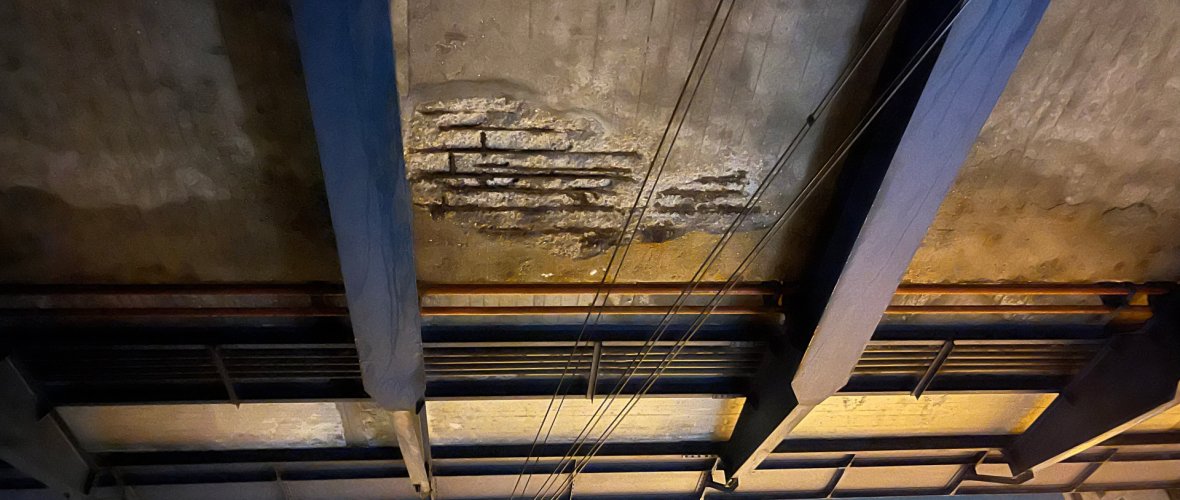
The Burtscheider Bridge, a steel-concrete composite bridge built in 1952, is in poor structural condition. Significant moisture damage has developed on the bridge’s deck, primarily as a result of the deteriorating drainage system. Due to the leaks, hollow pockets have formed in the concrete of the structure. During a special inspection in January 2026, damaged concrete sections on the underside of the deck—which were in danger of collapsing onto the railroad tracks below—were already chipped away and removed. The damage continues to spread steadily, which now jeopardizes the structure’s stability and impairs its load-bearing capacity.
The drainage system must be replaced to prevent further damage that could compromise the bridge’s structural stability, to ensure the bridge can continue to be used, and to guarantee the traffic safety of the rail tracks below. Due to the progressively deteriorating condition of the structure, the renovation work can no longer be postponed. At its most recent meeting on Wednesday, October 14, the Aachen City Council therefore decided to release the additional funds for the construction work, amounting to approximately 3.11 million euros.
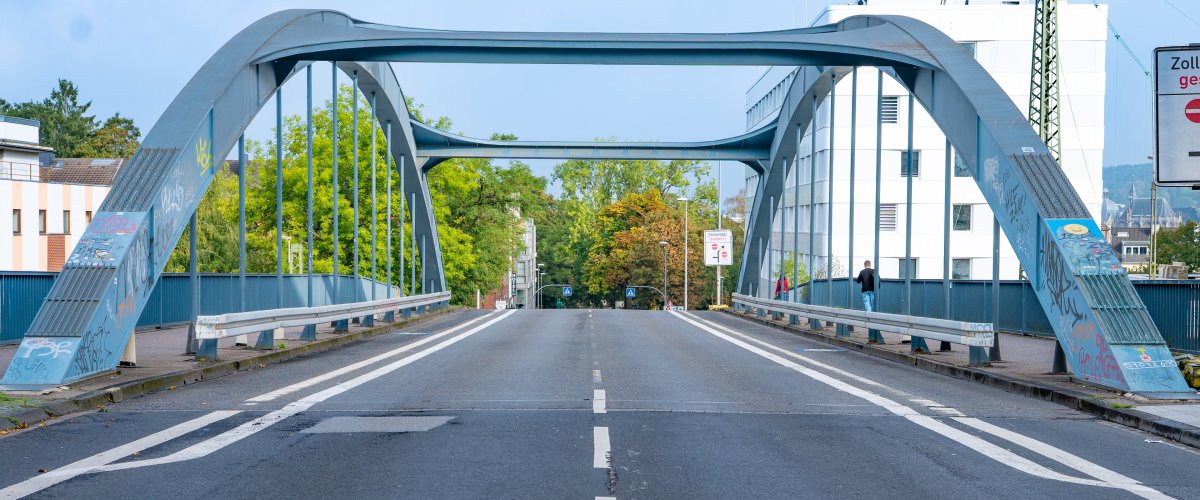
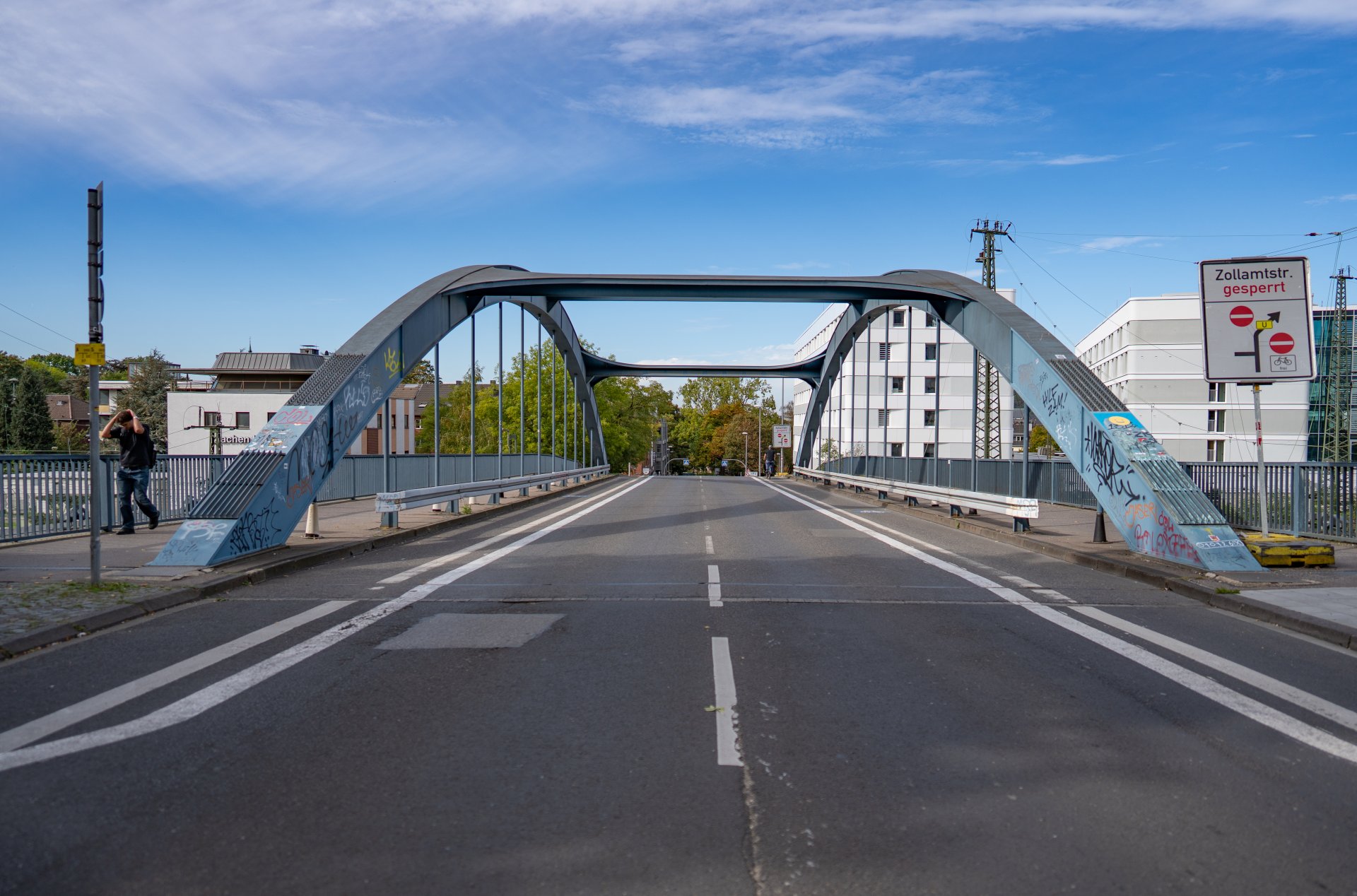
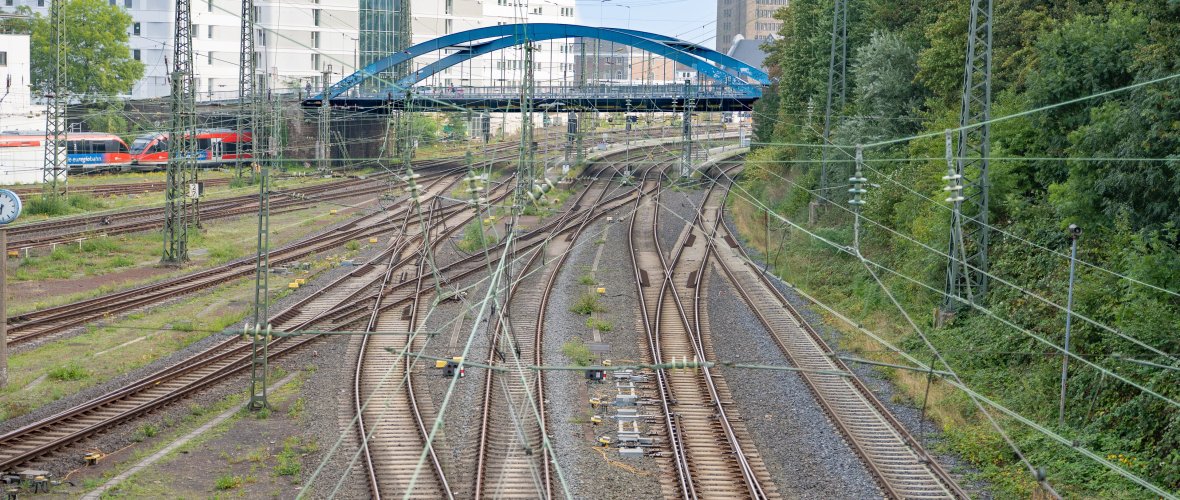
The Burtscheider Bridge consists of three separate structures. The main bridge spans the Burtscheider Straße and the rail tracks of Aachen Central Station. It was destroyed during World War II and rebuilt in 1952 as a steel cable-stayed arch bridge with a suspended concrete deck, resting on the existing abutments. During the reconstruction, the tension cables from the Rodenkirchen Bridge in Cologne were installed; these have since run beneath the deck and are connected to the arch hangers. The steel crossbeams, in turn, run beneath them.
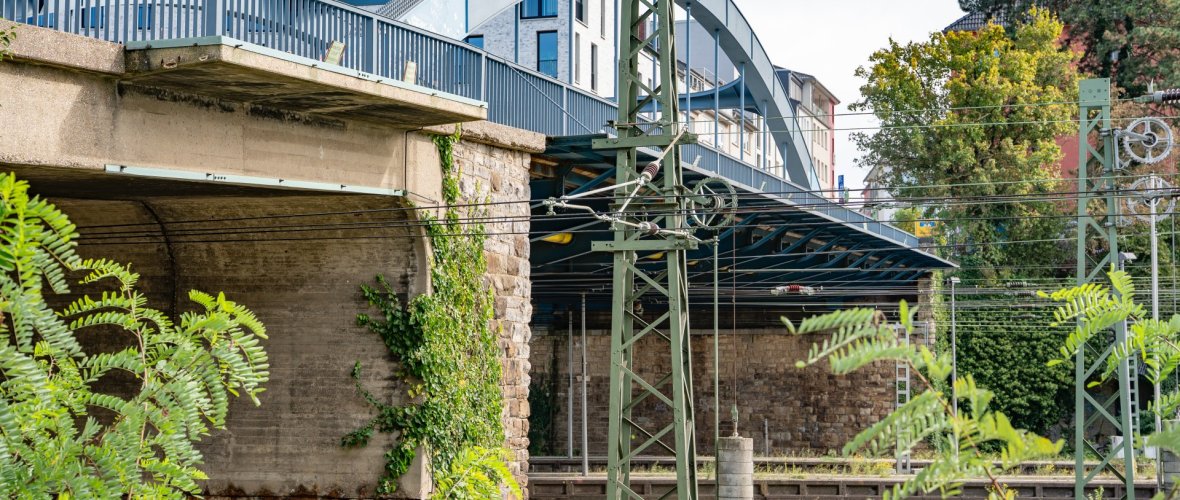
The first approach bridge is a reinforced concrete frame bridge built in 1964, also constructed on existing abutments, which crosses a Deutsche Bahn service track. The second approach bridge is a so-called concrete arch bridge, parts of which date back to around 1900. Following war damage, it was partially rebuilt in 1952. Beneath this bridge underpass lies a former Deutsche Bahn service road; the road leading to the site is no longer needed and will be abandoned.
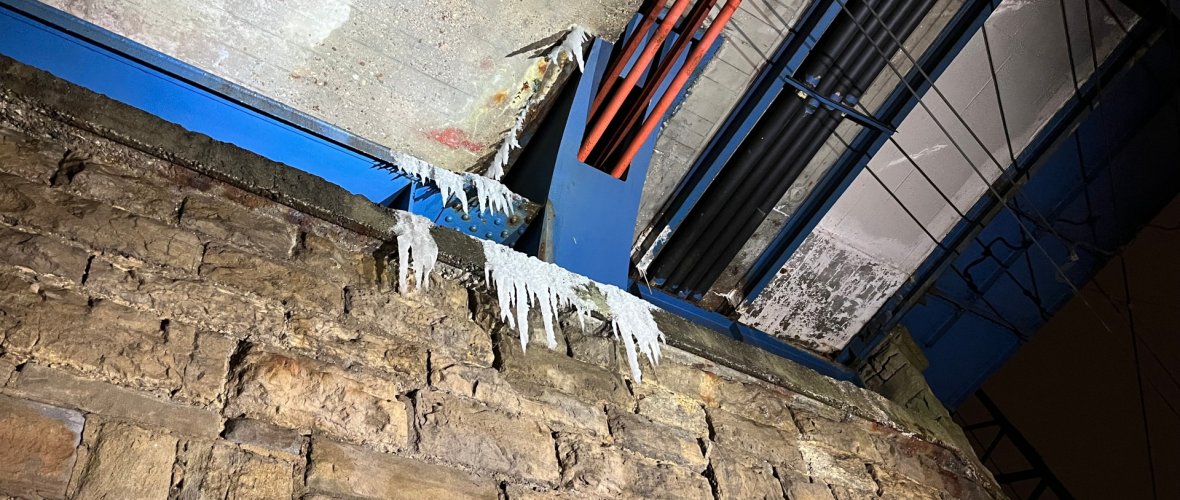
As part of various structural inspections, a team from Aachen’s municipal utilities observed changes in the bridge’s condition: In 2022, a major inspection revealed serious damage to the underside of the bridge. At that time, the outer two meters of the deck on each side were particularly affected. The reinforcing steel in the concrete slab was severely corroded. Additional leaks were found at the transition structures. Massive leaks were identified particularly at the lowest point of the Reumontstraße abutment, through which rainwater runs down the abutment wall. Due to the deteriorating condition already evident at that time, the team began inspecting the underside of the bridge after every winter in 2023, whenever frost damage was expected. In addition, visual inspections of the structure were conducted several times a year; in 2025, a routine basic inspection was also performed. In January 2026, a special inspection of the underside was conducted from the tracks to remove loose concrete fragments. During the special inspection, the inspectors noted that icicles had formed on the underside along the edge of the roadway and the transition structures due to leaks.
Based on the test reports, a recalculation of the bridge’s load-bearing capacity was initiated. It revealed that the main bridge no longer corresponds to its original classification as Bridge Class BK 60, but rather to BK 30. The specified bridge class describes the structure’s load-bearing capacity. A BK 60 bridge is designed to safely support and bear the load of a heavy-duty vehicle with a gross weight of up to 60 metric tons. Accordingly, a BK 30 bridge is designed for vehicles with a gross weight of up to 30 metric tons.
The bridge's current load-bearing capacity is sufficient for the current volume of inner-city traffic, but it does not provide adequate load-bearing reserves. After the renovation, the bridge will once again be classified as Bridge Class 60.
For structural reasons, and to maintain traffic safety, traffic had to be reduced along the perimeter in the spring of 2026: The city public works department narrowed the lanes in both directions and, for safety reasons, imposed a weight limit of 7.5 metric tons.
Due to the ongoing damage, a comprehensive restoration plan for the structure has been developed in recent years.
“The bridge’s steel structure was renovated in 2003,” explains Barbara Siodmok, a bridge engineer with Aachen City Utilities and project manager for the Burtscheider Bridge renovation. “That was the focus of the renovation at the time. For cost reasons, it was not possible at that time to renovate the drainage system as part of the same project. Water that had seeped in over the years caused progressive damage to the structural integrity of the bridge.” As a result of prolonged exposure to moisture, the bridge’s concrete components are saturated over a large area. In addition, road salt that has seeped into the concrete has led to chloride contamination of the concrete roadway and sidewalk areas. The chlorides attack the reinforcement and cause corrosion, which in turn leads to concrete spalling on the surfaces of the structural elements. The areas where the hangers penetrate the deck slab are particularly affected. Because these areas are leaky, moisture penetration into the deck slab is further exacerbated. The condition of the roadway slab has now deteriorated to such an extent that redesigning the drainage system is insufficient; instead, the roadway slab must be replaced. Replacing the roadway slab is an essential part of the overall repair.
The steel structure itself is generally in good condition. There are currently no indications of significant damage to the tension cables either.
The bridge is expected to be closed in September 2027. Work will begin with setting up the construction site: guardrails will be removed, barriers will be erected, construction trailers will be positioned, and the lifting equipment and protective scaffolding will be delivered. “Everything will be ready to ensure there are no delays on the first day of the closure,” says Barbara Siodmok.
The Burtscheider Bridge rests on abutments made of natural stone. These abutments consist of solid walls designed to counteract the forces acting on them. However, because the bridge must also adapt to temperature changes and traffic loads, it rests on movable bearings. During the closure period, the entire bridge can be raised by approximately two meters at these movable bearings using hydraulic jacks. During this process, the structure is shored up with steel sections and steel plates. This is followed by grounding work and safety measures in the track area. Below the bridge superstructure, in front of the abutments, a protective suspended scaffold is erected around the structure. This allows work to be carried out on the bridge while rail operations continue uninterrupted below.
During construction, the roadway, sidewalk slabs, and curbs will be removed, as will the guardrails, before the drainage system can be replaced and the new roadway slab can be installed. The guardrail in the area of the rails will be replaced with a guardrail inclined at a 20-degree angle. The concrete on the bearing pads will be repaired, the hanger covers will be replaced, and the masonry of the abutments will be repaired. Later in the project, a “bridge drainage system”—a new linear drainage system in the curb—will be installed. This system will divert stormwater directly from the edge of the roadway on the upper deck of the bridge to the nearest street inlet, ensuring that no water from the bridge structure enters the rail area. Unlike conventional drainage systems, which are routed along the underside of the structure, the entire drainage system is located on the upper side.
Since the entire road cross-section must be renovated, the bicycle path will be raised to sidewalk level in the area of the bridges. This will reduce the roadway width to 6.50 meters and widen the bicycle lanes on both sides to 2.50 meters. The sidewalk width will be approximately three meters on each side. This will make it possible to eliminate the guardrail—which no longer complies with regulations—as impact protection for the trailers.
Once the main bridge has been renovated, work will begin on the first and second approach bridges, which are part of the extension of Burtscheider Straße. The first arch spans a German Rail service track, while the second arch spans the access road to BlueGate. The latter will be completely closed off, following consultation with the city’s historic preservation office. “The arched bridge is in poor condition, and a renovation would be significantly more expensive,” explains Barbara Siodmok. The arched bridge will be filled with liquid concrete, and the ends will be sealed with brickwork. For both approach bridges, the waterproofing must be replaced, and the masonry joints will be repaired.
Once the scaffolding has been dismantled, the bridge can be lowered again using the hydraulic presses until it returns to its original position. This will be followed by connection work on the roadway, the installation of the new crossing structure, and the installation of studded pavers to physically separate the bike path from the sidewalk.
In addition, the lighting system must be adjusted following the modification of the protective guard to allow for the implementation of the plan approved in 2006/2007. Because the protective guard is being modified, it is no longer possible to mount the headlights on it. However, the new headlights are significantly smaller and can be attached to the railing, which will also be installed during this phase. Once the roadway has been marked, the structure will be reopened to all road users.
The recommended detour for private vehicles is signposted via Kasinostraße, Kurbrunnenstraße, Römerstraße, and Zollamtstraße. From the direction of downtown, the detour runs via Lagerhausstraße, Römerstraße, Kurbrunnenstraße, and Kasinostraße.
Pedestrians are routed along Kasinostraße, Hackländerstraße, and Zollamtstraße. An assessment is currently underway to determine whether the existing railroad underpass can be renovated; however, it is not accessible to people with disabilities.
The closure will not affect public transportation, as no bus routes cross the Burtscheider Bridge. However, there are numerous options for getting from the upper end of Burtscheider Straße to the lower end—and vice versa—via regular public transportation.
At the Burtscheid Hauptstraße stop, at the upper end of Burtscheider Straße, lines 14, 34, and 54 run toward the city center to the Elisenbrunnen and Aachen Bushof stops. Line 14 travels via Römerstraße, Lagerhausstraße, Boxgraben, and Franzstraße, serving the Hauptbahnhof and Misereor stops along its route, which are located near the lower end of Burtscheider Straße. This route requires no transfers and runs every half hour on weekdays and every hour on Sundays and holidays.
On lines 34 and 54, which run along Theaterstraße, you can transfer at the Normaluhr stop to lines 11, 21, 51, 3B, and 13B, which in turn stop at the Hauptbahnhof and Misereor stops. On weekdays, lines 34 and 54 alternate every half hour, resulting in a quarter-hourly service. On Sundays and holidays, line 34 does not run, while line 54 continues to run every half hour.
Bus lines 11, 21, 51, 3B, and 13B alternate service at the Normaluhr stop so that a bus departs for the Hauptbahnhof and Misereor stops every two to three minutes.
Conversely, the routes run in exactly the same way, though it is important to note that from Misereor or the Central Station toward the Normaluhr stop, lines 3A and 13A run alongside lines 11, 21, and 51.