
Köngistrasse 18-24
Monument #17


Introduction
In the Middle Ages, the King's Road was part of the Via Regia, one of the most important European west-east routes. It crossed the two gates of the inner and outer city walls and led past the execution site and the Melaten leprosarium to Maastricht. The gate was closed in the 17th century. It was replaced in 1836 by the customs house (Königstr. 75), which still exists today, and the street regained its importance.


Moving history
The house at Königstraße no. 18-22, with its striking gable and gateway, is attributed to the Aachen Baroque architect Laurenz Mefferdatis. Built in 1738, the building was badly damaged during the Second World War. In order to build a new school gymnasium, the city of Aachen's building department decided to remove the remains of the façade and integrate them into the new building as a reconstruction. Unlike the Wespien façade (Kockerellstr.), the new gymnasium building is completely concealed from the street side.
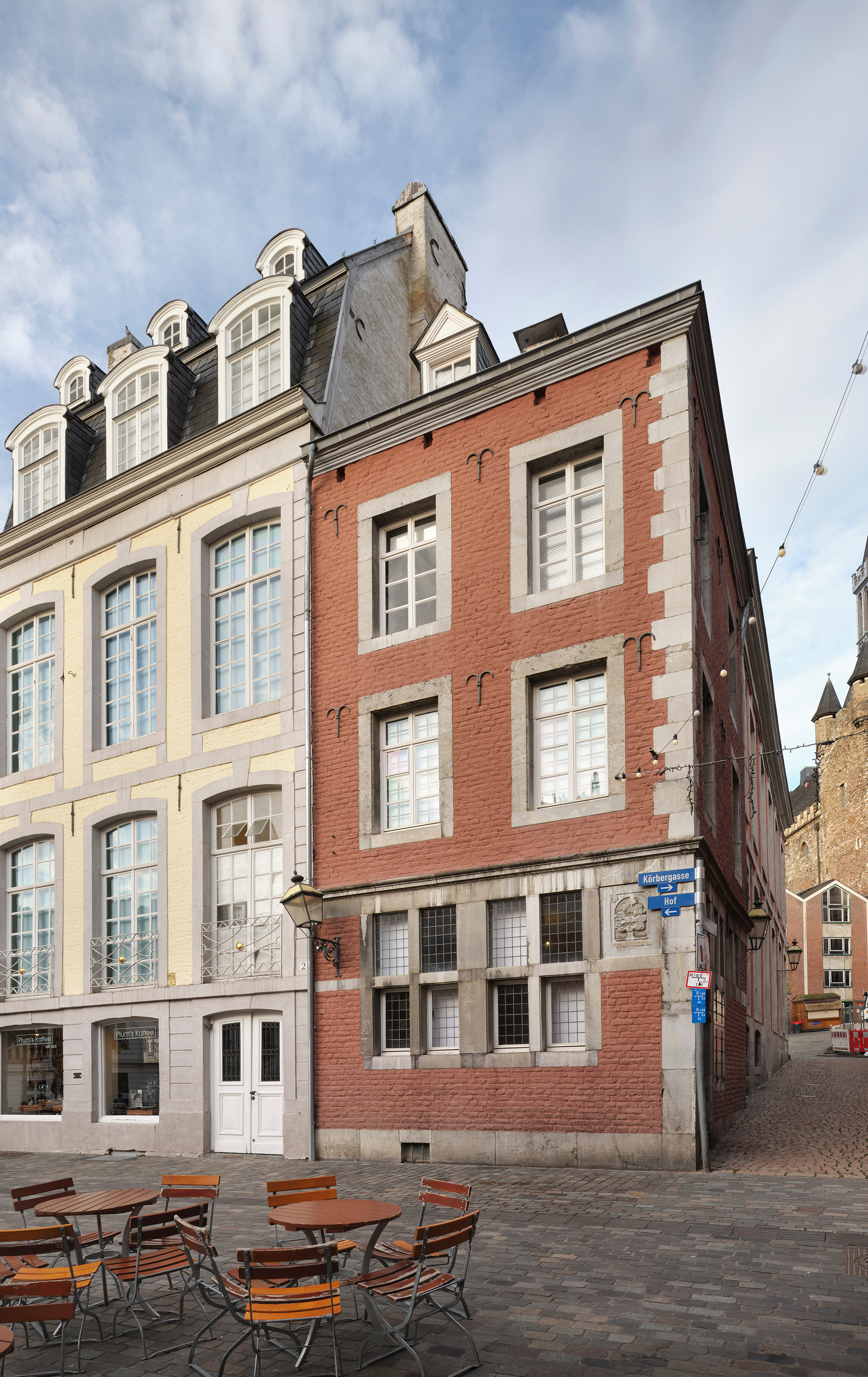
House no. 24 probably dates back to the middle of the 19th century. Although it had survived the war without major damage, it was completely renovated in 1970 and also incorporated into the Beginenstraße school complex as a janitor's apartment. Historic façade elements from its predecessor were reused.
Search for clues
During the reconstruction of nos. 18-22, missing bluestone walls were supplemented with material from the municipal building yard (upper floor on the right). The window in the gable was changed, but otherwise emphasis was placed on a design that was as true to the original as possible, e.g. five of the former six anchor irons were reworked.
House no. 24 is a typical Aachen three-window house with a simple brick and bluestone façade. During the reconstruction, the position and size of the windows were slightly altered and adapted to the neighboring building no. 26. The area under the roof, known as the jamb, is slightly lower here than in the historic façade.
 © Olaf Rohl
The severe war damage to the house 18-22 was compensated for by material additions in the area of the blue stone walls from the municipal building yard.
Special features
As with almost all new construction projects with translocated facades, the predecessor buildings of both houses were completely demolished down to basement level. Historical remains of the predecessor buildings are therefore mostly completely lost.
Picture gallery
Discover more

All monuments at a glance
Translocation
The method of translocation was already known and popular in 19th century urban planning. It allowed old building stock to be saved and reused. In Aachen, this method was applied in a special and extensive way.