
Yard 1
Monument #32


Introduction
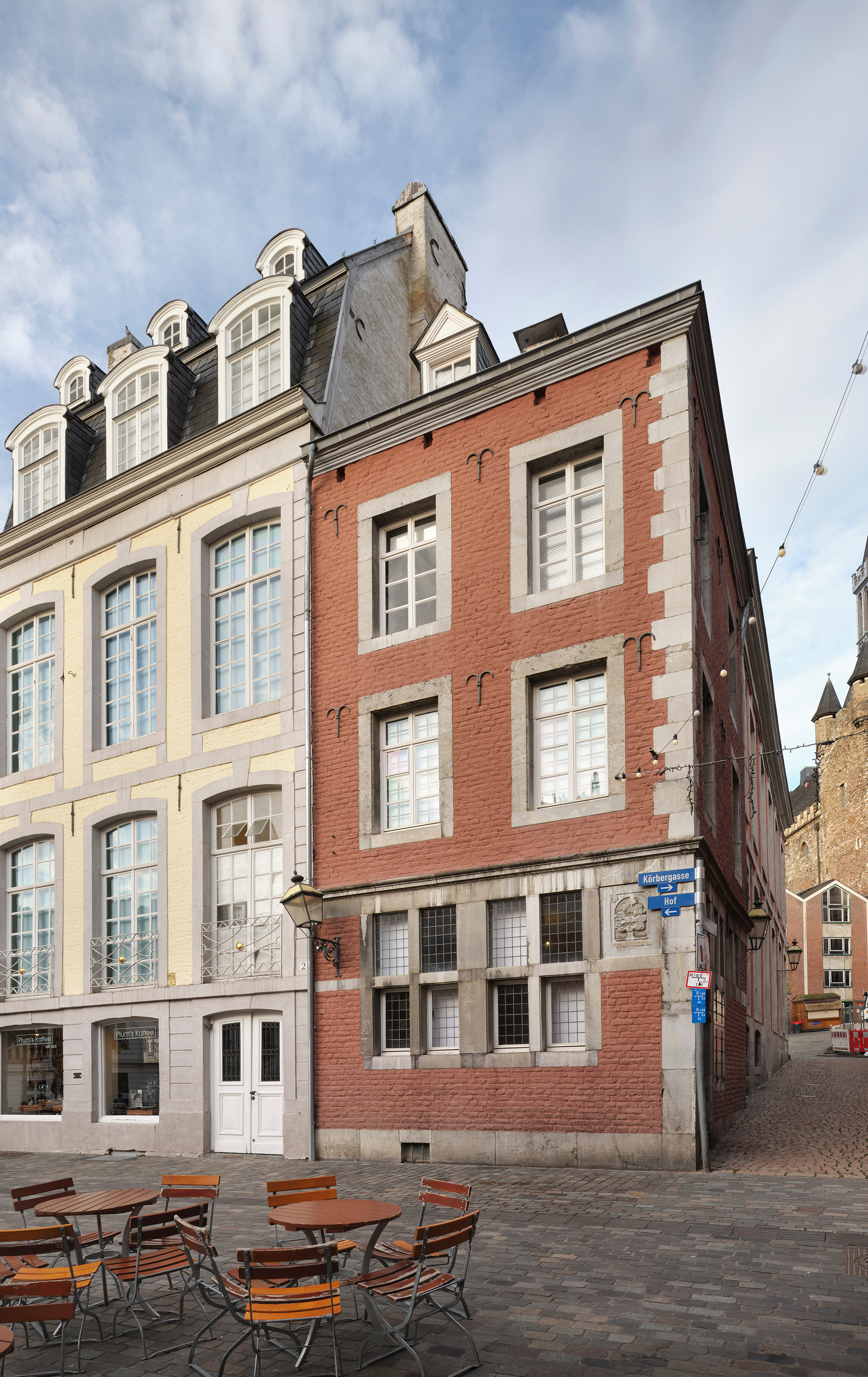
Built in 1658, the "Domkeller" is known and loved by the people of Aachen as an iconic pub. The building was erected in brick with bluestone elements shortly after the city fire of 1656. With this typical change of material and the window shapes, it corresponds to the style of the so-called Maasland Renaissance. However, the current building is largely the result of a remodeling shortly after the Second World War.


Moving history
As early as 1949/1950, the architect Michael Esser submitted plans for a reconstruction of the façade, which primarily envisaged the restoration of the large cloister windows. Both newly manufactured elements and replacement stones from the monument preservation depot were used in the work. The position of some of the windows was shifted slightly and the former loading hatch into the attic was restored to a wider width. The house was also given a floating gable again.
Search for clues
On the main façade, the added stones are precisely depicted on a construction plan from 1950, but they are also clearly visible in the façade. The year of construction, 1658, can also be seen in two places. The side façade is also interesting, as it is essentially still historical. The small window next to the door used to have a shutter that could be folded out like a table to sell goods. Other windows have a frame made of oak beams instead of bluestone. These were often installed at the side or rear as a cheaper alternative.

In addition to the modern additions to the façade, the year of construction 1658 can be seen on two original stones. An 18th century shop window has been preserved on the side.
Special features
Older photos from 1915 and around 1910 show a façade with altered windows, but reveal traces of the historical window sizes. In addition, a drawing from the 1920s served as a model for the architect, so that the reconstruction is largely plausible. This distinguishes the "Domkeller" from Löwenstein House, which was reconstructed in a much freer style.
Picture gallery
Discover more

All monuments at a glance
Translocation
The method of translocation was already known and popular in 19th century urban planning. It allowed old building stock to be saved and reused. In Aachen, this method was applied in a special and extensive way.