
Büchel 22-24
Monument #30


Introduction
In the immediate vicinity of the courtyard, one of the most beautiful squares in the old town, there are thermal springs that were already used by the Romans with a thermal bath on the Büchel. They built a forum here at the courtyard. The reconstructed arcades (original in the Bonn State Museum) bear witness to this. In the Middle Ages, the Blasiusspital and the Quirinusbad existed on the south-east side of the courtyard. The bombing in the Second World War tore large gaps right here - so what to do?


Moving history
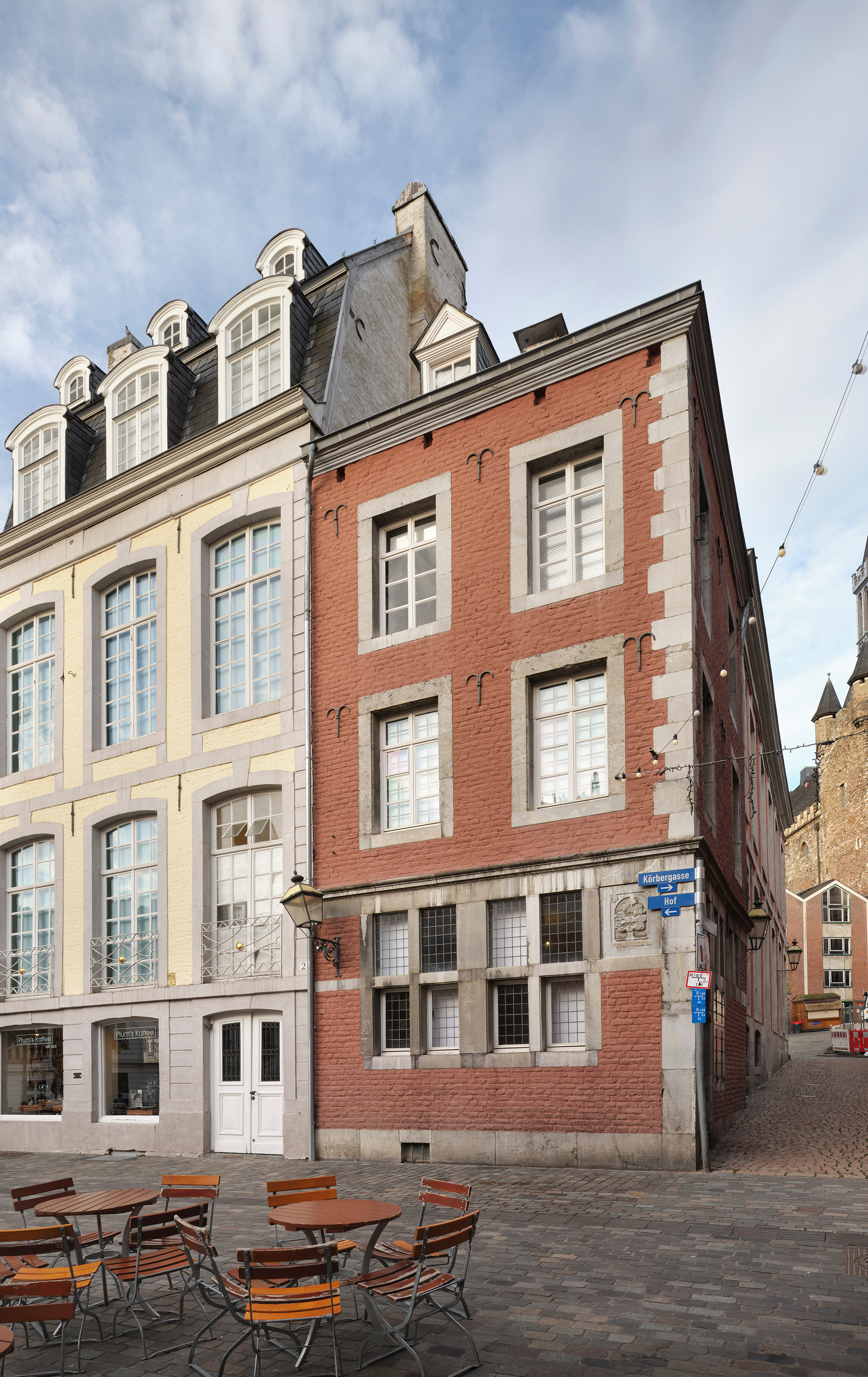
When the city of Aachen planned the reconstruction of the Hof and Büchel area in the 1960s, it was decided to completely demolish the damaged building fabric in the south-east. Plots 22 and 24 on Büchel were merged and extended as far as the courtyard. The new building, which was constructed on this plot in 1972 under architect Werner Schottstädt, was given a historic-looking, translocated façade facing the courtyard.
Search for clues
The façade facing the courtyard has a typical old Aachen design with brick surfaces and bluestone elements. The bricks probably date from the early 19th century and were inserted into the new façade facing the courtyard from the demolished building at Büchel 22. Their design thus matches that of the two neighboring buildings, courtyard nos. 1 and 3, which are in fact largely historical.

The design of the façade with brick surfaces and bluestone elements visually matches the two neighboring buildings.
Special features
This small, important urban space at the courtyard was to be spared as much as possible from the traffic of the post-war period and largely retain its historical character, while the neighboring Büchel was largely built on in a modern style. As a result, the new building was given a "historic" façade facing the courtyard and a modern façade facing the Büchel. The historical effect of the courtyard was precisely planned and modeled for this purpose.
Picture gallery
Discover more

All monuments at a glance
Translocation
The method of translocation was already known and popular in 19th century urban planning. It allowed old building stock to be saved and reused. In Aachen, this method was applied in a special and extensive way.