Paugasse 13
Monument #20


Introduction
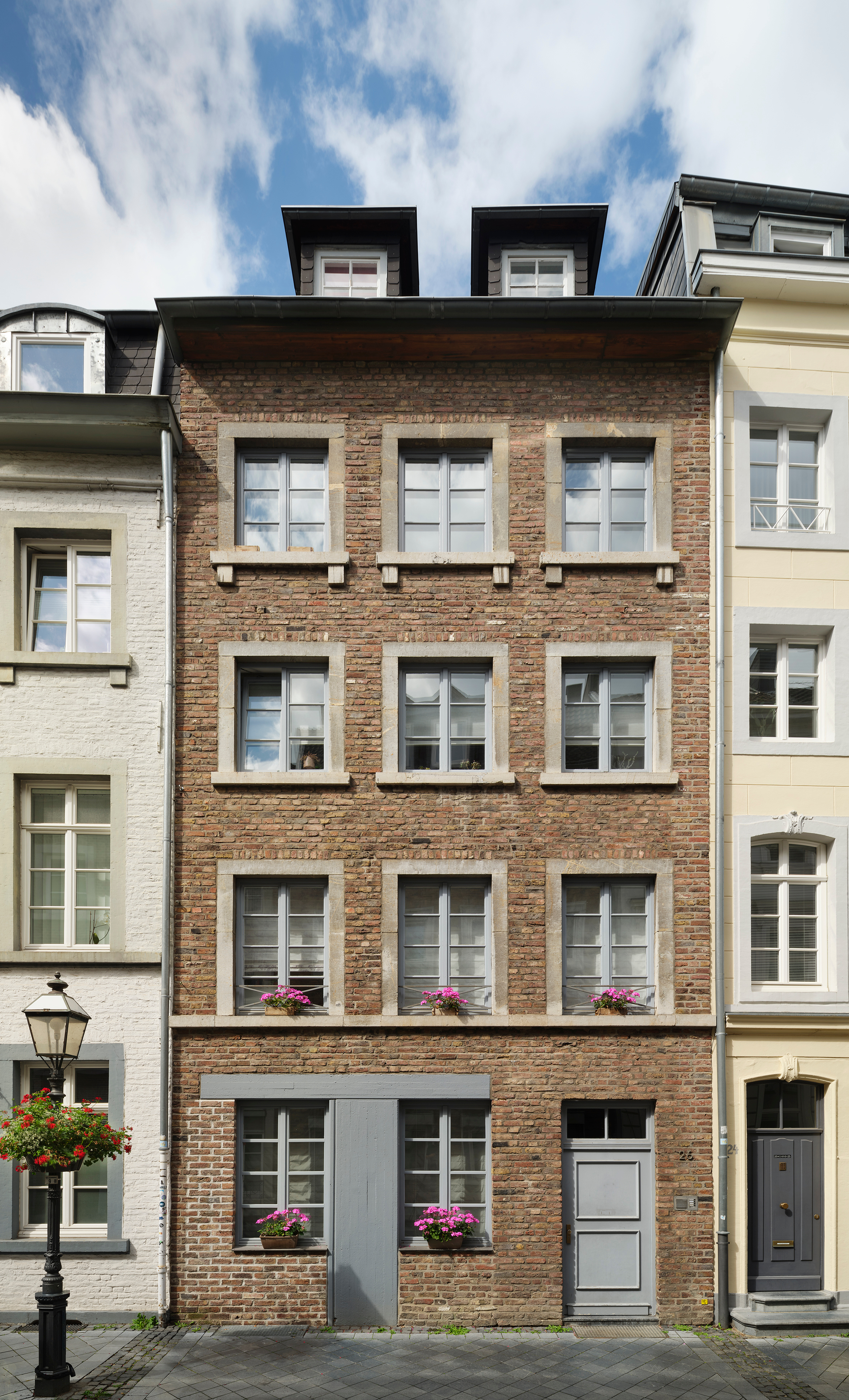
The information "ANNO 1799" emblazoned on the façade of this house leads us on the wrong track. Of course, this is not the year of construction of the current house, but is one of the historical building components reused in the new building.


Moving history
The residential building at Paugasse 13 is part of a larger complex of buildings built in 1975 by the Gemeinnützige Baugesellschaft für Aachen und Burtscheid (now gewoge), which also includes the historic neighboring buildings no. 11 and 15. The old buildings on Paugasse were already designated as listed buildings in the planning documents of the 1960s. Nevertheless, they were demolished, but their façades were reused and reconstructed in the new building as characteristic architecture for the Rosviertel.
Search for clues
The façades of the three houses at nos. 11, 13 and 15 were slightly offset, but restored in the same order. The two right-hand windows on the first floor of no. 13 were reconstructed, as they had already been altered and supplemented with a concrete lintel before demolition. The iron anchors were originally used to connect the ceiling beams to the façade. Today, with modern concrete ceilings inside, they are purely decorative.

The “Anno 1799” iron elements initially lead one down the wrong path while at the same time paying tribute to the building’s historical significance.
Special features
Reconstructions of facades on the same site were the exception in Aachen's redevelopment program. In most cases, demolished façades were stored and reused elsewhere in the urban fabric or recombined with other parts.
Picture gallery
Discover more

All monuments at a glance
Translocation
The method of translocation was already known and popular in 19th century urban planning. It allowed old building stock to be saved and reused. In Aachen, this method was applied in a special and extensive way.