Kockerellstrasse 7
Monument #5


Introduction
During the war, the area around Kockerellstraße, Judengasse and Jakobstraße had suffered little damage, but the building fabric had been neglected for a long time. There were vacancies and in some cases catastrophic living and hygiene conditions. As part of the urban redevelopment work in the 1970s, almost all of the buildings here were demolished and entire street alignments were changed. Judengasse, for example, was moved to the west and Augustinerplatz was created in its place.


Moving history
The three buildings that stood on this site until the early 1970s, with house numbers 9, 11 and 13, probably dated from the 18th and 19th centuries, presumably with an older core. They were demolished in the early 1970s, not least due to considerable structural damage. The current building at Kockerellstraße 7 was subsequently rebuilt on the former plots.
Search for clues
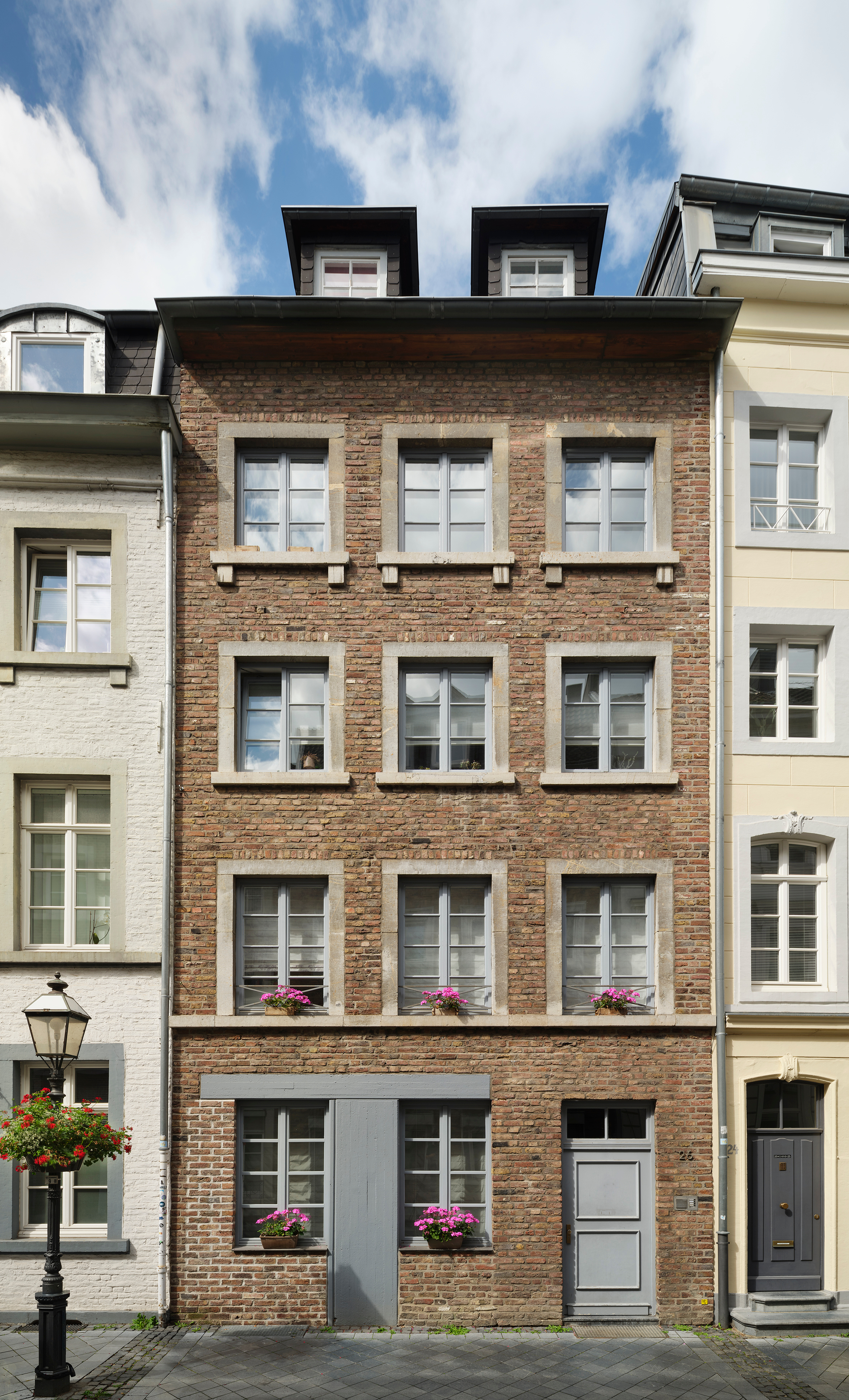
The façades of the previous buildings were only suitable for reuse to a limited extent. The façade of the new building nevertheless shows a uniform design with 15 similar, very simple blue stone walls. Only the segmental arch lintel and wedge stone are characteristic; there is no further decoration. The large number of identical walls makes it likely that they were brought together from several buildings and adapted where necessary. Unfortunately, records no longer exist. It can be assumed that the jambs were taken from the house at Peterstraße 51, and a large part could also have come from the Bodenhof, which was located outside the town. This moated, castle-like courtyard complex was almost completely demolished in the 1960s.

Elements from various predecessor buildings were brought together to design the simple façade.
Special features
As with the neighboring building, new components were added here with mullioned windows, a mansard roof and individual dormers, which match the overall historic appearance.
Picture gallery
Discover more

All monuments at a glance
Translocation
The method of translocation was already known and popular in 19th century urban planning. It allowed old building stock to be saved and reused. In Aachen, this method was applied in a special and extensive way.