Diese Seite wurde automatisch übersetzt. Es kann daher zu Abweichungen oder Ungenauigkeiten im Text kommen. Verbindlich ist ausschließlich die Originalfassung. Rechtsansprüche aus Inhalten der übersetzten Version sind ausgeschlossen.

Jakobstrasse 10

Monument #13

The house at Jakobstraße 10 was built in 1973. The façade sections date from the 18th and 19th centuries. The bluestone portal is an important translocation detail. The time travel factor of the monument is approx. 154-223 years.

The house at Jakobstraße 10 was built in 1973. The façade sections date from the 18th and 19th centuries. The bluestone portal is an important translocation detail. The time travel factor of the monument is approx. 154-223 years.

Introduction

The corner building at Jakobstraße 10 has a very similar construction history to its neighboring buildings 4, 6 and 8: they were demolished and rebuilt in the course of the strict renovation program of the 1970s, using historical façade elements from demolished buildings. House no. 10 was designed by Leo Hugot.

Time travel

The monument has a time travel factor of approx. 154-223 years and has moved approx. 20-320 meters. Its design includes features from two to three eras.

Time travel

The monument has a time travel factor of approx. 154-223 years and has moved approx. 20-320 meters. Its design includes features from two to three eras.

  • Moving history

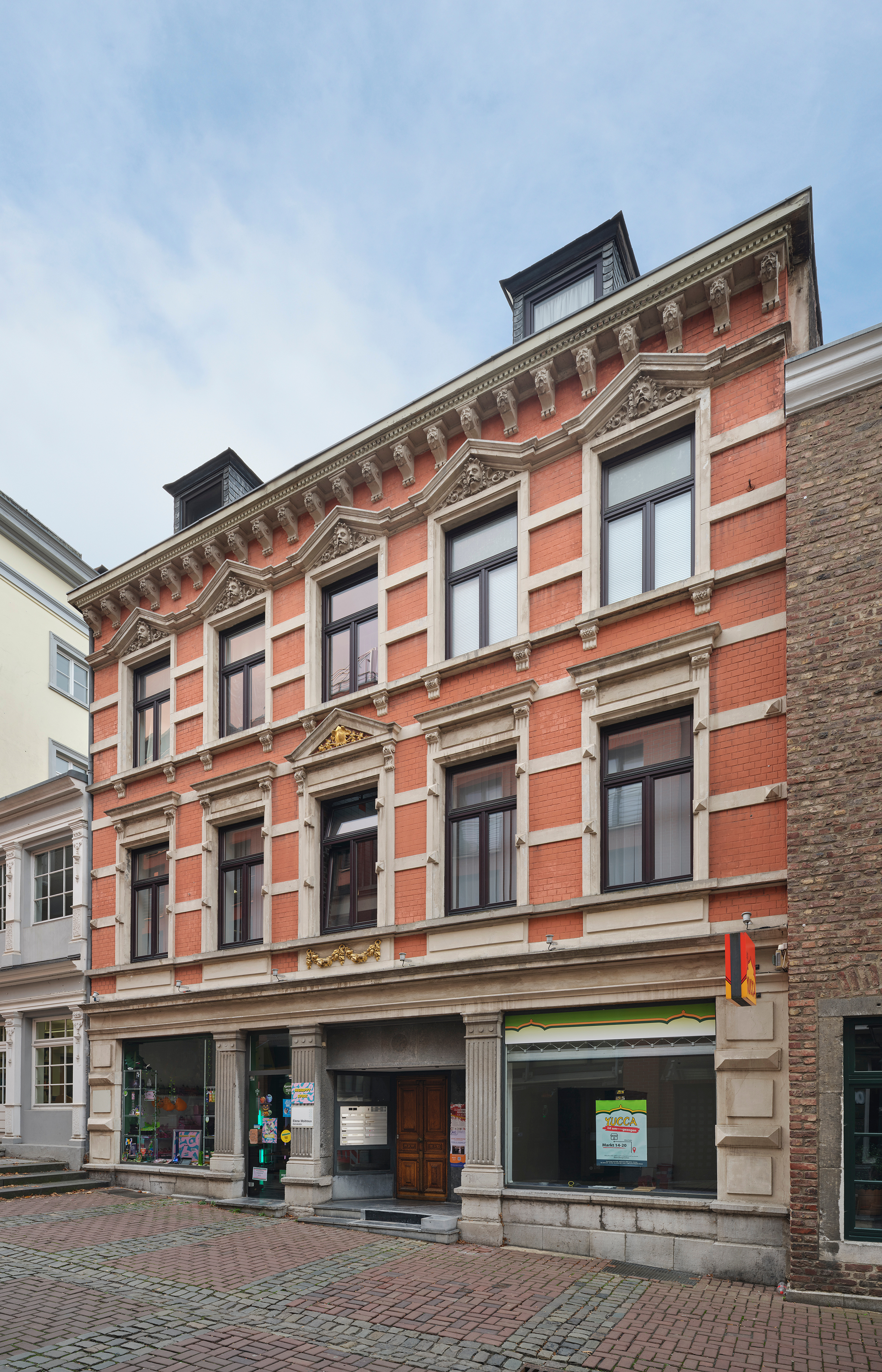
    Jakobstraße, which dates back to the Roman settlement, was one of the most important street axes in the historic town, where mainly traders, merchants and citizens settled. The continuity of building sites was correspondingly high and the houses that stood here until the post-war period were predominantly 17th/18th century buildings on much older cellars and foundations. After the demolition of the old building, the house was rebuilt under the direction of the city conservator Hugot using parts of the façade of Judengasse no. 2 from 1819.

  • Search for clues

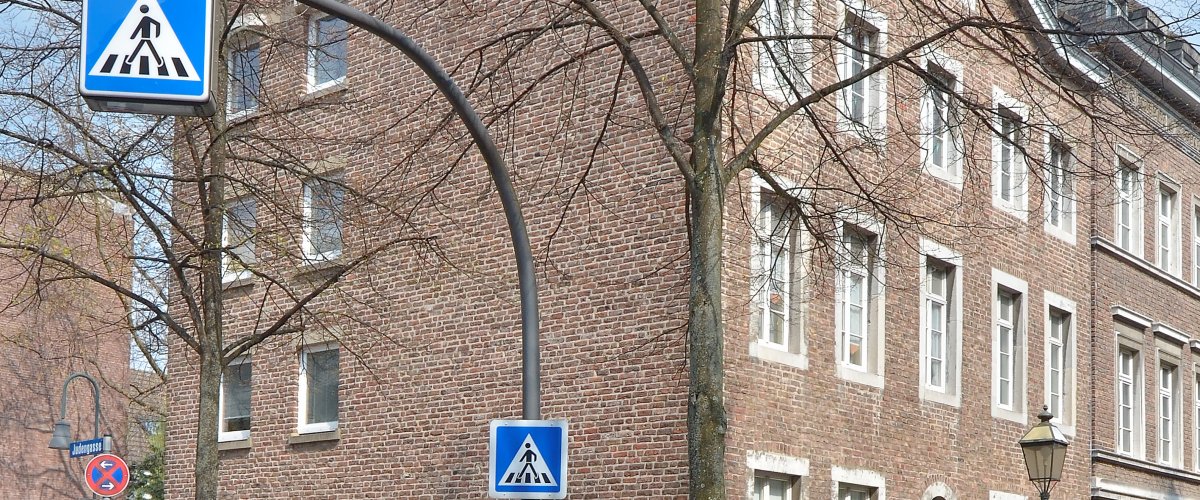
    The main façade facing Jakobstrasse, which has been adapted to modern storey heights with translocated historical façade elements, is complemented by a modern side façade facing Judengasse. While the idealized main façade with brick, bluestone, mullioned windows and gabled roof with small dormers contributes to the historic streetscape, the other façades with concrete elements, balconies and undivided windows create a contemporary contrast. However, historical elements can also be discovered here in isolated cases: The round window (so-called ox-eye) in the gable zone probably comes from the house at Templergraben 79, the large bluestone portal originally from the house at Peterstraße 45. A terracotta city eagle is embedded in the courtyard wall, which comes from the former extension to the "Queen of Hungary" baths in Buchkremerstraße.

    Facade photo documentation, actual state 2012/2013

    Historic façade elements had to be adapted to modern storey heights.

  • Special features

    The building has a special floor plan structure: All rooms are arranged radially around a central staircase oval. The central arrangement of the staircase makes it possible to change the storey height at the rear. This means that two more storeys can be used on the courtyard side than on the street side. The slope of the Judengasse was thus optimally utilized.

Picture gallery

Discover more
All monuments at a glance

Translocation

The method of translocation was already known and popular in 19th century urban planning. It allowed old building stock to be saved and reused. In Aachen, this method was applied in a special and extensive way.

More about translocation

Help with accessibility

  • General

    We make every effort to ensure that our websites are accessible. You can find details on this in our accessibility statement. You can send us suggestions for improvement using our"Report a barrier" feedback form.

  • Font size

    To adjust the font size, please use the following key combinations:

    Larger

    ⌘command
    +

    Smaller

    ⌘command

    Larger

    Ctrl
    +

    Smaller

    Ctrl
  • Keyboard navigation

    Use TAB and SHIFT + TAB to navigate through next/previous links, form elements and buttons.

    Use ENTER to open links and interact with elements.

  • Contrast mode

    Press the following key combination to reduce or increase the contrast:

    Enlarge

    ⌃control
    ⌥option
    ⌘command
    .

    Decrease

    ⌃control
    ⌥option
    ⌘command
    ,
    Note: The shortcuts must be activated in the system settings of the operating system.

    Press left ALT + left SHIFT + PRINT to quickly switch the high contrast mode on or off.

  • Invert colors

    Press the following key combination to switch the color inversion on and off:

    ⌃control
    ⌥option
    ⌘command
    8
    Note: The shortcuts must be activated in the system settings of the operating system.

    First activate the screen magnifier and then switch the color inversion on and off with the following key combinations:

    1. screen magnifier

    +

    2. invert colors

    Ctrl
    Old
    I
  • Screen magnifier

    Press the following key combinations to use the screen magnifier:

    Switch on/off

    ⌥option
    ⌘command
    8

    Enlarge view

    ⌥option
    ⌘command
    =

    Reduce view

    ⌥option
    ⌘command
    Note: The shortcuts must be activated in the system settings of the operating system.

    Switch on / Enlarge view

    +

    Reduce view