
Market 39-41
Monument #1
Introduction
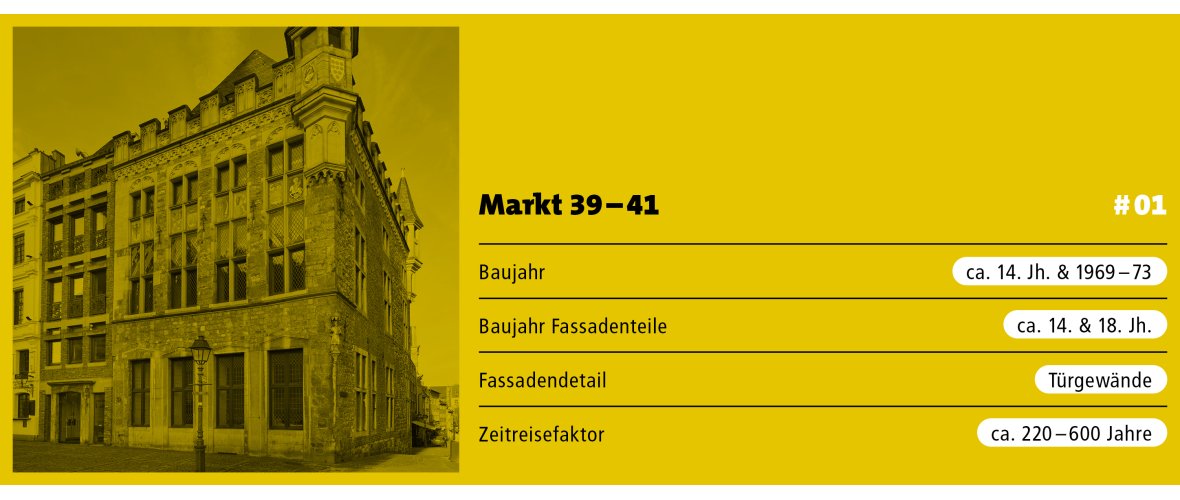
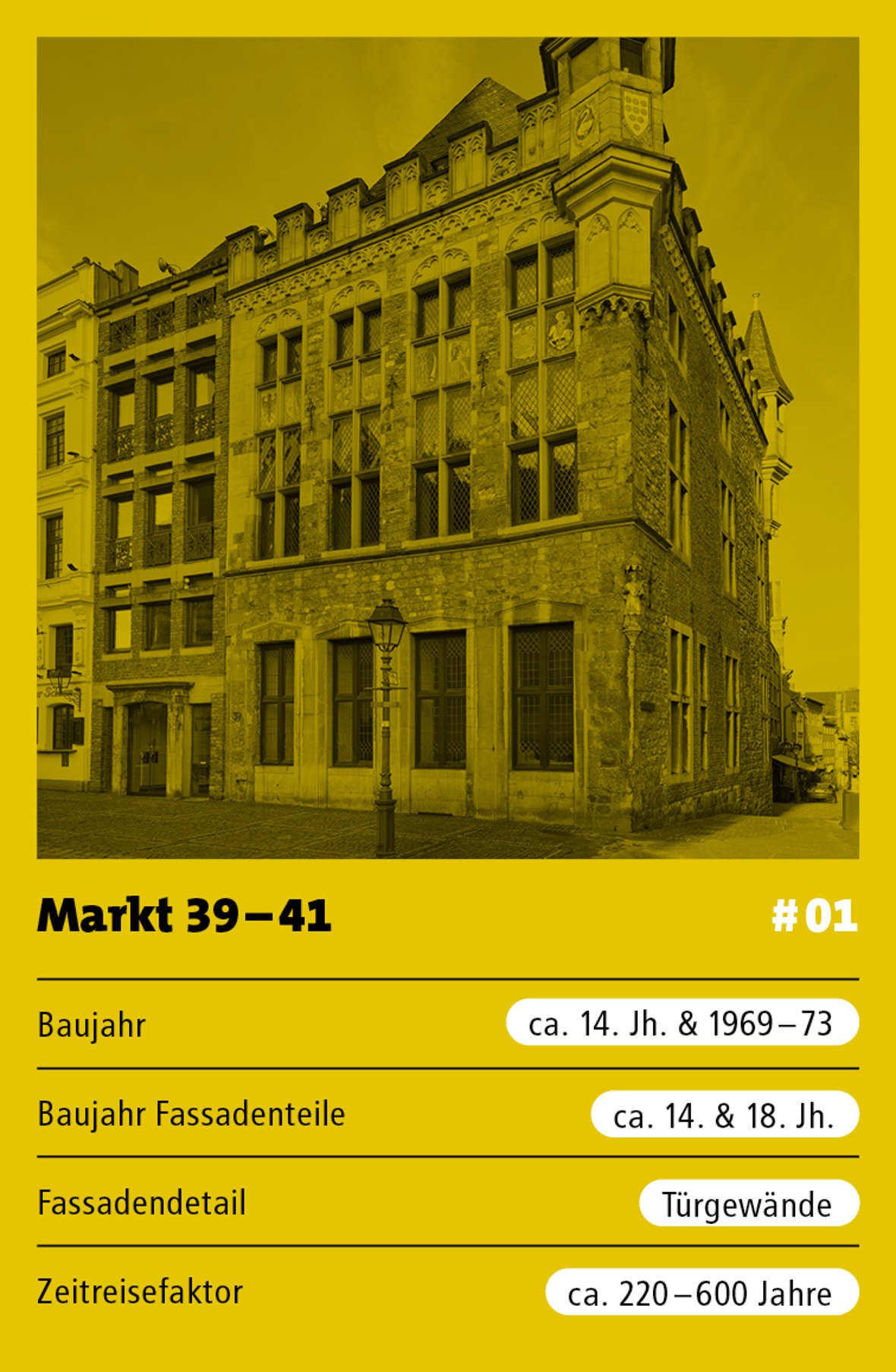
The building known as Haus Löwenstein at Markt 39-41 is one of the most characteristic houses in Aachen's old town. The stone façade with corner turrets and battlements forms a fitting counterpart to the town hall. However, the building did not acquire its medieval appearance until 1969-1973, and the design of the façade is the result of a good deal of creativity.


Moving history
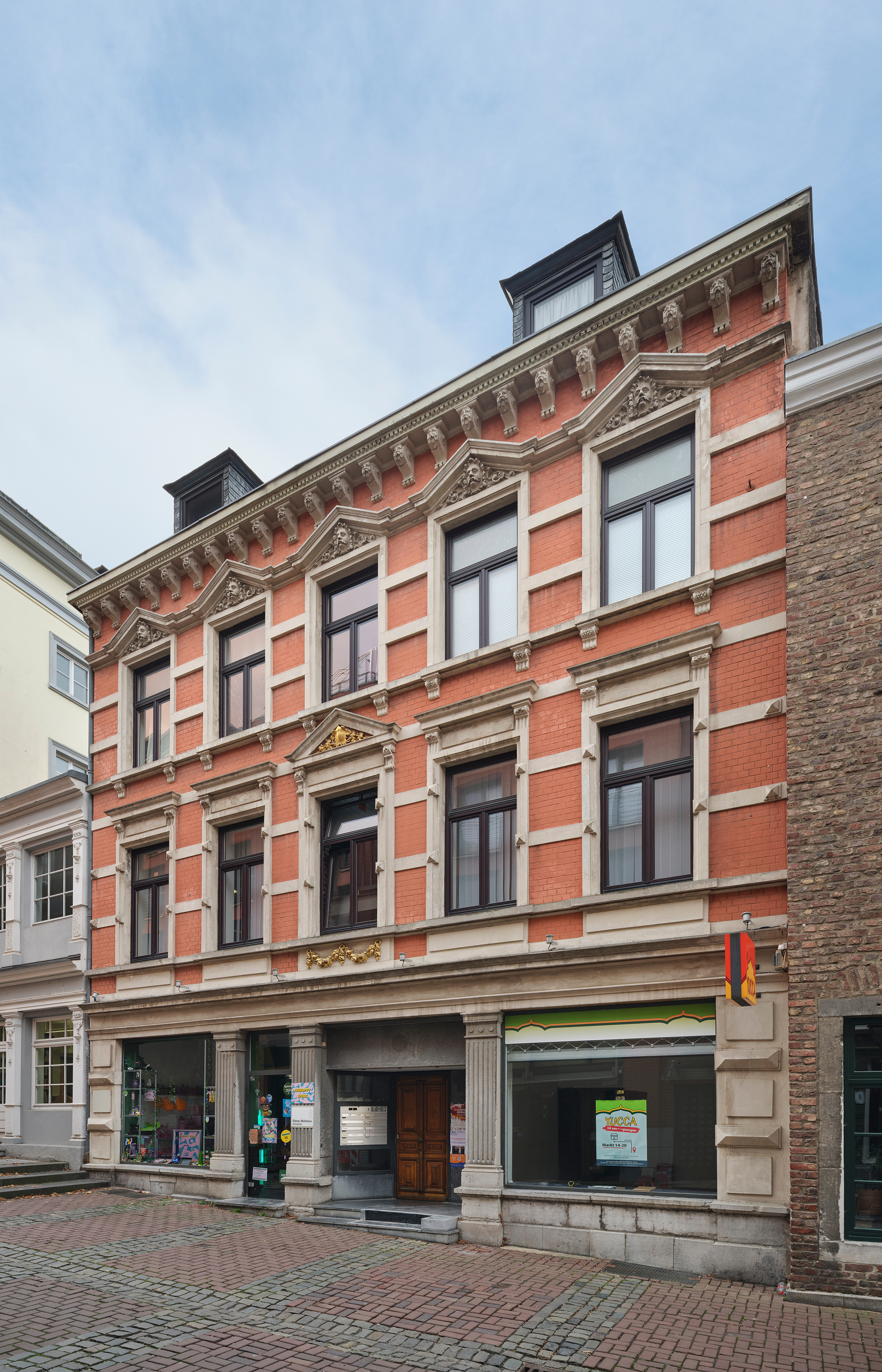
The building was erected in the 14th century in place of a previous building. The name probably goes back to the noble Lewe family. In the Middle Ages, the "stein" part of the name referred to a building constructed of solid natural stone, in contrast to the half-timbered houses that were common at the time. Over the centuries, the building served as a residence, inn and hostel, and at times the "Zunft zum Löwenstein" guild met here. In the middle of the 18th century, Haus Löwenstein and the neighboring, narrower Haus zum Wolf were joined together and were even given a uniform façade in neo-Gothic style, large shop windows and a balcony in 1905. Between 1969 and 1973, Leo Hugot had the left-hand part of the house completely rebuilt in concrete and brick. The right-hand part of the house, on the other hand, was restored to its medieval state and the historic façade was massively reworked. The battlements and corner turrets have indeed survived from historical illustrations, but the exact details have been creatively recreated. When designing the market façade, Hugot was inspired by found remains of medieval buildings and Gothic buildings from other cities such as Nuremberg and Trier
Search for clues
Looking at the walls, it is easy to distinguish the many, mostly lighter-colored additions from the old, roughly hewn stones of the medieval building. At the top of the façade, the coats of arms of the municipalities incorporated in 1972 are integrated into the façade design of the house. At the corner of the house is the golden statue of the bridge saint Johann von Nepomuk from 1747. Wait, bridge? Yes, Pontstraße, which ends here and contains the Latin word "pons" for "bridge", crossed the Johannisbach below the market hill.
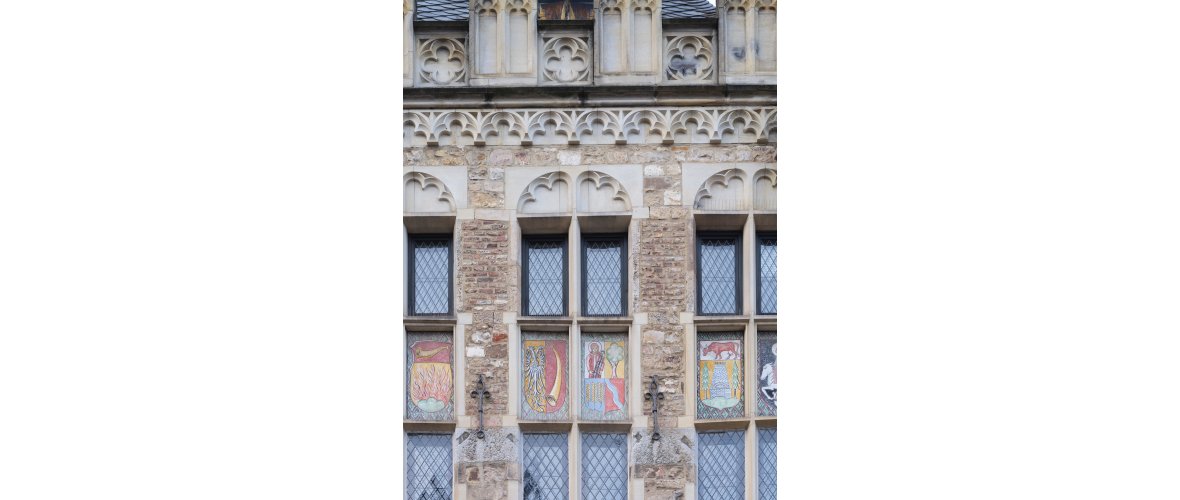
Gothic buildings in other cities served as models for architect Leo Hugot for the reconstruction of the façade.
Special features
Löwenstein House is a special case of reconstruction in Aachen, as an existing building was reconstructed on the basis of a few remains and analogies. As a prime example of creative monument preservation, the regotization of Löwenstein House can be viewed critically from today's perspective.
Picture gallery
Discover more
All monuments at a glance
Translocation
The method of translocation was already known and popular in 19th century urban planning. It allowed old building stock to be saved and reused. In Aachen, this method was applied in a special and extensive way.