Yard 2
Monument #31


Introduction
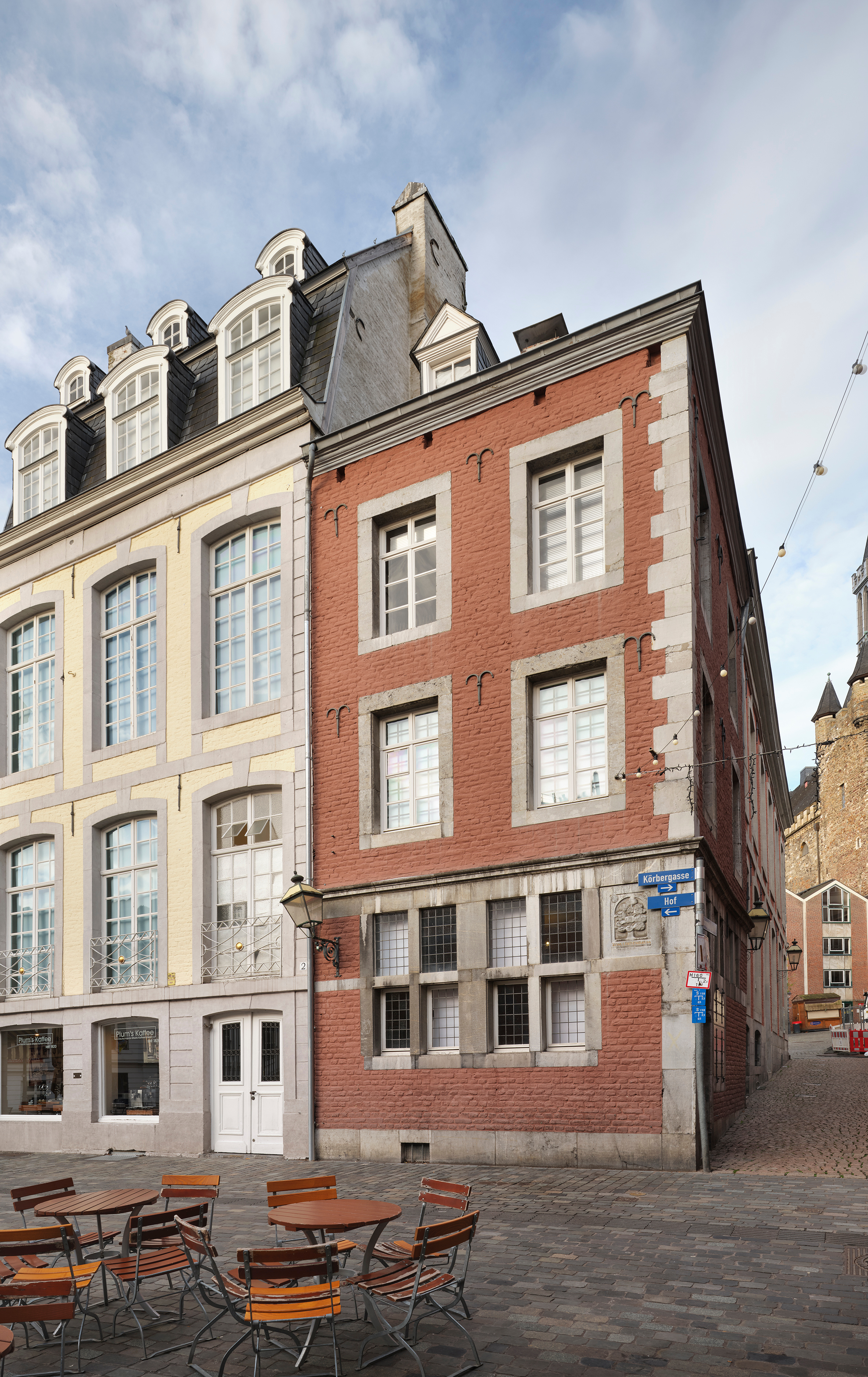
The Hof 2 building is neither a classic reconstruction nor a gap filler. Instead, the first floor of an existing building has been restored to a supposedly historical state. The house has belonged to the Aachen Couven Museum since 1961.


Moving history
The corner building was built in the 17th century, as an entry in the historical property register dated September 9, 1656 suggests. However, it is questionable whether it survived the town fire shortly before largely unscathed. As early as 1669, changes were made to the building, which are documented in the archives. Changes were also made repeatedly later on until the building was finally renovated by the city of Aachen in 1965.
Search for clues
The ground floor had already been altered before 1965 to include a large storefront window. During the renovation, mullioned windows were installed, and a window arrangement facing Rommelsgasse was reconstructed to match the one preserved across the street at House Hof 1 or on Pontstraße. In the past, when goods were displayed for sale from inside the houses, this was done through such arched windows with wooden shutters, among other features. It is likely that elements salvaged from the rubble of other houses were used in the renovation. Like many historic houses, this one also has a name. If you look closely, you can spot a so-called house sign that provides clear evidence of this.
The special feature of the building is the reconstruction of the mullioned windows and the window with wooden shutters. The latter were used for trading and selling goods from the house.
Special features
The architecture of the first floor was idealized and restored in the style of the time. There was no clear evidence on the basis of which it would have been possible to restore the building to its original state. The house sign is also a free invention, although the name is historically documented.
Picture gallery
Discover more
All monuments at a glance
Translocation
The method of translocation was already known and popular in 19th century urban planning. It allowed old building stock to be saved and reused. In Aachen, this method was applied in a special and extensive way.