
Theaterstrasse 88
Monument #26


Introduction
Where a fountain now stands on a small square in front of a modern office building, there used to be a stately building. In the 1970s, there was a real tug-of-war over its preservation, but it was demolished anyway. But it has not disappeared completely.


Moving history
The history of Theaterstraße only began in 1825, when the new theater building was completed on the site of the former Capuchin monastery. At the same time, state building inspector Johann Peter Cremer was commissioned to create a wide and prestigious street axis that would not only showcase the new theater, but also connect Aachen's city center with the then still independent town of Burtscheid. Over the course of the 19th century, banks, insurance companies and wealthy families settled in Theaterstrasse to construct prestigious buildings there.
One such villa was built here in 1840 by the architect Wilhelm Rosen. The building had been up for sale since the mid-1960s. An insurance company wanted to incorporate the property into a new building. Apparently there was no way of preserving the building and so it was demolished in 1973 together with the neighboring house no. 88. An attempt was made to incorporate the salvaged parts of the façade in the inner city in redevelopment area I, but in the end the house was rebuilt in 1976 in place of house no. 88 and with the historic façade.
Search for clues
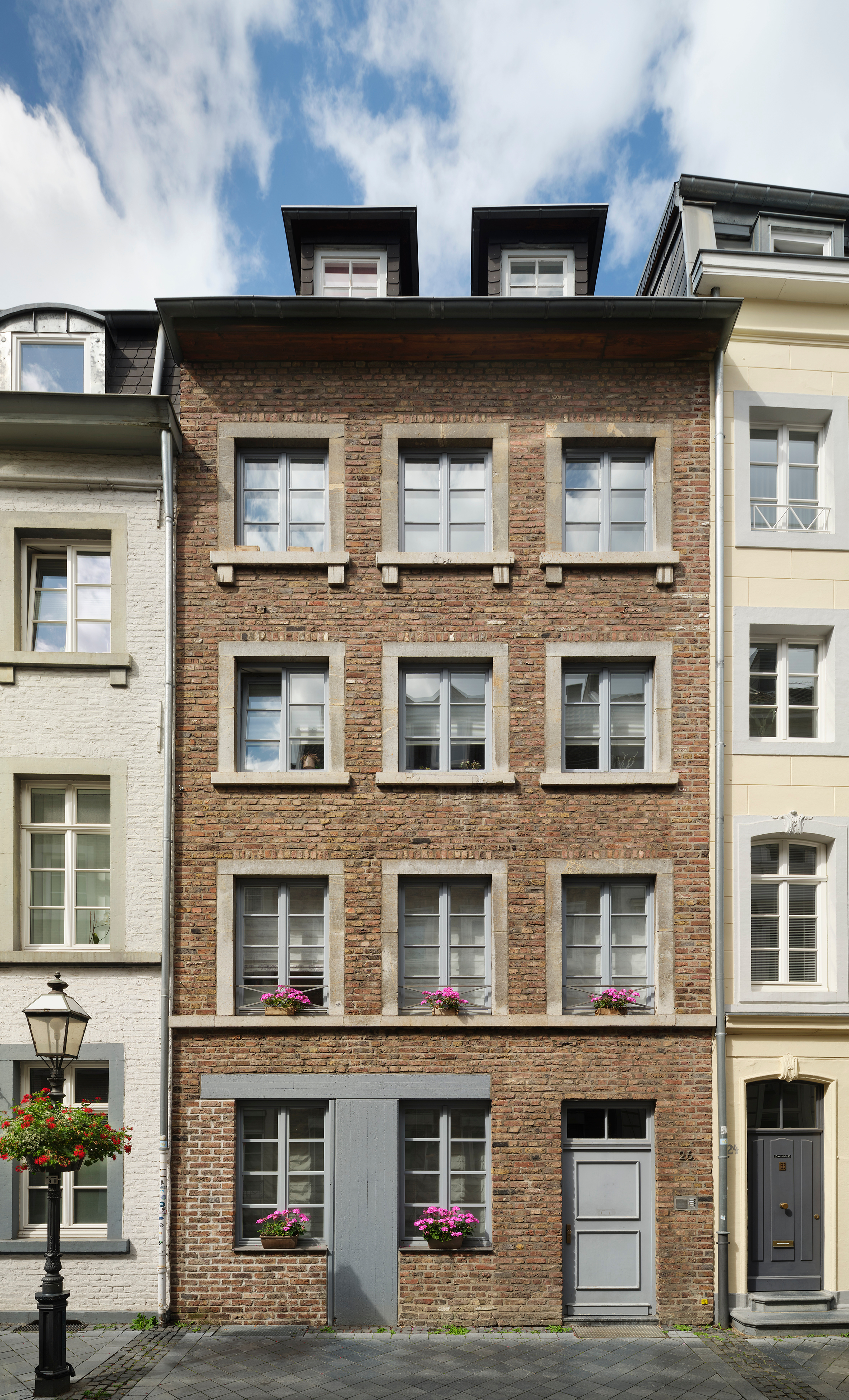
After being stored in the building yard for three years, the façade sections were placed in front of the new building on the site of no. 88. The proportions and structure of the façade are based on the original building and are largely true to the original. The previously existing plastered surfaces were omitted. The doors, which had previously been bricked up, were also rebuilt in the same way. A new addition, however, is the triangular gable facing Vereinsstraße and the significantly stronger eaves and gable cornice.

Today, the house blends in with the surrounding modern architecture in an interesting way, which was an important aim of the reconstruction within the Aachen model.
Special features
It is the only relocation of a façade in the eastern part of the city center involving the municipal monument authority and the state conservator.
Picture gallery
Discover more
All monuments at a glance
Translocation
The method of translocation was already known and popular in 19th century urban planning. It allowed old building stock to be saved and reused. In Aachen, this method was applied in a special and extensive way.