
Jakobstrasse 14-16
Monument #15

Introduction
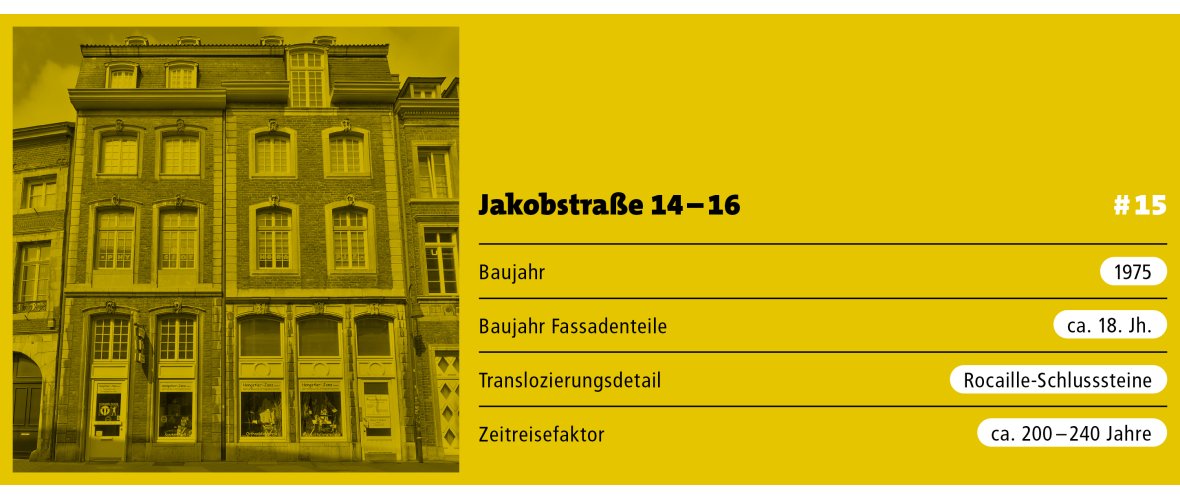
A uniform mansard roof connects two similar, but in detail different facades. The house at Jakobstraße 14-16 fits into the row of historicizing new buildings in the former redevelopment area on Jakobstraße.
Moving history
The previous building was demolished in the 1970s. The subsequent new building on the same site was completed in 1975. In order to preserve the impression of the historic, small-scale development on narrow plots, two separate façades were placed in front of the larger new building.
Search for clues
The two façades are historical originals from the houses at Großkölnstraße 3 and 5. The two old buildings were also located directly next to each other at the time, the order was the same: No. 3 on the left, No. 5 on the right. On the first floor, there are three high baroque blue stone walls with a segmental arch and ornamented rocaille wedge stone. During reconstruction, the door and window openings were divided by a wide blind element. In the process, bluestone was added and the openings were raised by around 60 cm compared to the old façade, resulting in today's unusually high window format. The historic building at Großkölnstraße 3 had a gabled roof, which was changed to a mansard roof in the new building and thus adapted to the neighboring building. The eaves cornices and mansard dormers of the two halves of the house were designed differently to reinforce the impression of two different parts of the house.
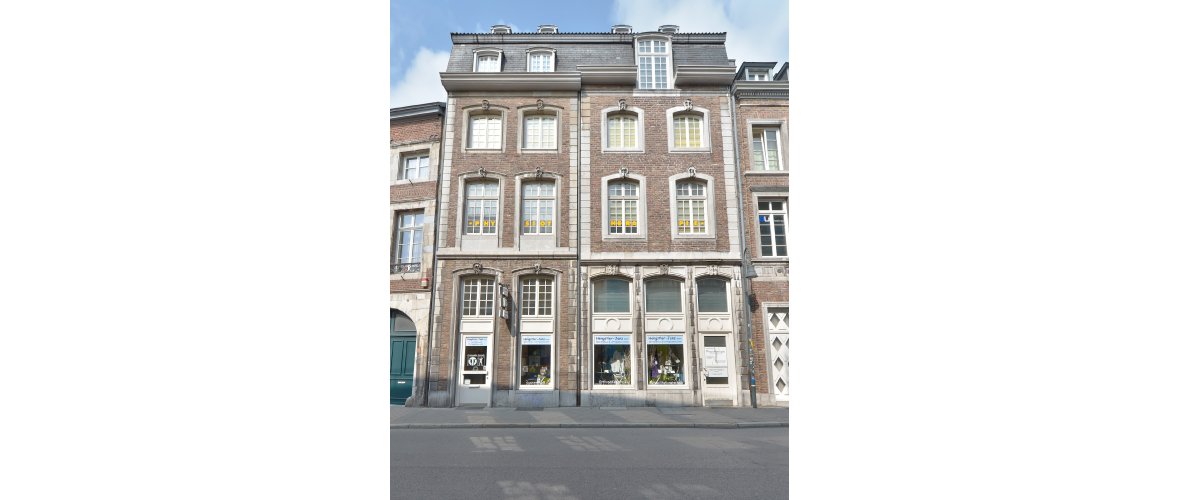
The two façades used here are similar, but not quite identical. A closer look at the two façades reveals different materials and finishes.
Special features
The jambs of the old façades have raised profiles and are decorated with segmental arches and elaborate rocaille keystones, which, according to Leo Hugot, are said to be among the most beautiful in Aachen.
Picture gallery
Discover more
All monuments at a glance
Translocation
The method of translocation was already known and popular in 19th century urban planning. It allowed old building stock to be saved and reused. In Aachen, this method was applied in a special and extensive way.