Seizing opportunities for the future of Europe with courage: Professor Mario Draghi awarded the Charlemagne Prize
- The Charlemagne Prize in 2026 will be held in the context of the economic and security challenges posed by various crises. The tenor: it takes courage to seize this situation as an opportunity for Europe.
- A core task for Europe is to strengthen the internal market and thus become a reliable partner in the fields of economy, energy and defense.
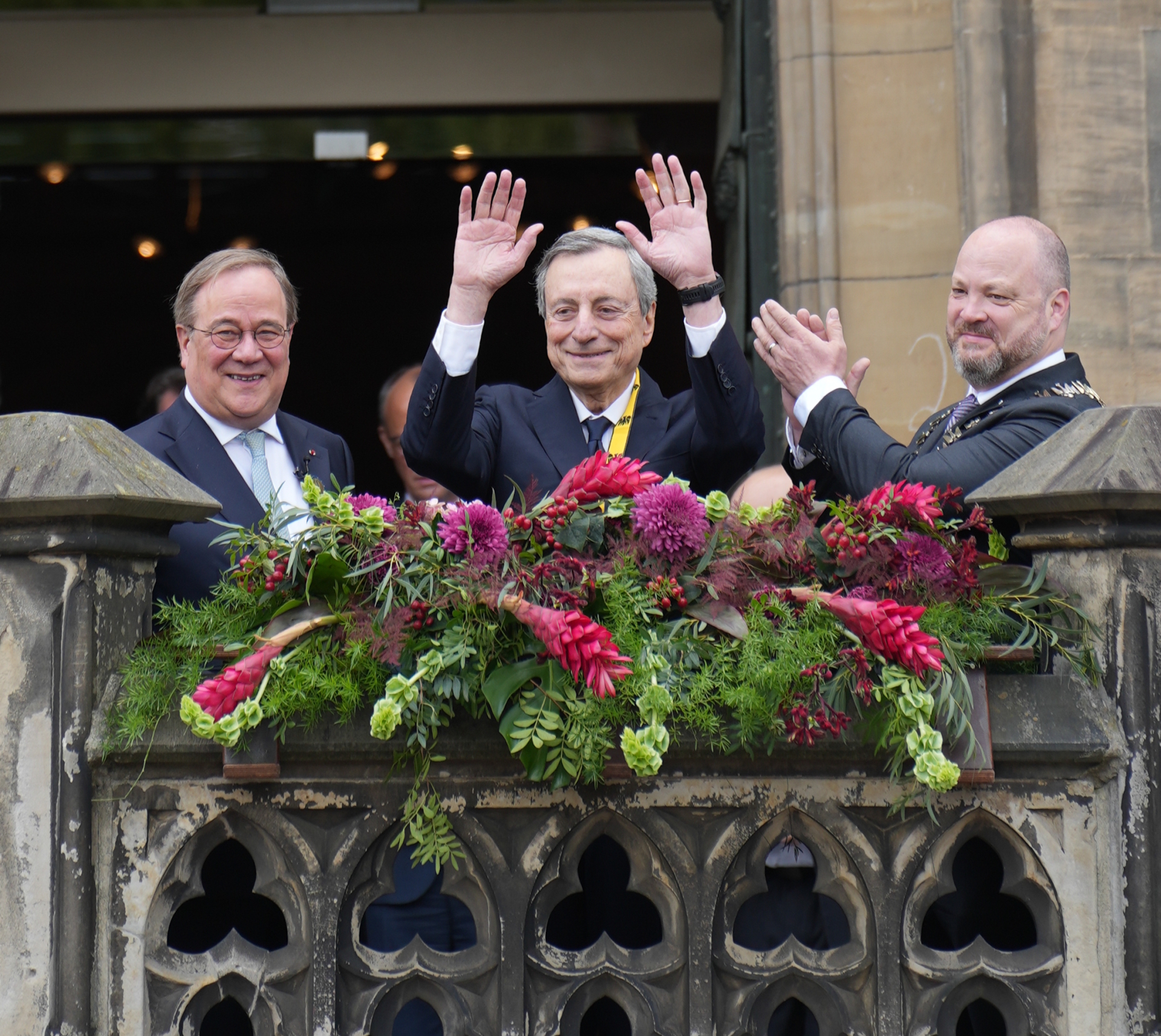
- Around 700 guests attend the ceremony in the Coronation Hall of Aachen Town Hall, and many people cheer on the Charlemagne Prize winner after the ceremony and during his subsequent appearance on the Katschhof.
The former President of the European Central Bank and former Italian Prime Minister, Professor Mario Draghi, was honored today, Ascension Day, May 14, not only as a deserving politician and genuine economist, but also as a visionary and thought leader. The economic situation of the European Union, competitiveness, stability and security on the European continent - and the strategies called for by Draghi in his much-quoted Draghi Report - were therefore the key topics of the award ceremony. All speakers agreed on the fact that, at this time, we need the courage to see this situation as an opportunity for Europe. An opportunity that can only lead to success through a joint effort across all European countries.
Mario Draghi: The European Single Market Must Be
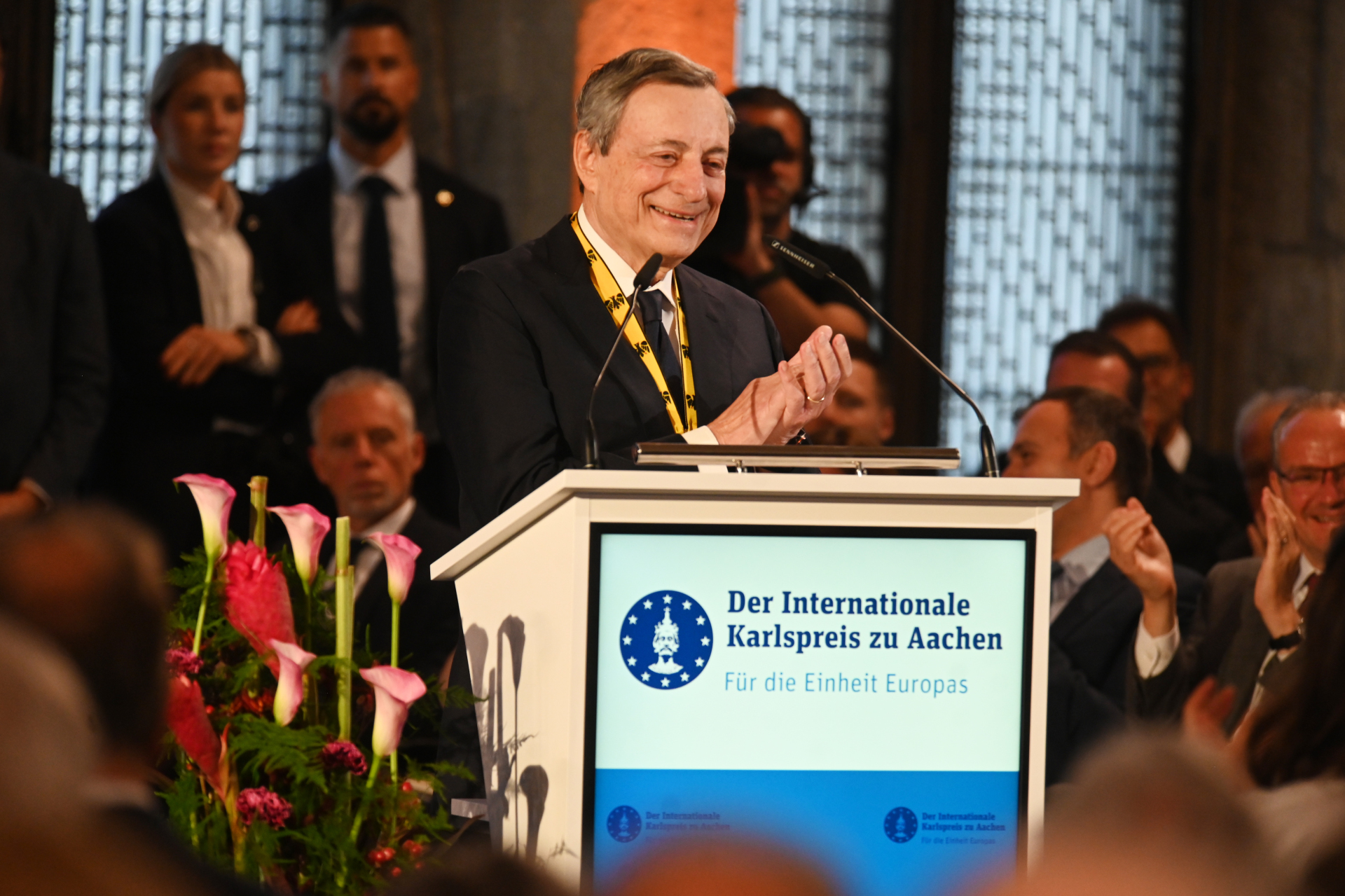
CompletedAt the start of his speech, Charlemagne Prize laureate Professor Mario Draghi appeared deeply moved. He said he was deeply honored by the warmth and hospitality of the people of Aachen and delighted to have the opportunity to express his gratitude for the praise and appreciation shown to him.
In his further remarks, Draghi then showed that he is the clear analyst and relentless admonisher that the Charlemagne Prize Board of Directors has chosen as this year's laureate. What lies ahead for Europe is certainly not easy, he said, with external pressure increasing from month to month. "But it is also a moment of revelation. The forces that are testing us are achieving what decades of peace have not: They are forcing Europeans to recognize what they have in common and what they are willing to build together," Draghi said.
"For the first time in our memory, we are truly alone. Europe is reacting to this new reality. But it is responding in a system that was not designed for challenges of this magnitude." The problems of the past are now catching up with Europe: "Internally, we have ignored the openness we preach. We have left the single market unfinished, capital markets fragmented, energy systems insufficiently connected and large parts of the economy squeezed between layers upon layers of regulation. We have denied our markets the continental dimension they needed to succeed."
Cross-border investments have been postponed for too long, the dependencies on American and Chinese politics are immense and there is a clear gap in the technology sector that is getting bigger and bigger. The transformation driven by artificial intelligence in particular is crucial. "Europe has the financial resources, the talent and the latent energy potential to keep pace with this transformation. But borders and constraints are preventing us from mobilizing these assets to the extent that this time requires." Europe must offer a market that is large and strong enough to invest in. Without its own demand, Europe could not take a credible stance abroad. Within the current structure of the internal market, a large-scale industrial policy was doomed to failure.
The loss of the U.S. as a reliable partner as an opportunity to build our own strength
. Europe must therefore rely more on itself and have confidence in its own capabilities, but it must also forge reliable partnerships—including with the U.S. “Yet the partner we rely on has become more confrontational and unpredictable,” Draghi said. Above all, Europe needs the ability to respond more decisively to this new situation in order to restore the partnership to a more equal footing. “What is really holding us back is security. An alliance in which Europe depends on the United States for its defense is one in which security can overshadow all negotiations: on trade, technology, and industry.”
This attitude on the part of the USA should therefore not only be seen as a danger, but as a necessary awakening. If the USA demands more European involvement in its own defence, then Europe must also learn more autonomy in the organization of its defence. In this way, Europe could gain more strength in its trade and energy relations. "This need not weaken transatlantic relations. On the contrary, it would put both partners on solid ground," explains Draghi. "The opportunity for Europe is considerable."
The European Union is being forced to make decisions that it has long avoided. The difficult situation is understood by governments and citizens alike. A plan is in place and measures are already being taken in some areas. Europe is being reminded of values that have long seemed self-evident: Solidarity, democracy, the rule of law, protection of minorities - the legacy of post-war Europe. They are coming to the fore because they are being put to the test.
It is already clear to citizens which path Europe must take. They want greater unity in action. The Charlemagne Prize winner makes a clear demand: "The heads of government know where the work lies and they must now decide whether they are prepared to put substance before procedure. We are at a point where decisions can no longer remain within institutional frameworks. We must meet the trust of our citizens with courage."
Chancellor Merz: Europe Must Stand Its
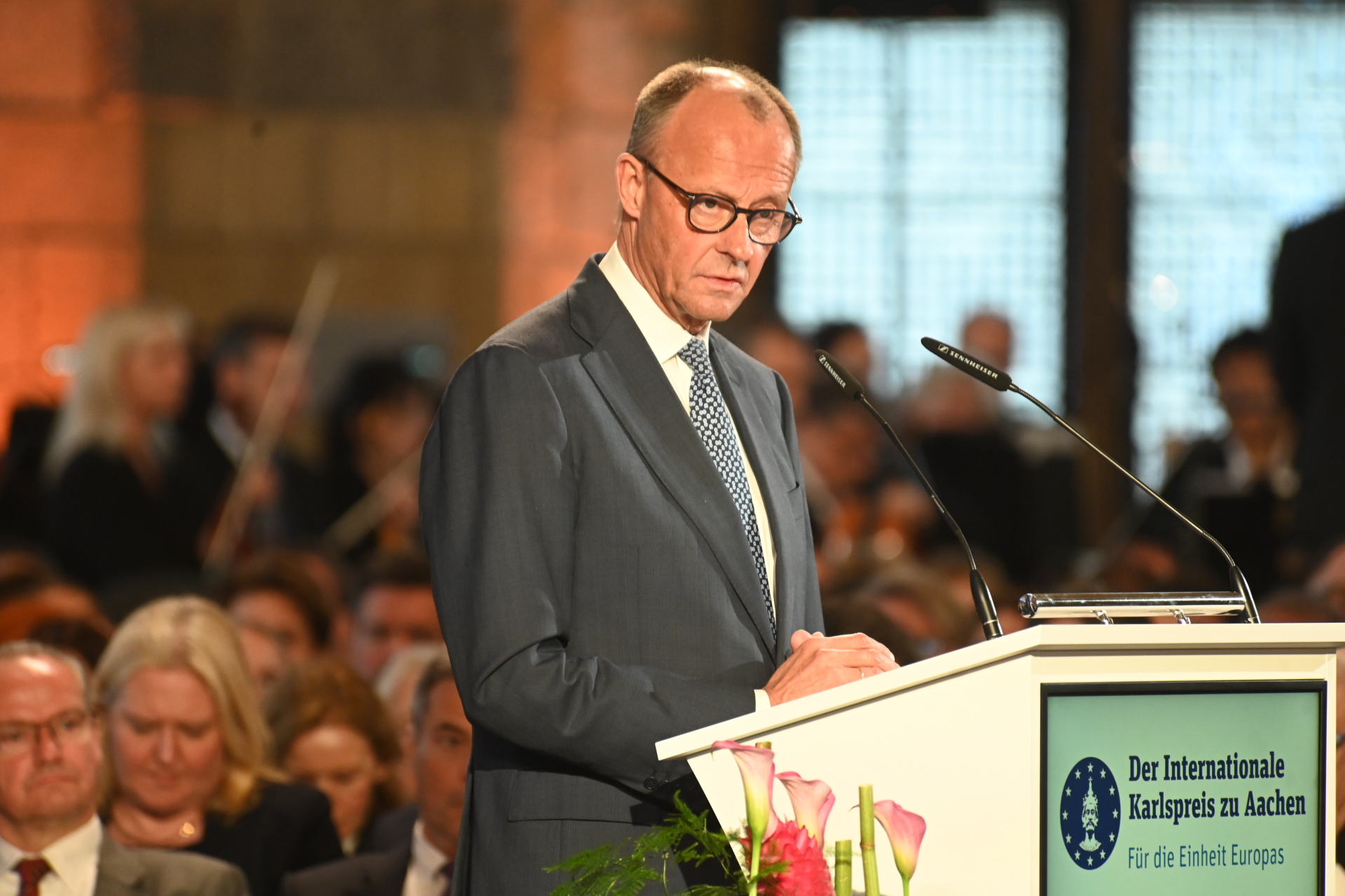
GroundIn his laudatory speech, Chancellor Friedrich Merz once again emphasized that Mario Draghi’s career alone would be enough to fill five résumés. “I think you’ll understand why his friends call him Super Mario.” Draghi has rendered outstanding service to Europe. “You took charge of the euro during a time of crisis, and you stabilized the euro and the monetary union—using measures that were controversial. That was courageous; you took a risk, it succeeded, and it paid off. For which we, the Europeans, are deeply grateful to you, Mario Draghi.”
Today, Europe finds itself once again and more than ever in a threatening time, something that Draghi repeatedly emphasizes. "We in Europe relied too much on the power of humanistic, European Western ideas to transform the world as a whole into a realm of freedom and peace. We were wrong. But recognizing the error of false optimism does not mean giving up the confidence that people can live together in freedom and peace. Europe has the opportunity to help shape the new world order so that it is governed by norms and rules instead of arbitrariness and the law of the jungle," said Merz. The world is currently reorganizing itself, with new crises every week. In this situation, Europe must maintain a clear course and a cool head.
"Europe must assert itself today. I say Europe has understood this, Europe has woken up," explained the Federal Chancellor. Europe is strengthening itself economically and in terms of security policy - and doing so quickly. New trade partnerships are being forged, dependencies are being reduced and Ukraine is also being resolutely supported in its defensive struggle against Russia.
Europe has set out to become a power that promotes itself with freedom and justice, peace and prosperity - and wins over its citizens. "We Europeans are discovering our strength and capabilities, especially when we stand together resolutely." This not only applies to security policy. Europe also has economic resources that can be deployed. "Others are also dependent on us, not just us on them. And if we show that we are prepared to use these resources, we can achieve a lot." The potential of the European market must be uncovered. A market that is bigger than the US market. The internal market must finally be revitalized as it was once intended.
In his 2024 report, Mario Draghi made precise proposals, relentlessly analyzed European competitiveness and called for a fundamental change of course. "He does not stop at analyzing the problem, his answers are clear and ambitious. All of this reflects his personality. A level-headed, thoughtful person who cares more about the European common good than almost anything else."
Draghi's proposals have come at just the right time and it is now up to those responsible - as requested by the Charlemagne Prize Board of Directors in its explanatory statement - to turn them into binding resolutions and use them to strengthen Europe. "The request has been received, we are in the process of implementing it," concluded Merz.
Kyriakos Mitsotakis: Draghi Helped Europe Help ItselfGreek Prime
Minister Kyriakos Mitsotakis also begins by noting the significance of Aachen, a city “that so strongly embodies the memory of Europe. Europe was never a geographical construct, but an idea, a vision, and a decision. A decision that has been made anew time and again. That is why this award is so important. It honors not only those who have always believed in Europe, but also those who have strengthened Europe in moments when strength was most needed.”
The Charlemagne Prize Board of Directors would be honoring just such a European today. Mario Draghi's life was characterized by his loyalty to his profession, his courage to lead and his willingness to take risks. Draghi is an important voice on what Europe needs to do, he is an inspiration: "One of your greatest challenges and achievements in your career was that you helped Europe to help itself," said Mitsotakis. Draghi is recognized because in recent years he has told Europe what needs to be said, directly and refreshingly undiplomatically.
The threat to Europe today is not the collapse of the South, but an erosion of competitiveness. Europe lacks innovation and investment. Technological dependency and the lack of strategic supply chains would prevent Europe from becoming the shaper of its own future. "We must therefore not regard the Draghi report as just another document. It is a wake-up call, a detailed blueprint of what needs to be done."
"We need sovereign decision-making freedom, we need strategic autonomy, self-confidence. A strong Europe is a better ally, a more capable Europe is a credible partner," said Mitsotakis. Common challenges require common courage. "Mario, Europe owes you a debt of gratitude for your courage, your sense of responsibility." If Europe decides to do what is necessary - "whatever it takes" - then Europe can continue to help shape the future.
Mayor Ziemons: The Draghi Report as a Social Policy
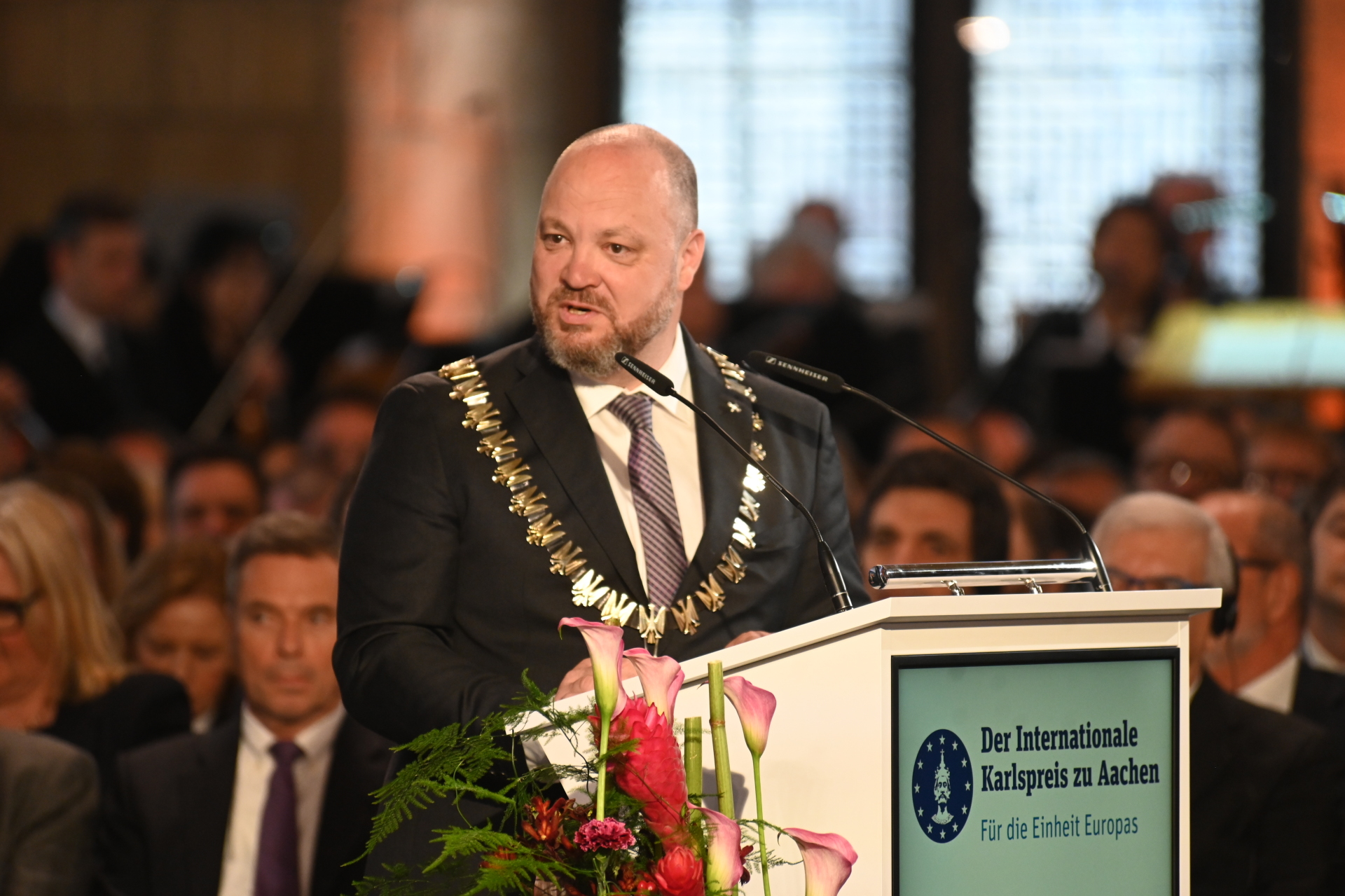
Wake-up CallAachen Mayor Dr. Michael Ziemons also echoed the praise for Mario Draghi’s decisive action in his opening remarks, describing the Charlemagne Prize laureate as a legend “because he took action at a time when others hesitated.” Draghi’s courage is needed again today, “in a different guise, with different means—but with the same inner resolve: the willingness to do what is necessary, even when it is uncomfortable.” The current political crises and the loss of the United States of America as a reliable partner also present an opportunity for Europe “to finally become what its founders always had in mind: Europe must be a player that helps shape the world.”
Ziemons bridged the gap between the geopolitical and economic situation of the European Union and the local political and social challenges on the ground: "Competitiveness sounds like stock market prices and investment quotas. But behind these figures are the realities of life. The Draghi Report is therefore not an end in itself for economists - it is a socio-political wake-up call if you read it correctly. Those who implement the Draghi Report are not fighting for corporate balance sheets. Those who implement it are fighting for the pensioner in Aachen who wonders whether her pension is secure. For the skilled worker in a German car plant who senses that the transformation of his industry is catching up with him. For the student who wants to find a future in Europe - and trusts that Europe will give her one."
The Lord Mayor thus brought up a circumstance that goes deeper than economic targets: the trust of local people in the European idea. "Whether people trust in Europe, whether they trust European values to be the better ones, is certainly not decided in Brussels, Strasbourg or the summit cities of this world, but in the everyday reality of the lives of those who ultimately have to bear the consequences of all decisions. Nobody expects infallibility, but they do expect a policy that makes the right decisions with courage and strength and knows how to explain and live them," said Ziemons.
The old Europe is irrevocably coming to an end. In Mario Draghi, a European is being honored who has provided the right impetus for the new Europe. "With him, we hope for a courageous departure into a future that will also enable the people of the future Europe to enjoy peace, freedom and social security."
Statement by the
Charlemagne Prize BoardThe Board’s statement reads, in part: “In honoring Prof. Mario Draghi, the Charlemagne Prize Board is recognizing a figure who, with single-minded focus and unwavering determination, has achieved great things for Europe: saving the euro, stabilizing his home country during a severe crisis, and now formulating an agenda for the future of the entire continent. The recognition of his outstanding life’s work is therefore far more than a tribute to the past. It is an affirmation of the existential importance of his recent wake-up call and, at the same time, a call to all political and social forces in Europe to take his analysis seriously and to make courageous decisions and take action themselves now. The awarding of the 2026 Charlemagne Prize to Mario Draghi is thus a deliberate signal regarding the urgently needed prioritization: Europe must renew its economic strength in order to shape its future on its own terms. We call on the European Commission and European heads of state and government to implement the Draghi Report now.”
Quotes and facts in brief:
- The award recipient: Professor Mario Draghi was awarded the “International Charlemagne Prize of Aachen” today, Ascension Day, May 14. “Like no other, Mario Draghi stands for the economic strengthening of Europe, and his eponymous Draghi Report of 2024 outlines the necessary strategy to ensure competitiveness, growth, and stability on the continent,” writes the Charlemagne Prize Board, led by its chairman Armin Laschet, in its statement.
- Draghi: “When citizens call for more Europe, they are not simply asking for more of the Europe we have. They are not asking for some abstract institutional blueprint; they are asking for improvements in how Europe protects and strengthens itself.”
- Chancellor Friedrich Merz on the war in Ukraine: “We are meeting here for the fifth year in a row in the shadow of this war. And we say it again: We support Ukraine in its fight for freedom, because it is also a fight for our freedom. We want to help bring this war to an end. And we Europeans decide for ourselves who speaks for us.”
- Kyriakos Mitsotakis, Prime Minister of Greece: “The Charlemagne Prize should remind us that Europe is never finished. We should leave Aachen not only with a sense of gratitude, but also with a sense of determination.”
- Aachen Mayor Dr. Michael Ziemons: “When Europe’s economy is in the doldrums, it’s the regions that feel the impact first. When democracy comes under pressure, it starts in our local communities. When social cohesion erodes, it’s first evident in our town squares and neighborhoods. That is precisely why we certainly don’t need timid and cautious responses—we need bold ones! The people who, like us, believe in Europe, expect exactly that—and they deserve it.”
- The Ceremony: Approximately 700 people, including numerous distinguished guests, attended the festivities in the Coronation Hall of Aachen City Hall. Seated on the podium of honor, alongside Charlemagne Prize laureate Professor Mario Draghi, were German Chancellor Friedrich Merz, Greek Prime Minister Kyriakos Mitsotakis, Mayor of Aachen Dr. Michael Ziemons, Chairman of the Charlemagne Prize Board Armin Laschet, this year’s Youth Charlemagne Prize winners, and former Charlemagne Prize laureates, His Royal Highness Grand Duke Guillaume V (on behalf of the people of Luxembourg, 1986), European Central Bank President Christine Lagarde (representing the euro, 2002), Jean-Claude Juncker (2006), Jean-Claude Trichet (2011), Martin Schulz (2015), Chief Rabbi Pinchas Goldschmidt (2024), and Dr. Ursula von der Leyen (2025), as well as the 2022 laureates Veronica Tsepkalo, Svetlana Tikhanovskaya, and Maria Kalesnikava.
- Other guests: Among the guests at the Charlemagne Prize award ceremony were Edi Rama (Prime Minister of Albania), Dr. Gordan Grlić Radman (Foreign Minister of Croatia), Gunther Krichbaum (Minister of State for Europe at the Federal Foreign Office), European Commission Vice-President Teresa Ribera, European Parliament Vice-President Sabine Verheyen, Hendrik Wüst (Minister-President of North Rhine-Westphalia), Nathanael Liminski (NRW Minister for Federal and European Affairs, International Affairs, and Media), Mona Neubaur (NRW Minister for Economic Affairs, Industry, Climate Protection, and Energy), and Herbert Reul (NRW Minister of the Interior) are guests of honor at the Charlemagne Prize award ceremony. Numerous other elected officials, ambassadors, representatives of churches and religious communities, as well as representatives from Aachen’s sister cities.
- The program: The Charlemagne Prize award ceremony featured musical accompaniment by the Aachen Symphony Orchestra, which, under the baton of Music Director Christopher Ward, performed works by Ludwig van Beethoven and Antonio Vivaldi. The Italian guitar quartet 40 Fingers performed “Caruso” by Italian composer Lucio Dalla.
- Media interest: Over 80 media representatives have been accredited for the 2026 Charlemagne Prize ceremony—including teams from ARD, ZDF, and WDR; El Periódico; Reuters; Süddeutsche Zeitung; DPA; Deutsche Welle; Neue Zürcher Zeitung; Börsen-Zeitung; AFP; as well as numerous regional media outlets from Germany, Belgium, and the Netherlands. The live TV broadcast aired on WDR Fernsehen and is still available there.
Information on the International Charlemagne Prize of Aachen:
The International Charlemagne Prize of Aachen is considered one of the most prestigious European awards. Since 1950, it has been awarded to individuals and institutions that have rendered outstanding services to European unity. Chief Rabbi Pinchas Goldschmidt and the Jewish communities in Europe are the 65th recipients of the International Charlemagne Prize of Aachen. They follow the President of Ukraine, Volodymyr Zelenskyy, and the Ukrainian people, who were awarded the Charlemagne Prize in 2023. Previous laureates in Aachen have included Konrad Adenauer (1954), King Juan Carlos I of Spain (1982), U.S. President Bill Clinton (2000), Luxembourg Prime Minister Jean-Claude Juncker (2006), German Chancellor Angela Merkel (2008), Pope Francis (2016), French President Emmanuel Macron (2018), António Guterres, Secretary-General of the United Nations (2019), the Belarusian civil rights activists Maria Kalesnikava, Svetlana Tikhanovskaya, and Veronika Tsepkalo (2022), Ukrainian President Volodymyr Zelenskyy and the Ukrainian people (2023), Chief Rabbi Pinchas Goldschmidt (2024), and European Commission President Ursula von der Leyen (2025).
As part of the festive ceremony in the historic Coronation Hall of Aachen's Town Hall, a medal is awarded alongside a certificate, which shows the oldest Aachen city seal from the 12th century with Charlemagne enthroned on the front and an inscription for the respective prizewinners on the back.
Further information:
You can subscribe to our RSS feed for our press releases here https://www.aachen.de/rss-feed-pressemitteilungen/rss.xml