Commercial transport & logistics
Commercial traffic in a city is an indispensable prerequisite for the supply of goods and products to citizens and for production and service companies to live and do business.
City of Aachen
Urban commercial traffic includes freight and passenger traffic. The commercial goods traffic and works traffic considered here includes freight forwarders, the trades, (urban) service vehicles and courier, parcel and express services (CEP) as well as other traffic such as that of the catering trade. If urban delivery traffic is considered in more detail, the following subdivisions can be made:
- Container transport (20/40-foot containers and swap bodies),
- Bulk transportation (mostly construction site traffic),
- General cargo transportation (containers often on Euro pallets),
- Courier, express and parcel services (CEP shipments up to approx. 40 kg)
Commercial transports can occur as source transports (e.g. dispatch of manufactured products), destination transports (e.g. supply of CEP depots with swap bodies in the nightly main run) and internal transports (e.g. plant transports and CEP delivery tours from the depot to the customers) of a city.
Against the backdrop of steadily rising traffic figures, urban-compatible commercial transport and functioning city logistics can only be reconciled if the municipalities actively plan and coordinate the design and management of delivery traffic in cooperation with stakeholders and implement appropriate measures, also taking into account other traffic development measures and other planning principles.
Data on Commercial Traffic
To achieve the goals of transportation planning and climate protection, a reliable data foundation regarding commercial traffic is essential—and has been lacking until now. Against this backdrop, a commercial transportation report was prepared that uses existing data to provide insights into the current state of delivery traffic and derives recommendations and proposed measures for Aachen from these findings. In addition, development scenarios for urban traffic and emissions for the years 2027 and 2030 are presented. The study area is the city of Aachen, including its core city within the Grabenring, the Alleenring, and the Outer Ring (Adenauerallee/Madrider Ring/Berliner Ring/Prager Ring/A4/Toledoring/Pariser Ring/Amsterdamer Ring/Brüsseler Ring/Luxemburger Ring/St. Vither Str./Siegelallee), as well as some industrial parks, depending on the available data.
Economic Traffic Assessment for the City of Aachen (Summary)
Economic Traffic Assessment for the City of Aachen (Full Version)
City-friendly parcel delivery
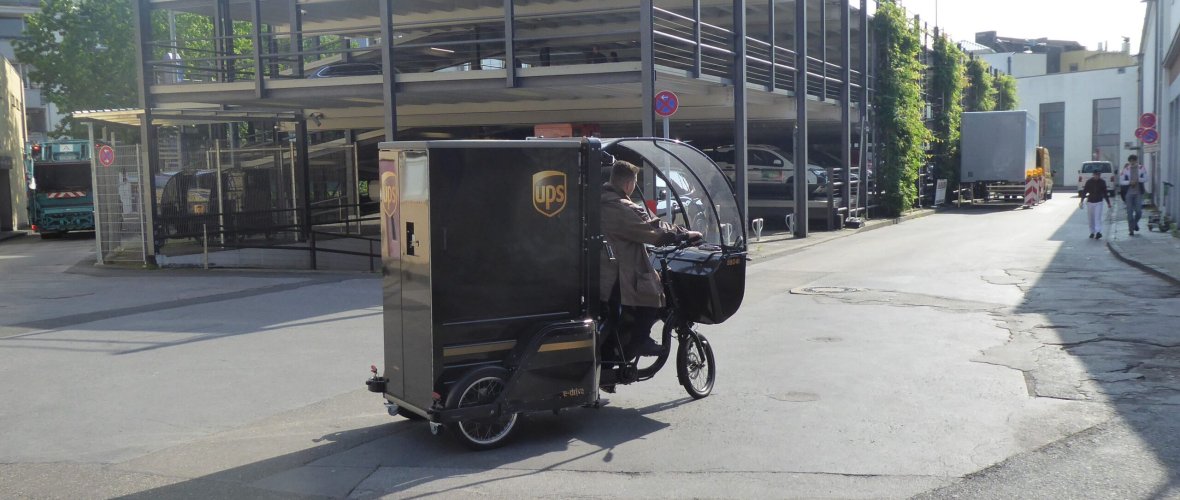
The gradual conversion of parcel deliveries from combustion vehicles to electric vans and cargo bikes will improve the flow of traffic in Aachen's city center.
Since March 2021, the express and parcel service provider UPS has been operating a mobile micro-depot at the Adalbertstraße parking garage in cooperation with APAG Parkhaus GmbH and the city of Aachen. From here, parcels can be delivered efficiently and in a more climate-friendly way in the city center.
Every morning, several hundred packages are delivered to the light blue container, which are then distributed throughout the day in the central downtown area using five electric cargo bikes. At night, the cargo bikes are securely parked in the parking garage, where they can be charged. In the evening, the container is then taken back to the distribution center in Eschweiler with returned packages to be reloaded.
Expansion following a successful test phase
Following a successful trial period, the micro-depot will now be permanently established at the Adalbertstraße parking garage. The switch to cargo bikes as delivery vehicles will not only make the city’s air cleaner but also eliminate the need for large delivery vehicles to double-park. Delivery riders can more easily reach many destinations in the city center by cargo bike and take up less space. This not only improves traffic flow but also makes it safer for all road users.
Meanwhile, two additional delivery companies (Amazon and Deutsche Post-DHL) are successfully operating cargo bike delivery services in the city center.
Areas of Action in the Economic Transport Plan
The Aachen Economic Mobility Report, as well as supraregional exchange platforms, highlight where specific opportunities for action exist for municipalities. In Aachen
, these opportunities for action should focus on the following areas, in accordance with the report’s recommendations and available resources:
- Organization of Commercial Traffic
- Low-Emission Commercial Transportation and Delivery
- Digital Data and Information on Commercial Transactions
- Cooperation and Mobility Management in Commercial Transportation
Examples of measures that fall under these areas of action include:
Establishment of Loading Zones/Loading Areas
Delivery vehicles have long been part of the urban landscape of every city. At the same time, the vehicles require a lot of space and often block parts of the road when loading and unloading. The city of Aachen has set up special loading zones to provide space for delivery vehicles.