The Latest Housing Market Report 2026
- The housing market in Aachen will remain tight in 2026 as well. Ensuring the long-term preservation and expansion of affordable housing will remain the most important housing policy priorities in the coming years.
- New legal options created by the “Bauturbo” initiative, broader networking through the Aachen Housing Summit, and close regional cooperation are intended to remove obstacles to housing development.
- For the first time, the housing market report includes interviews with experts from counseling centers, social service agencies, and other stakeholders.
Structural strain in Aachen’s housing market continues. A significant imbalance between persistently high demand and a limited supply of housing has continued to intensify. While asking rents in the rental housing market have reached a new high, new construction has failed to keep pace with actual housing demand. The long-term preservation and expansion of affordable housing remain the most important housing policy priorities for the coming years. Mayor Dr. Michael Ziemons emphasizes that it is essential to accelerate processes, create reliable framework conditions, and lead the way boldly as a city.
Thomas Hissel, the city councilor for Housing, Social Affairs, and Economic Development, recognizes the seriousness of the situation but emphasizes: “The situation is tense, but not hopeless. Demand is rising, and the supply side is growing along with it—but not at the same rate. There are many reasons for this.” High construction costs, increased financing costs, and limited available land continue to hinder the development of new housing projects.
Once again, low- and middle-income households, single parents, older adults, families, students, and apprentices are particularly affected, as the lack of housing options—especially in the publicly subsidized sector—makes it difficult for them to find housing. Despite some positive developments, a significant problem persists, particularly in the affordable and mid-range market segments.
Expiring Commitments Weigh on the Publicly Subsidized Housing Market
The situation in the publicly subsidized housing market remains particularly critical. Despite improved subsidy terms, another year of high subsidy figures, and strong demand for public funding, the significant number of expiring commitments in the coming years cannot be offset. The stock of publicly subsidized housing is declining significantly faster than new housing can be created. More than 1,000 units were released from rent and occupancy restrictions within a single year. In contrast, only 318 new housing units were approved. “Despite a decline compared to the previous year, this is the fourth-highest figure of the past 20 years,” emphasizes Norbert Plum, Chair of the Housing and Real Estate Committee.
With its quota resolution, active housing placement services, reviews of lease extensions, and the Housing Action Plan, the City of Aachen already has important housing policy tools at its disposal. These initiatives are to be consistently developed further. In 2025, nearly 68 million euros in funding had already been approved as part of the North Rhine-Westphalia state’s public housing subsidy program. “This can only be achieved through close cooperation among various stakeholders from the City of Aachen, StädteRegion, the state, companies, and investors,” says Plum.
Aachen Housing Summit and “Bauturbo”
In February 2026, the first “Aachen Housing Summit” took place to intensify the exchange between city administration and the housing industry and to discuss joint approaches to accelerating housing construction projects and improving the framework conditions for housing development. The Housing Summit marked the beginning of an ongoing dialogue between the city administration and the housing industry. Suggestions from the housing industry were taken up by the administration and tested in practice. As the first outcome of the Housing Summit, the City of Aachen convened a “Bauturbo Steering Committee” for targeted implementation. The amendment to the Building Code enables the accelerated creation of housing (colloquially referred to as “Bauturbo”).
Another approach to addressing current housing policy challenges is the joint application by the City of Aachen and the Aachen Metropolitan Region for the federally funded research project “Model Project for Regional Planning (MORO).” A key outcome of the project is the establishment of lasting intermunicipal cooperation structures. In the future, existing municipal knowledge will be pooled and new knowledge generated to make it accessible to all cities and municipalities. The City of Aachen and the Aachen Urban Region are now committed to sustaining this cooperation and collaboration with a view toward Euregional housing development.
“Together, we want to give housing construction in Aachen a new boost. This can only succeed if the city, the housing and construction sectors, investors, and other partners work hand in hand. With the Housing Summit, we have significantly intensified this dialogue—and concrete steps are already emerging from it. The federal government’s ‘Bauturbo’ initiative, the state’s improved funding framework, our ‘Turbokonzept’ procedure, and regional cooperation are providing us with additional opportunities. Many projects are already in the pipeline. That is why I am confident that we will be able to get more housing off the ground in the coming years,” says Thomas Hissel
New Focus Areas in the
Housing Market Report While in recent years the report has primarily focused on the quantitative housing shortage, today the emphasis is increasingly shifting to qualitative issues: “What kinds of housing are needed? Which population groups face the greatest difficulties in accessing the housing market? What is the housing market situation like for different groups of people?” explains Alexandra Weis, team leader for housing development in the city’s Department of Housing, Social Affairs, and Integration.
The 2026 Housing Market Report therefore sets new priorities: in-depth interviews with professionals who directly assist and advise a diverse range of people seeking housing. This new perspective complements the statistical analyses with valuable practical insights. “In many cases, the housing issue is not just a matter of supply, but also a matter of access to that supply,” says Weis. This access is no longer determined solely by the number of available apartments. Digital application processes, language barriers, a lack of networks, bureaucratic requirements, or specific support needs are increasingly determining whether people actually secure an apartment.
Taking ancillary and operating costs into account also provides a broader perspective on housing affordability. The so-called “second rent” is becoming an increasingly heavy burden for many households. Even with stable base rents, rising energy prices and higher operating and service costs can significantly increase total housing costs.
Student dormitory on Karl-Marx-Allee
The press conference on the new housing market report took place at the student dormitory located at Karl-Marx-Allee 220. In 2020, the City of Aachen and BLB-NRW entered into a land use agreement stipulating that publicly subsidized housing in the form of student apartments would be built on this site. The complex was completed this year.
Corinna Kalscheuer of the project developer ConKav Stadtentwicklung und Projektsteuerung oversaw the entire development process of the new student residence for Stefan Frey AG. The residence hall is operated as a “Plug and Study” facility. The sophisticated architectural design features 233 high-quality, affordable housing units for students, complete with full furnishings and comfortable common areas. And the concept is working: “We began marketing the property in April, and as of today, 203 of the 233 apartments have been leased,” says Kalscheuer.
The project is also a good example of the much-touted collaboration among various stakeholders in the effort to secure housing. “We held a competition in collaboration with the city; all key administrative departments were involved, and thanks to the excellent cooperation, the entire process for such a large project went off without a hitch,” says Kalscheuer. Another publicly funded project in the planning phase in Aachen Brand—featuring residential development and a daycare center—is already under construction and is scheduled for completion in the fall of next year.
Planning Framework for Various Housing Market Stakeholders
The Housing Market Report, published by the Department of Housing, Social Affairs, and Integration of the City of Aachen, regularly analyzes trends and long-term developments in the Aachen housing market based on a broad data set. Its findings serve as a reliable basis for planning and help the city develop integrated strategies and target housing policy measures effectively. This is based on the Housing Action Plan, which is currently in the implementation phase.
2026
Housing Market Report A printed copy of the 2026 Housing Market Report can be requested from the Department of Housing, Social Affairs, and Integration of the City of Aachen by calling 0241/432-56306 or by emailing komwob@mail.aachen.de.
The housing market report can be found on the Internet at www.aachen.de/wohnungsmarktbericht.
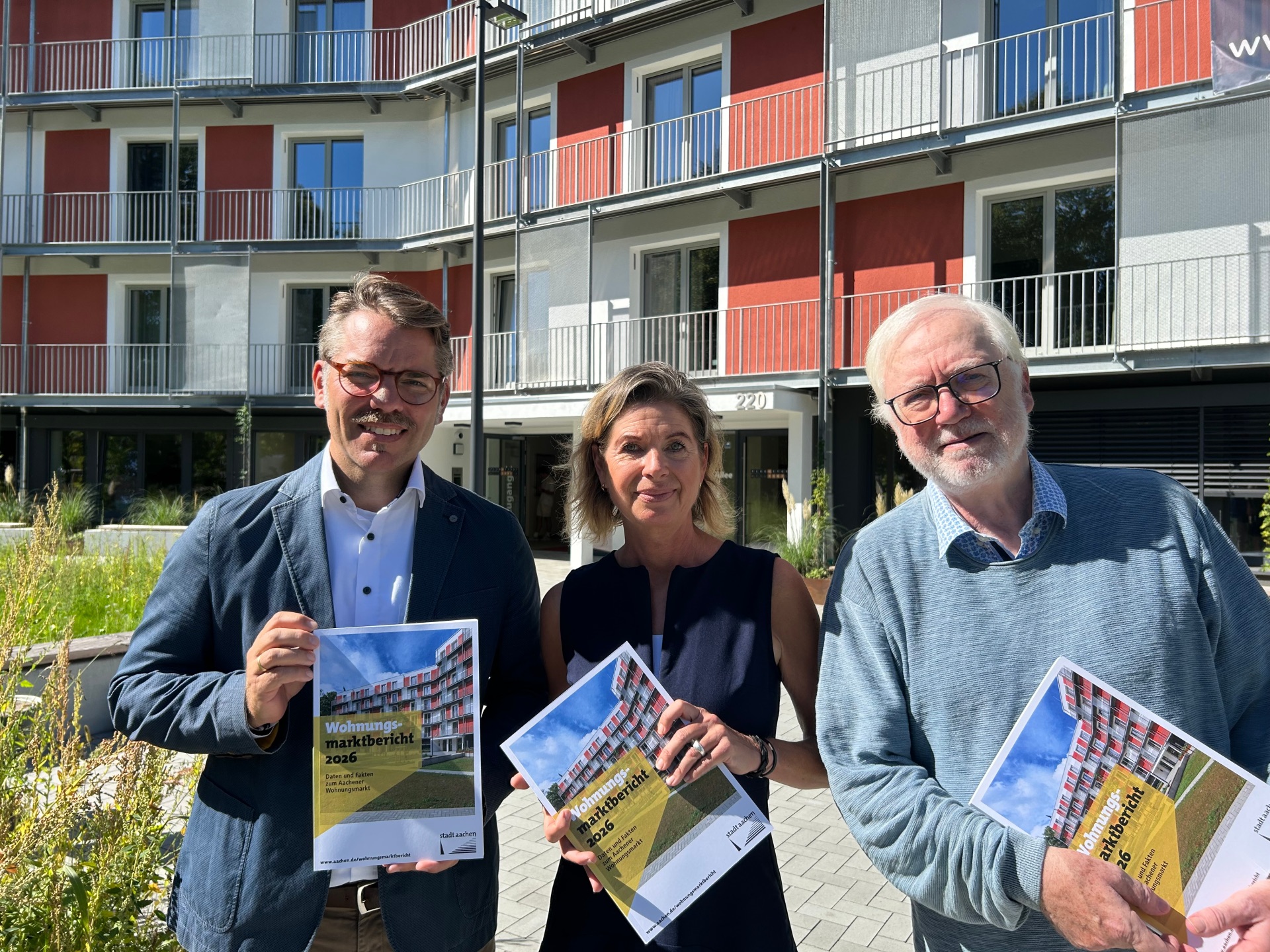
Thomas Hissel, City Councilor for Housing, Social Affairs, and Economic Development; Norbert Plum, Chair of the Housing and Real Estate Committee; and Corinna Kalscheuer, ConKav Urban Development and Project Management, will present the 2026 Housing Market Report at the student residence hall located at Karl-Marx-Allee 220.
You can subscribe to our RSS feed for our press releases here https://www.aachen.de/rss-feed-pressemitteilungen/rss.xml