First Citywide Sustainability Report: Aachen Highlights Sustainability and Invites Everyone to Take Action Together
- The City of Aachen has released its first comprehensive sustainability report.
- The assessment shows what is already happening and lays the groundwork for the next steps.
- Sustainability thrives on participation, and sustainability starts at the local level.
How sustainable is Aachen today? What is already going well? And what are the next steps? The City of Aachen’s first citywide sustainability report provides answers to these questions: For the first time, it brings together the city’s diverse activities, structures, and developments related to sustainability and highlights what is already being accomplished in Aachen.
The report’s scope extends far beyond climate protection: It examines strategies and projects as well as partnerships, participatory formats, and measurable developments. From climate adaptation and sustainable mobility to the protection of nature and biodiversity, and on to social justice, education, health, and sustainable economic management, it becomes clear that sustainability affects nearly every aspect of urban life.
“For Aachen, sustainability is not an abstract issue for the future, but a concrete challenge that affects our city today and tomorrow. The first citywide sustainability report impressively demonstrates the wide range of actions Aachen is already taking and where we can tap into further potential. Especially in times of great challenges, we want to maintain the courage to live by sustainability, continue to advance it, and thereby invest in the future of our city,” says Dr. Michael Ziemons, Mayor of Aachen.
Sustainability has many facets
. The report is based on the “Sustainable Municipality” reporting framework (BNK 2.0) and covers eight management criteria—such as communication and participation, organization and human resources, contracting and procurement, as well as digitalization, innovation, and research—and eleven areas of action. These areas include, among others, climate protection and climate adaptation, the circular economy, biodiversity and environmental protection, sustainable mobility, housing and neighborhood development, social justice, education and culture, health, as well as sustainable economic management and global cooperation.
This explicitly recognizes sustainability as a cross-cutting priority for the administration. Environmental, social, and economic issues are interrelated—and sustainable urban development takes place where these areas are considered together. “The report is more than just a status report from the city administration. Sustainability is a collaborative effort and benefits the entire city. We want to reach out openly to the city’s residents, the business community, academia, and civil society. What does sustainability mean for Aachen, a city of knowledge and innovation? Where does it benefit from a special commitment—most recently, for example, in defending its status as a university of excellence?” emphasizes Heiko Thomas, Deputy Mayor for Climate, Municipal Services, and Buildings for the City of Aachen.
Developed collaboratively, comparable
nationwide The sustainability report was prepared as part of the “BNK Bundesweit 2025” project by the “Servicestelle Kommunen in der Einen Welt” (SKEW) by “Engagement Global” on behalf of the Federal Ministry for Economic Cooperation and Development (BMZ). The participating municipalities were supported throughout the project by the state working group “Agenda 21 NRW e. V.” (LAG 21 NRW).
In Aachen, the report was produced through an interdisciplinary process. Representatives from numerous departments and municipal agencies compiled information, evaluated activities, and analyzed indicators. This resulted in a comprehensive overview that brings together the many individual components of sustainable urban development.
The report makes progress measurable, highlights existing activities, and helps identify opportunities for action and development at an early stage. At the same time, it is intended to help ensure that sustainability is given even greater consideration in day-to-day decisions and administrative processes.
Aachen Builds on
Experience Aachen isn’t starting from scratch. The city can look back on a long tradition of sustainable practices. As early as the 1990s, Aachen set the stage for the expansion of renewable energy with the so-called “Aachen Model of Cost-Covering Feed-in Tariffs.” Further important steps followed: Aachen became a Fairtrade Town, signed the model resolution “2030 Agenda for Sustainable Development” and the Circular Cities Declaration, and took another significant step forward by joining the Climate City Pact as part of the EU mission “100 Climate-Neutral and Smart Cities by 2030.” The Climate City Pact also demonstrates that sustainable development is not solely the responsibility of the city administration. More than 150 Aachen-based companies, institutions, associations, and educational and cultural organizations have participated in it.
The sustainability report builds on these experiences. It looks back at what has already been achieved while also looking ahead.
Sustainability thrives on participation
. Sustainability begins locally and thrives on participation. That is why this report is addressed not only to policymakers and city officials, but also explicitly to the citizens of Aachen. Citizens, businesses, organizations, initiatives, scientific and educational institutions, and other stakeholders are invited to contribute their own ideas and projects, take advantage of existing programs, and work together with the city to develop new approaches.
The complete 2025 Sustainability Report for the City of Aachen is available online at www.aachen.de/nachhaltigkeit and invites readers to learn more about the city’s diverse activities and areas of focus.
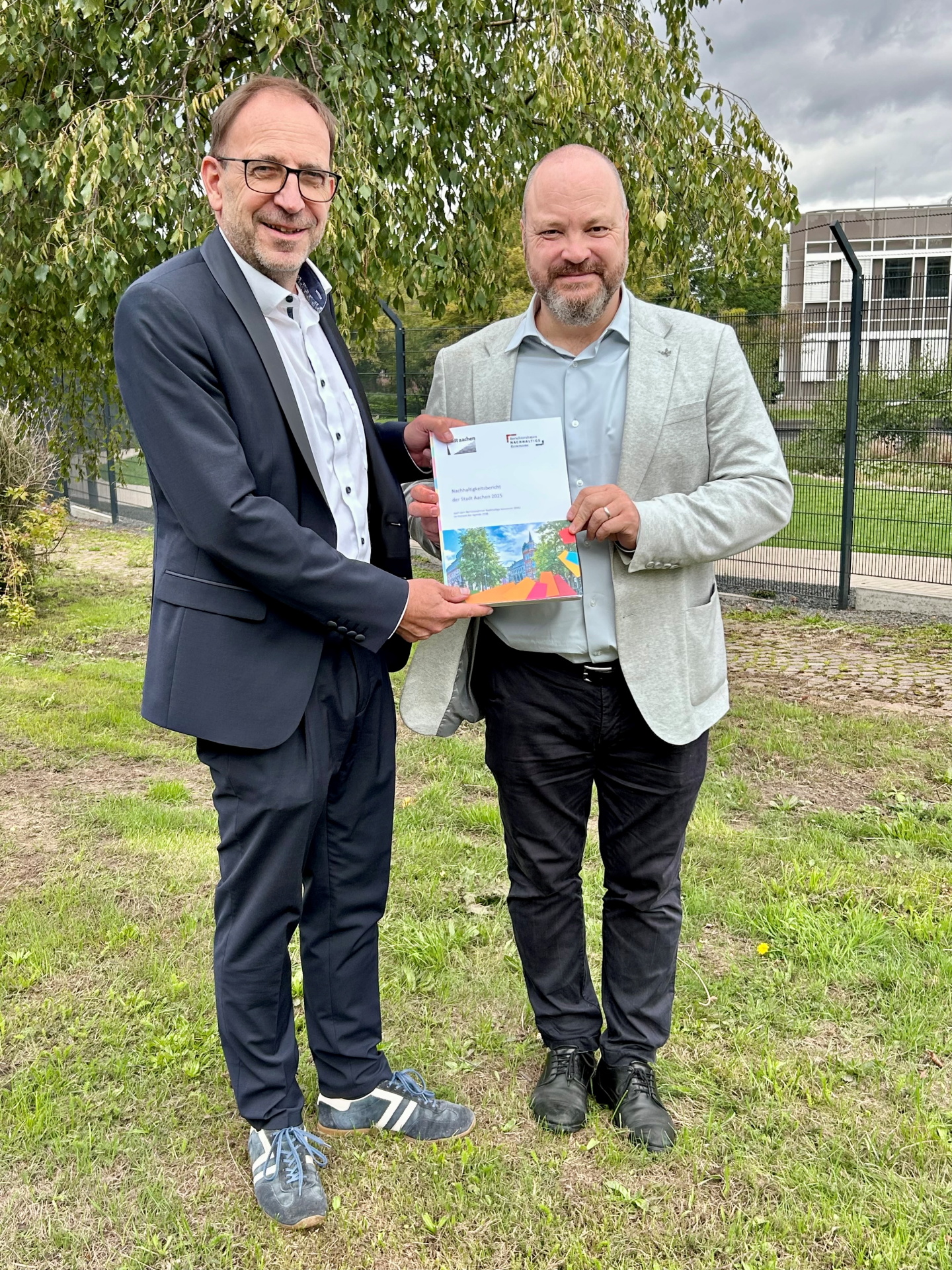
Sustainability has many facets: Aachen’s Director of Environmental Affairs, Heiko Thomas, and Aachen’s Mayor, Dr. Michael Ziemons, present the city’s first citywide sustainability report (from left).
You can subscribe to our RSS feed for our press releases here https://www.aachen.de/rss-feed-pressemitteilungen/rss.xml