125 Years of Statistics for Aachen: On the Development of Settlements and Population in the City of Aachen
“Gentlemen will recall that two opposing camps have long since formed between Aachen and Burtscheid regarding the issue of incorporation (…). The issue has caused a tremendous stir in Aachen and Burtscheid, particularly during Carnival. There have been some lighthearted pranks that, in some instances, have led to quite heated situations.”
Theodor Mooren, member of the Center Party in the Prussian State Parliament, on the vote on the Aachen-Burtscheid Act on March 26, 1897.
In: Aachener Anzeiger, March 28, 1897
Since the late 19th century, the city of Aachen has undergone a massive—and by no means uncontroversial—transformation from a small, industrial town into a sprawling, science-oriented metropolis. In 1890, Aachen surpassed the historic milestone of 100,000 residents for the first time, thereby officially attaining the status of a major city. At that time, the city’s area—approximately 30.5 km²—was still very compact compared to today. (Fig. 1)
Incorporations, World War II – Growth in
Phases Urban growth in the 20th century occurred in phases, driven primarily by legal mergers. As early as the turn of the century, the first significant annexations—including the historic spa town of Burtscheid (1897, approx. 16,000 residents) and Forst (1906, approx. 7,000 residents)—expanded the city’s territory. After a dramatic, war-induced decline to just 11,139 remaining residents in October 1944 (Battle of Aachen), the population rebounded rapidly as residents returned, surpassing the 100,000 mark again as early as December 1945. By 1971, the population had risen steadily to over 175,000 people (Fig. 3)
“Aachen Act”: Incorporation of Seven Surrounding
Areas The most historically significant change occurred on January 1, 1972, when the so-called “Aachen Act” on municipal reorganization went into effect. With the incorporation of seven surrounding municipalities (Brand, Eilendorf, Haaren, Kornelimünster, Laurensberg, Richterich, and Walheim), Aachen’s municipal area suddenly expanded to its current size of 160.85 km² (Fig. 2). At the same time, the official population surged by approximately 63,000 people to about 240,000 residents.
However, as had been the case during the discussions regarding the incorporation of Burtscheid, this reorganization was marked by heated, contentious debates and local resistance. In the decades that followed, growth stabilized at a high level, strongly supported by the steady expansion of the Rheinisch-Westfälische Technische Hochschule (RWTH) and the influx of students. Today, Germany’s westernmost major city has an official population of approximately 262,000 residents, with its total area remaining unchanged.
Historical challenges have been overcome, and new demands and changes await the city of Aachen. Even before the first incorporation in 1897, it was said: “In this case, the goal is not to create a large city, but to bring a large city together into a harmonious whole in the interest of all.” (Theodor Mooren, March 26, 1897)
125 Years – A Journey Through the Statistics
: The Statistics Office team is celebrating this anniversary year—in keeping with its mission—with a journey through many interesting and curious facts, figures, and data about the Imperial City. Topics range from population trends and changes in land area to attendance figures for Alemannia’s home games. Through August 2027, the City of Aachen will publish additional installments of this series at regular intervals on aachen.de/statistik.
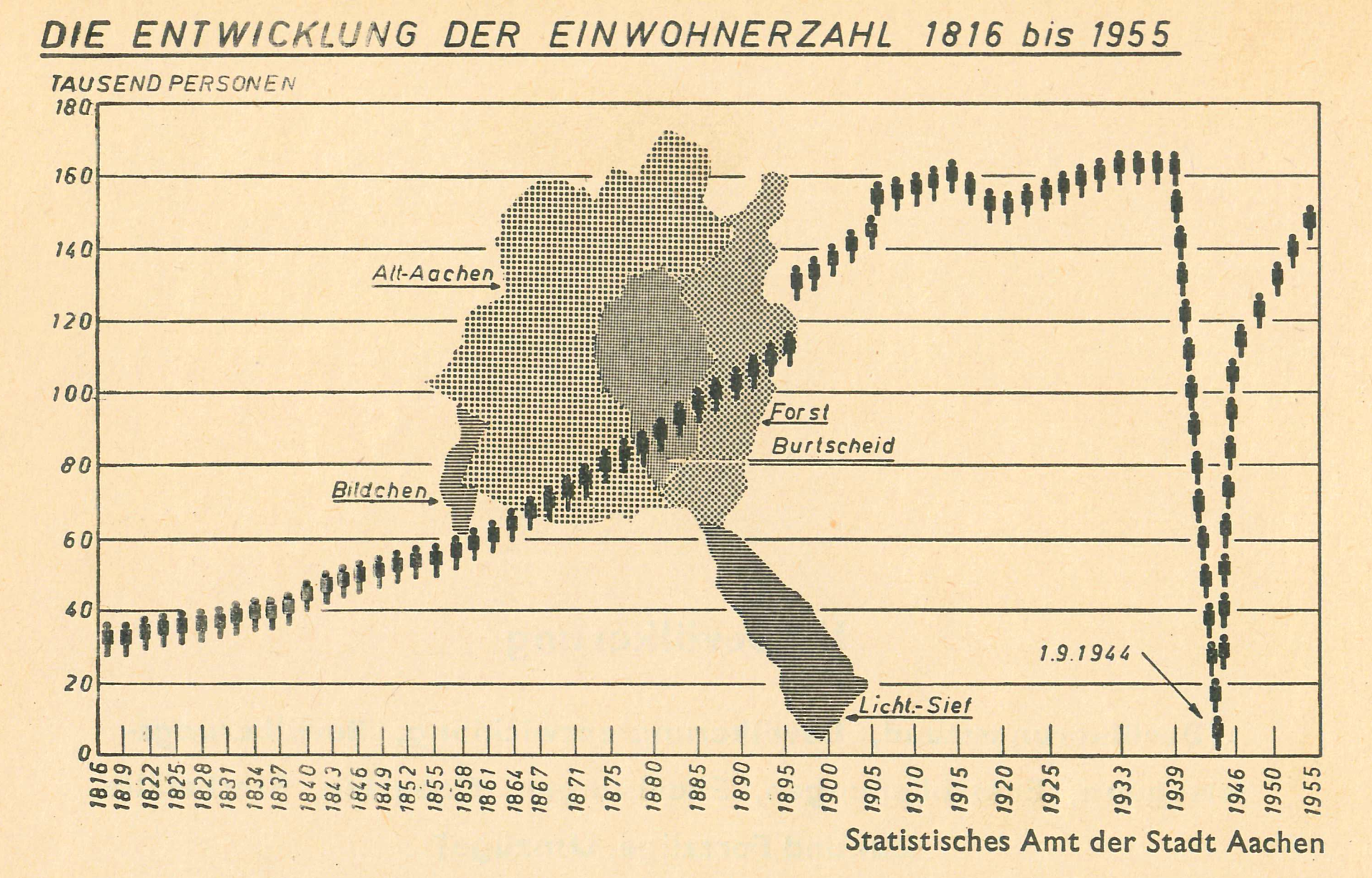
Population Trends from 1816 to 1965.
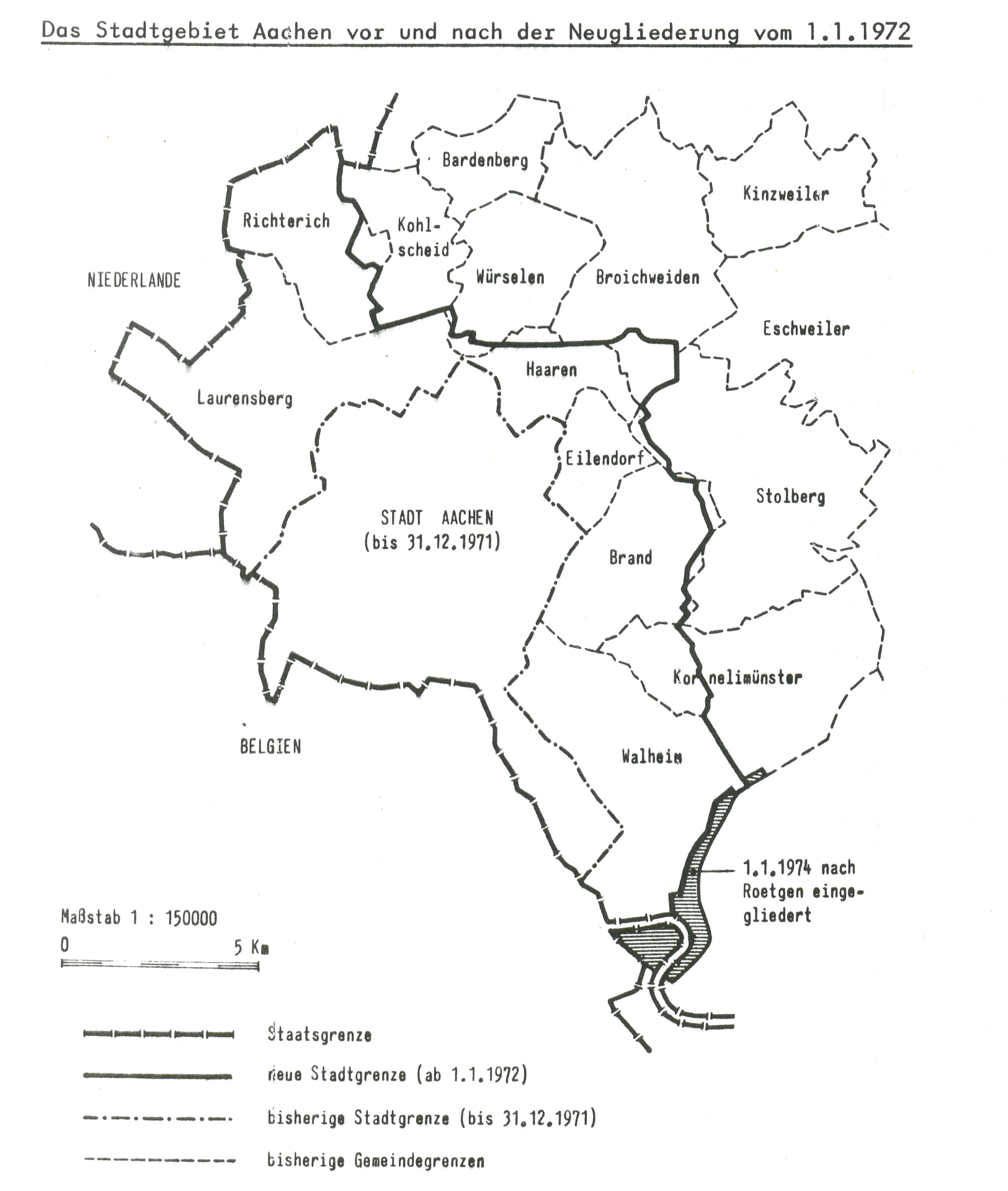
Map of the Aachen metropolitan area following the 1972 reorganization.
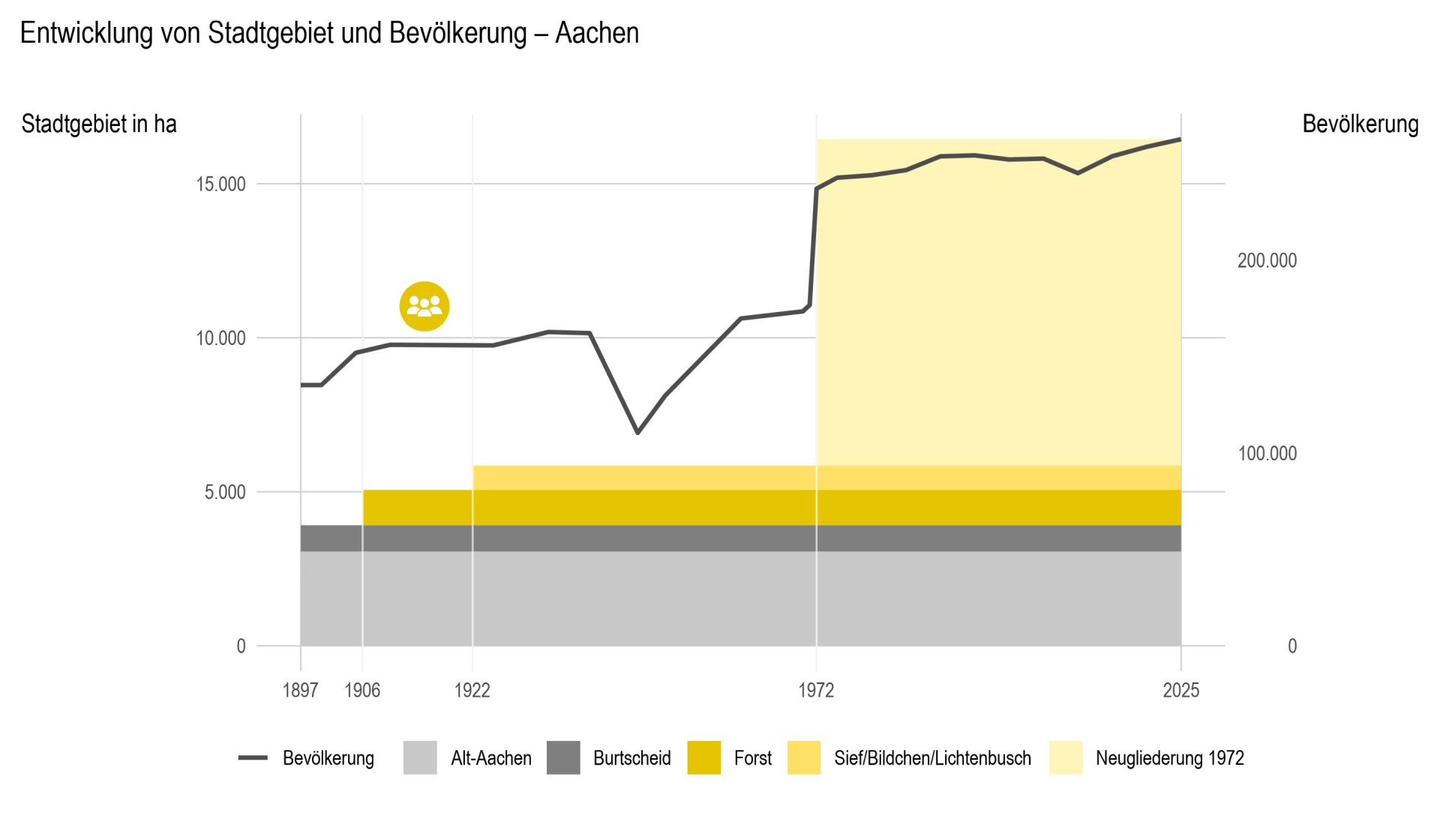
Population trends in the city of Aachen from 1897 to 2025.
You can subscribe to our RSS feed for our press releases here https://www.aachen.de/rss-feed-pressemitteilungen/rss.xml