Challenges of Cross-Border Mobility: Annual Conference of Passenger Advisory Boards Held in Aachen
About 50 representatives from 32 passenger advisory boards gathered in Aachen on October 9 and 10 for their annual conference. Titled “Overcoming Boundaries,” the event took place in North Rhine-Westphalia for the first time. It was hosted by the Aachen Passenger Advisory Board and the City of Aachen.
The conference focused on the unique challenges facing local public transportation in the tri-border region between Germany, Belgium, and the Netherlands. Expert presentations and case studies demonstrated the complexity of planning and coordinating cross-border bus and rail connections and highlighted the solutions that emerge from cross-border cooperation.
Three-Country Train: Overcoming
Borders Together Thomas Clemens, Business Development Manager at Arriva Nederland, presented the Three-Country Train (“Drielandentrein”) project and the challenges associated with its implementation. Differing jurisdictions and structures among national authorities, varying power and train control systems, and complex fare issues are among the key challenges facing cross-border rail transport.
A key prerequisite for the project’s success, he said, is collaboration across linguistic and cultural boundaries. “One important lesson learned from practical experience was, above all, the need to build trust in order to successfully implement the international project and bring it into productive use despite various linguistic and cultural differences,” Clemens explained.
Dr. Kathrin Driessen of Aachen’s Straßenbahn und Energieversorgungs-AG (ASEAG) and Hanna Kroll of the Aachen Transport Association (AVV) provided further insights into mobility planning in the Rhine-Meuse Euregio. Their presentations shed light on the planning and coordination of mobility services in the cross-border region.
David van Looy, a public transit planner at the Darmstadt-based transit agency HEAG mobilo, drew on his professional experience to discuss the unique characteristics of public transit in Belgium. He focused in particular on linguistic diversity and regionally varying interests. In his presentation, he also drew an insightful comparison between the transportation systems in Belgium and Germany.
Innovative Approaches for Tomorrow’s
Local Transit Research also provided impetus for the discussion. Professor Dr. Christian Schindler from the Institute for Rail Vehicles at RWTH Aachen University presented the “Aachener Rail Shuttle” research project. The goal of the project is to deploy smaller, more cost-effective, battery-electric vehicles on existing or reactivated rail lines. This is intended to enable attractive public transportation options even in sparsely populated areas.
Aachen and the Euregio as Hosts
In addition to professional exchanges, the supporting program offered an opportunity to get to know Aachen and its transportation infrastructure better. Participants toured the ASEAG depot, explored the city’s history, and visited the Melaten university campus. An excursion to the Belgian city of Liège rounded out the program. A new light rail system is scheduled to begin operation there in April 2025.
Moritz Weber, spokesperson for the Aachen Passenger Advisory Board, offered a positive assessment: “The conference allowed us to shed light on specific challenges facing the Euregio Rhine-Meuse border region and to highlight promising solutions from research and our neighboring countries. We were very pleased with the high level of interest. It encourages us to continue breaking down barriers—whether in public transit fares, transportation services, or the responsibilities for bus and rail transit.”
Dr. Kristine Schaal, a member of the Frankfurt Passenger Advisory Board’s spokesperson team and part of the network’s five-person organizing team, also emphasized the importance of sharing experiences: “A key focus of the conferences in recent years has always been discussing how to address the various—yet often similar—problems at the local level. Aachen built on this proven formula. By focusing on transportation options beyond Germany’s borders as well as innovative examples from current research, the conference program struck a chord. The fact that there were over 50 participants alone speaks to that.”
Next Network Conference in the Rhine-Main Region
The next conference of the nationwide network of passenger advisory boards is scheduled for fall 2027 in the Rhine-Main region. It will be hosted by the Rhine-Main Transport Association (RMV) and its passenger advisory board.The network has been in existence since 2015 and offers volunteer passenger advisory board members from all over Germany a platform to exchange experiences, discuss common challenges, and provide ideas for the further development of public transit.
For more information about the conference in Aachen and the nationwide network of passenger advisory boards, visit: www.fahrgastbeiräte.de.
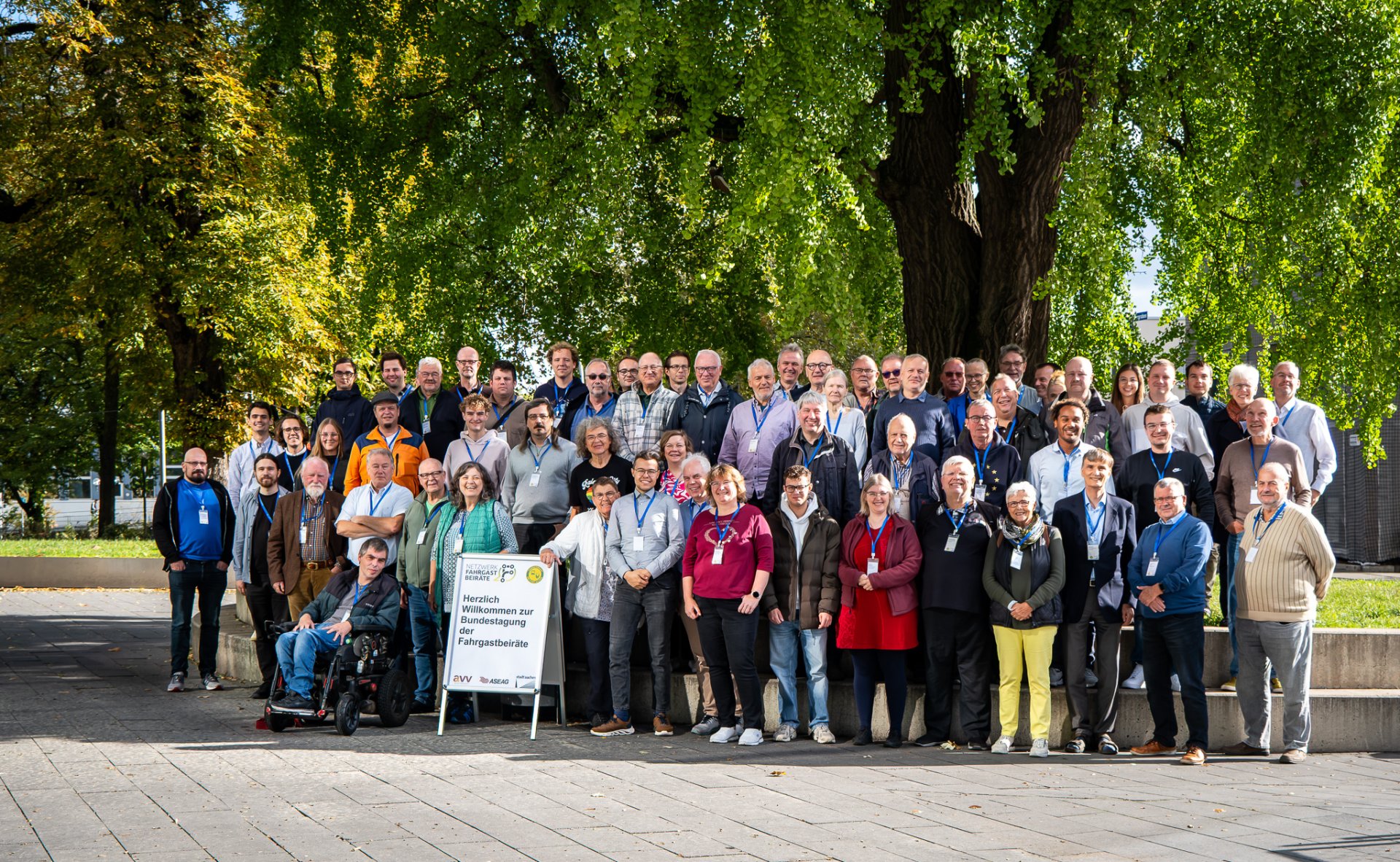
About 50 representatives from 32 passenger advisory boards gathered in Aachen on October 9 and 10 for their annual conference
You can subscribe to our RSS feed for our press releases here https://www.aachen.de/rss-feed-pressemitteilungen/rss.xml