The horse. Three museums. Exhibitions start in Aachen
The Horse. Three Museums Joint opening: Free admission - and all day in the museums.
Aachen in horse fever! Three museums, one theme: the horse. In the "Year of the Horse" and on the occasion of the CHIO and the 2026 World Equestrian Games, the Suermondt-Ludwig-Museum is showing masterpieces from Dürer to Goya, the Centre Charlemagne photos from 100 years of CHIO history and the Ludwig Forum two short films on the subject of man and horse. "All those who want to approach the subject of horses in an artistic way in the year of the World Equestrian Games in Aachen will be offered real highlights in the museums," emphasizes Lord Mayor Dr. Michael Ziemons.
|
The happiness of this earth. Dürer, Rubens, Goya: Horses in art Special exhibition Suermondt-Ludwig-Museum Aachen There are few animals that have become as deeply inscribed in our cultural memory as the horse. It carried emperors and kings, pulled plows and cannons, accompanied saints and heroes, became a projection screen for power, freedom, longing - and not least human cruelty. Hardly any other living creature moves so naturally between myth and everyday life, between representation and intimacy. With the exhibition "The Happiness of this Earth. Dürer, Rubens, Goya: Horses in Art", the Suermondt-Ludwig-Museum is dedicating an art and cultural history show comprising around 140 exhibits to this fascinating relationship. "In this exhibition, we are unfolding a panorama that extends from antiquity to the present day," says curator Wibke Birth. The occasion could hardly be more fitting. While Aachen becomes the international center of equestrian sport with the CHIO in May and the 2026 World Equestrian Games in August, the museum looks at the long cultural lines behind this present. Where top sporting achievements are celebrated today, a narrative begins that stretches back thousands of years. Hardly any other animal has had such a lasting influence on the relationship between man, power, work, war, religion and leisure over the millennia as the horse. The exhibition shows the horse as a prestigious companion of rulers and aristocrats, as an indispensable worker in agriculture and transportation, as a symbol of power and rule and as a partner in sport and leisure. At the same time, the animal is also viewed critically as a symbol of suffering, violence and excessive emotions. Using sculptures, paintings, prints and sculptures, the exhibition at the SLM spans an arc from ancient depictions to mythological and religious imagery through to contemporary positions. Works by artists such as Albrecht Dürer, Peter Paul Rubens, Philips Wouwerman, Francisco de Goya, Max Klinger, Pablo Picasso, Max Liebermann and Berlinde De Bruyckere make it clear how multifaceted the horse appears in art history - as hero, victim, symbol of power, mythological creature and mirror of social developments. Special emphasis is placed on the sustainable exhibition concept. The focus is predominantly on works from the Suermondt-Ludwig Museum's own collection, the potential of which has hardly been tapped into in this context to date. "We are showing many works from our depot that have rarely been exhibited," explains curator Sarvenaz Ayooghi. This not only reveals a new aspect of the collection, but also ensures that transport and loan requests are handled in a resource-friendly manner. These holdings are complemented by selected loans from German, Belgian and Dutch museums and private collections. In terms of content, the presentation also deliberately sets regional accents. The famous Aachen founding legend of Charlemagne and his horse, which discovered the hot springs, directly links the city's history with the exhibition theme. The history of field horses, court stables, horse keeping and the bourgeois leisure culture of the 19th century also show the close connection between Aachen and the horse. The city of Aachen not only owes a rich art collection to the Suermondt family. It also plays a central role in the development of equestrian sport in Aachen. Henry Suermondt was a successful breeder and rider (German men's champion in 1887/88). His stepbrother Otto was the most successful men's rider in Germany with over 1200 races and nine titles. Together they campaigned for horse racing in Aachen and founded the Aachener Rennverein in 1870, which organized the races. With its complexity, the exhibition is deliberately aimed at a wide audience: not only those interested in art history, but also people with a special affinity for horses, families, children and young people, as well as visitors who are closely connected to equestrian sport. The exhibition is accompanied by an extensive program of guided tours, workshops, action days, readings and dialogue-oriented formats. In cooperation with the museum service and equestrian sport experts, new spaces of experience and knowledge will be created that combine art, animal welfare, sport and the emotional relationship between humans and horses. In a creative room, young and old can get creative or browse through horse literature. You can explore the exhibition on your own using a specially designed rally: There is a hands-on booklet for younger children. The museum service offers special educational programs for school classes. Curators: Sarvenaz Ayooghi, Wibke Birth Bilderdownload:
Tradition – Innovation – Emotion. 100 Years of CHIO:
To mark the 100th anniversary of the CHIO Aachen, the Centre Charlemagne is presenting an extensive photo exhibition as part of the "Year of the Horse", which brings the history of the legendary horse show at the Soers to life. Around 90 photographs document the development of the CHIO since 1925 - from the first riding, jumping and driving competitions to today's World Equestrian Festival with the five disciplines of jumping, dressage, driving, vaulting and eventing. "The CHIO is firmly anchored in the consciousness of the people of Aachen. However, it is sometimes forgotten that this tournament is something very special, which cannot be found anywhere else in this form," explains Prof. Frank Pohle, curator of the exhibition and Director of the Route Charlemagne. The exhibition in the foyer of the Centre Charlemagne provides impressive insights behind the scenes and shows not only top sporting performances and emotional award ceremonies, but also the close connection between riders, horses and audience. Outstanding moments such as the father-son duel between Nelson and Rodrigo Pessoa, Ratina Z's last Grand Prix and legendary performances by Hans Günter Winkler, Isabell Werth and Ludger Beerbaum are revealed, as are the often hidden processes of an international tournament - from stable and groom work to vet checks and precise organization. In addition, the exhibition highlights the social and political Curated by: Dr. Doris Beaujean, Prof. Dr. Frank Pohle Download Bildmaterial:
Centaur – Man and Horse. A Film To coincide with the World Equestrian Games, the Ludwig Forum is presenting two short films in the main exhibition hall that explore the theme of humans and horses in very different ways. “For the first time, we have created a cinema-like setting in the center of the exhibition hall,” says curator Esther Bohle. The title comes from the film of the same name, *Centaur* (2020), by the German-Iranian artist and filmmaker Yalda Afsah (*1983*), who explores the complex structures of human-animal relationships in a compelling way. Navigating the line between care and control, the film offers intense insights into the microcosm of horse dressage. In a humorous and poetic way, the Swiss artist couple Marianne Halter (*1970) & Mario Marchisella (*1972) approach the theme in *Horses Across the Meadow* (2013). The short film depicts a breakneck ride on a bicycle and plays with the disjunction between image and sound. Quote Boehle Curator: Esther Boehle
|
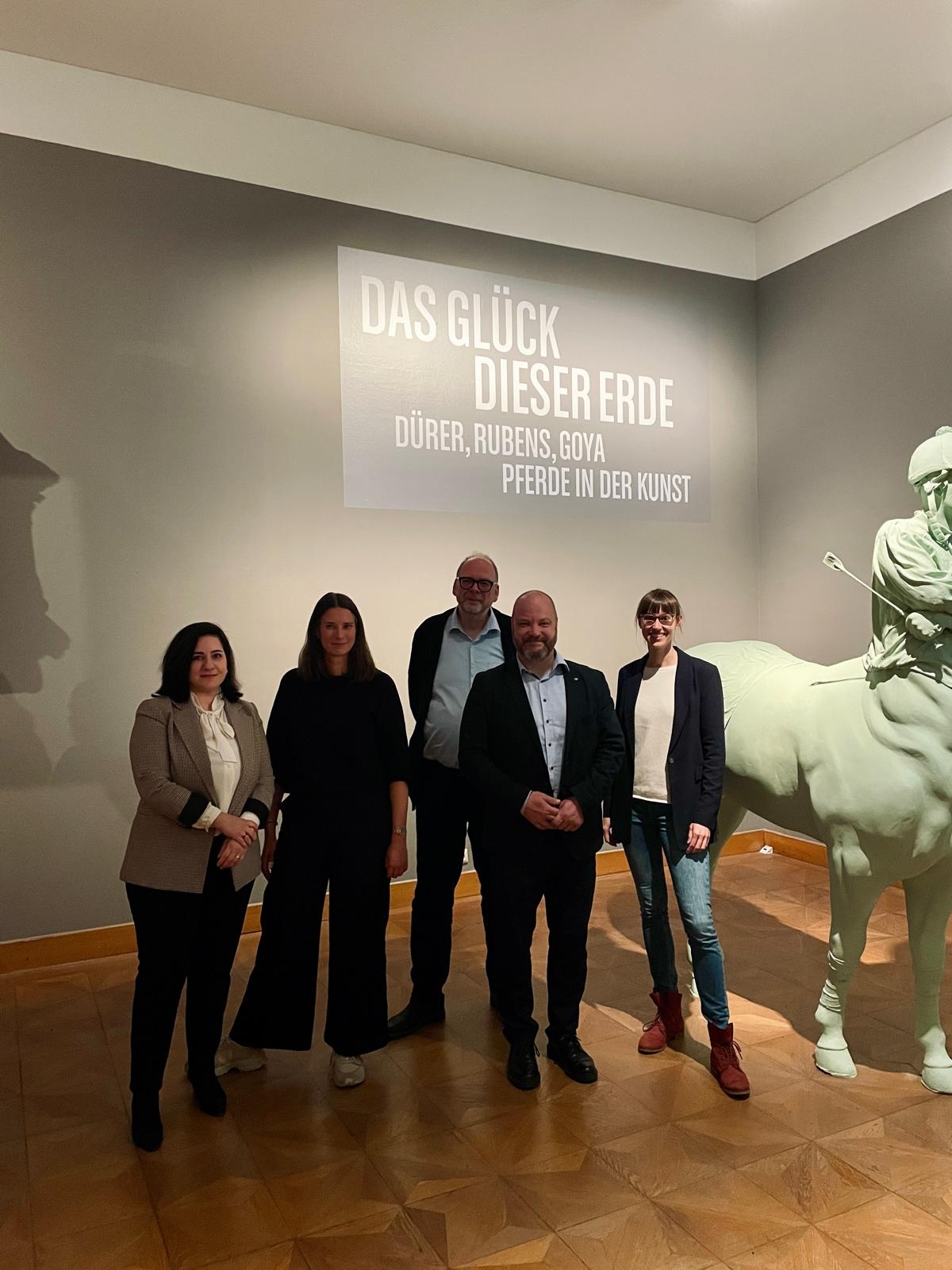
Exhibitions in the horse year start on May 17 in three museums
You can subscribe to our RSS feed for our press releases here https://www.aachen.de/rss-feed-pressemitteilungen/rss.xml