After her release from prison: Maria Kalesnikava received the Charlemagne Prize 2022 in person in Aachen
In a special ceremony today, civil rights activist Maria Kalesnikava was personally presented with the International Charlemagne Prize of Aachen, which was awarded to her in absentia in 2022, by her sister Tatsiana Khomich. The Belarusian opposition activist and musician was released from political prison in Belarus in December 2025. In Aachen's Coronation Hall, representatives from politics, civil society and culture paid tribute to her commitment to democracy, human rights and a free Belarus.
Aachen's Lord Mayor Dr. Michael Ziemons opened the ceremony with a welcome address and a laudatory speech for Maria Kalesnikava. He emphasized her extraordinary courage and unwavering stance in the fight for freedom and the rule of law: "Maria Kalesnikava has paid a high price for her commitment to freedom and democracy: more than 600 days in prison without contact to family or legal counsel, solitary confinement, denied medical care and repeated transfers to punishment cells. And yet, in the courtroom in September 2021, when she received the verdict and stood behind bars as if in a cage, she made a gesture that went far beyond that moment: with her hands cuffed, she formed a heart. This heart has become a symbol - for Belarus, for Europe and for the strength of a human will that does not bow to injustice. Mrs. Kalesnikava, it was your heart. But it beats for all of us."
Presentation of the International Charlemagne Prize of Aachen
The symbolic presentation of the Charlemagne Prize was at the heart of the festive event. Maria Kalesnikava's sister, Tatsiana Khomich, had accepted the award on behalf of her sister in 2022 and now ceremoniously presented it to the 2022 Charlemagne Prize winner. Afterwards, Kalesnikava signed the Golden Book of the City of Aachen.
In her speech, Kalesnikava thanked her sister Tatsiana Khomich for her commitment and tireless efforts and praised the support from Germany and from all over Europe as an encouraging signal for all those who stand up for freedom and human dignity in Belarus and elsewhere: "This prize stands for an idea: for European unity, solidarity and freedom. For me - as a Belarusian and former political prisoner - these words have a very personal meaning. This prize does not only belong to me. It belongs to all those who believed, fought and did not give up. [...] I thank Germany - the government and the German people - for the opportunity to live and work here in safety. For someone who has just come out of prison, that means more than words can express. [...] Democracy thrives on people speaking. That they take responsibility. That they stand up for each other. Sometimes the voice of aggression seems the loudest - the voice of hatred, the voice of fear. That is a deception. [...] Our voices must be stronger. The voice of freedom. The voice of dignity. The voice of solidarity."
Armin Laschet, the new Chairman of the Charlemagne Prize Board of Directors and Chairman of the Foreign Affairs Committee in the Bundestag, presented Tatsiana Khomich with a Charlemagne Prize plaque specially designed for the occasion. This highlighted her personal commitment as the voice of her imprisoned sister and as a representative of Belarusian civil society. "We must not forget Belarus in all the crises of these days. Tatsiana Khomich has been committed to this for many years. Belarus is on our doorstep, not America's. Europe must finally take on a strong diplomatic role in the world. This also includes opening up its own diplomatic channels to Belarus for human rights and freedom with self-confidence and determination," said Laschet.
Political and musical framework and cultural perspective from Belarus
The ceremony was framed by a round table discussion with Kalesnikava, the former Minister of State for Culture and the Media, Claudia Roth, and the former State Secretary Thomas Rachel, moderated by the former ZDF presenter Claus Kleber. The discussion shed light on the situation in Belarus, Kalesnikava's personal history and the role of the European public and political sponsorships as part of the German Bundestag's "Parliamentarians Protect Parliamentarians" program. Since 2003, this program has supported threatened foreign members of parliament and human rights defenders through international solidarity, public attention and personal sponsorships. Roth and Rachel had taken over the godparenthood for Kalesnikava during her imprisonment.
The event was musically accompanied by three works by the prominent Belarusian composer and organist Olga Podgaiskaya, which she performed on the grand piano together with the Five-Storey Ensemble, which she directs. Her compositions and the ensemble's contributions opened up an impressive artistic perspective on the cultural diversity and creative potential of Belarusian society.
Maria Kalesnikava
Maria Kalesnikava, born in Minsk in 1982, completed a soloist degree in flute in her home city and then studied early and contemporary music in Stuttgart. Before her arrest, she was most recently artistic director of the cultural center "OK-16" in Minsk.
In 2020, Kalesnikava became one of the most important voices of the democratic movement in Belarus. Together with Svetlana Tikhanovskaya and Veronika Tsepkalo, she formed an internationally acclaimed trio of women in the resistance against the long-time ruler Alexander Lukashenko. The three were jointly awarded the Charlemagne Prize in 2022 for their commitment.
After Kalesnikava refused to go into exile abroad, she was arrested during the protest movement in September 2020 and later sentenced to eleven years in prison. Internationally, she was considered a political prisoner and had to suffer under difficult prison conditions. In December 2025, after negotiations between the Belarusian regime and a US envoy, Kalesnikava was pardoned along with other opposition activists. Shortly afterwards, she traveled to Germany at the invitation of German authorities.
About the International Charlemagne Prize of Aachen
The International Charlemagne Prize of Aachen is regarded as the most important European prize for European unity. It has been awarded since 1950 to individuals and institutions that have rendered outstanding services to the unification of Europe. Last year, the President of the European Commission, Ursula von der Leyen, received the Charlemagne Prize. This year's Charlemagne Prize winner is the former Italian Prime Minister Mario Draghi. He will be presented with the Charlemagne Prize on May 14, 2026 in Aachen's Coronation Hall in recognition of his current impetus and his outstanding life's work in the service of European competitiveness. Draghi is the sixth Italian laureate in the 76-year history of the Charlemagne Prize.
Since 2025, the International Charlemagne Prize of Aachen has awarded an annual project prize money of one million euros to charitable pro-European initiatives. The funding - made possible by the charitable foundation of the Aachen citizens and entrepreneurs Dr. Eckhard Schulz and Dr. rer. nat. Stefanie Schäfer-Schulz - is awarded on the recommendation of the respective Charlemagne Prize winners. The aim is to strengthen pro-European commitment, emphasize common values and make the European idea visible beyond Aachen by effectively supporting new and existing projects throughout Europe.
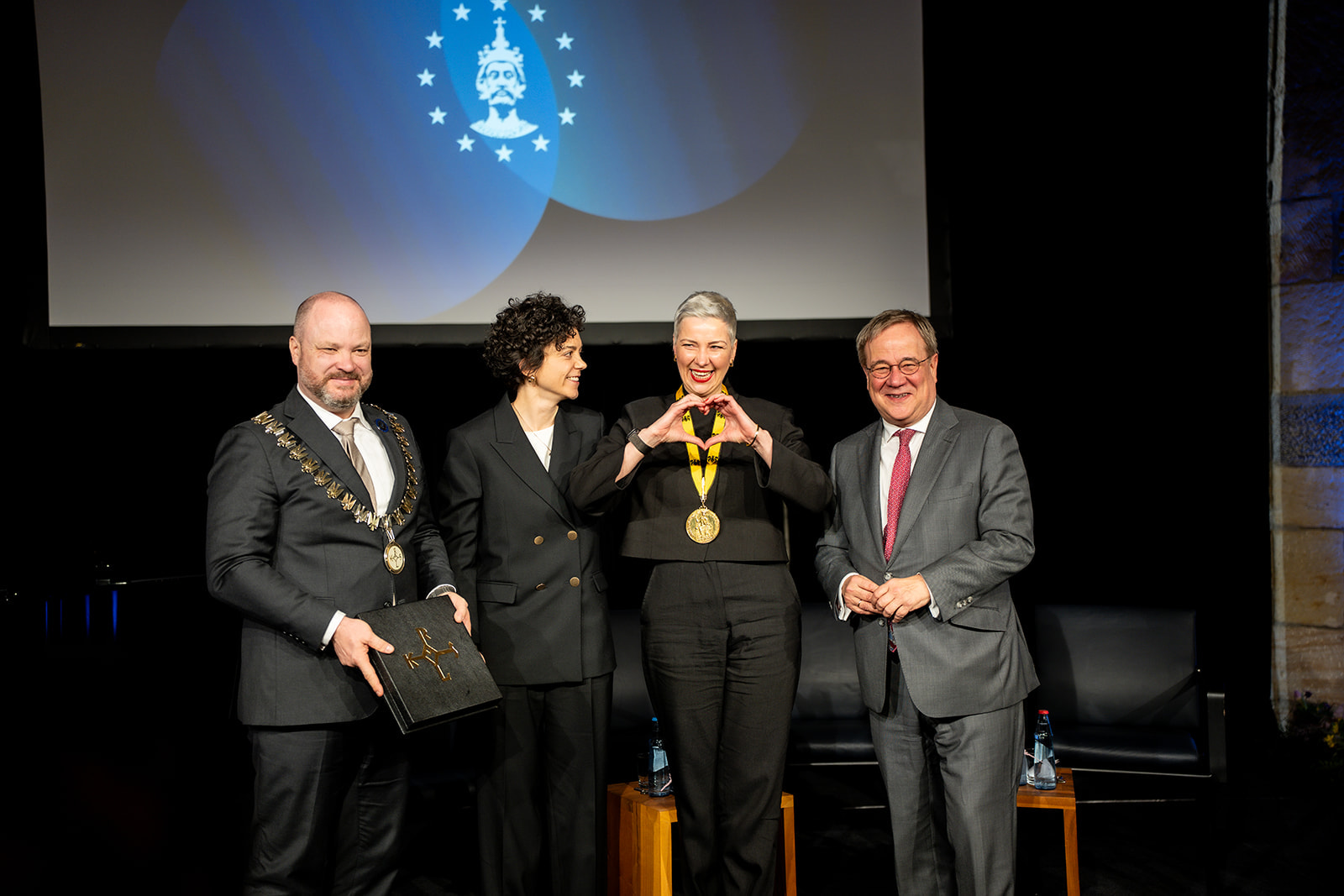
A sign of freedom and solidarity: Lord Mayor Dr. Michael Ziemons, the sister of Charlemagne Prize winner Tatsiana Khomich, Charlemagne Prize winner 2022 Maria Kalesnikava and Chairman of the Charlemagne Prize Board of Directors Armin Laschet (from left).
You can subscribe to our RSS feed for our press releases here https://www.aachen.de/rss-feed-pressemitteilungen/rss.xml