FLIP Meadows: A Complete Success for Everyone—Especially Biodiversity
- FLIP Meadows: A typical meadow type in the region is the smooth oatgrass meadow, a plant community that is now endangered but has been reintroduced in various areas.
- Land restoration, increased biodiversity, scientific findings, education, and public awareness: these various aspects are covered.
- The meadows in public spaces will remain in place after the project is completed and will be maintained by the city’s public works department; the field trips for schools will also continue.
Flip, the friendly and clever grasshopper from the children’s book “Maya the Bee,” is certainly the first image that comes to mind when you hear the name of the FLIP project. “Promoting quality of life for insects and people through perfect meadow environments”—this is the full title and goal of the joint project between RWTH Aachen University, the City of Aachen, and the Aachen Urban Region, which aims to promote biodiversity in specific areas. To this end, the FLIP partners have ecologically enhanced intensively used lawns in inner-city areas, field margins, and agricultural land in the city and Aachen metropolitan region to establish permanently species-rich meadows. The project, part of the federal “Biological Diversity” program, is also intended to offer expert advice. After six years, the project is now officially coming to an end. “I’ve been asked whether we’re actually saving biodiversity with these areas. Yes, to a certain extent,” says Heiko Thomas, Aachen’s Deputy Mayor for Climate and Environment, Municipal Services, and Buildings, who is convinced of FLIP and its impact: “It is a project that demonstrates how biodiversity can function in the city.”
More than a third of all native ferns and flowering plants—over 1,000 species—are found primarily in grasslands. In fact, around 40 percent of Germany’s endangered species are found mainly there. However, species-rich grasslands are becoming increasingly rare here. These areas are shrinking due to intensive use, fertilization, pesticide application, and land consolidation. “These meadows are dying in Germany,” says Prof. Dr. Martina Roß-Nickoll, project leader and coordinator at the Institute for Environmental Research, RWTH Aachen University. As the diversity of plants in meadows and pastures declines, so do the food sources and habitats for many insects. Eight to ten animal species per plant species, mainly insects, are possible. Because some plants and insects are so specialized and interdependent, the disappearance of a plant species can directly lead to the extinction of an insect species.
Native smooth oatgrass meadows
: This is where FLIP stepped in. A typical meadow type in the region is the smooth oatgrass meadow, a plant community that is now endangered and provides a valuable habitat not only for native plants, insects, arachnids, and other small animals such as snails and soil organisms, but also birds and mammals. These meadows have been successfully and permanently restored in and around the city of Aachen, thereby creating more habitat for plants and animals. Through these meadows, the project has created a connection between the city and the surrounding landscape, thereby ensuring habitat connectivity, which is crucial for the preservation of biodiversity. And: “These meadows have a significant impact on the climate. They sequester CO2, store water, and help cool the air at night,” says Prof. Dr. Roß-Nickoll.
FLIP demonstrates how urban green spaces, as well as areas on private properties, at schools, churches, daycare centers, and businesses, can be enhanced in an ecologically sound and site-appropriate manner. Based on project experience, intervention and ongoing maintenance of these areas should be kept to a minimum, making it possible for landowners to continue caring for them even after the project ends without significant time or financial investment. Anika Au, FLIP project manager at the City of Aachen’s Climate and Environment Department, remains enthusiastic about the commitment and enthusiasm of the citizens: “The more people know about these meadows, the more they accept these areas. Over 50 people have sown these FLIP meadows on private land.”
The revitalization of these areas is based on historical land-use concepts for extensive hay production in meadows. Ultimately, the concept should be transferable to other medium-sized cities—adapted to specific regional conditions. The stated goal: not just more colorful flower meadows, but a return to stable, site-specific meadow vegetation typical of the natural landscape, featuring native species.
Facts and Figures on the Meadow AreasThe
facts and figures on the newly created meadow areas are impressive: City departments and farmers have established approximately 17 hectares of municipal and agricultural meadows. A total of 96 individual plots ranging in size from just over 100 square meters to 2.8 hectares at the Hasselholz estate. 500 kilograms of seed, 313 tons of sand, and 46 tons of limestone gravel were applied. In addition, the City of Aachen distributed nearly 72 kilograms of its own seed to private individuals, daycare centers, and schools, resulting in an additional 4.2 hectares of meadows. And 5,500 seed packets were also distributed free of charge.
Meadow Management and Mowing – Best Practices
: Depending on the location, different types of meadows require different management and mowing practices. To preserve species-rich meadows such as the smooth oatgrass meadow, extensive use, mowing two to a maximum of three times a year, and insect-friendly mowing techniques all play a crucial role. Since many meadows in urban areas are very nutrient-rich and have a high biomass, it is important to remove the clippings from the area—that is, not to mulch. In the past, meadows were mowed in a way that was gentler on insects, without highly technical equipment, and were managed in sections and on a rotating basis. A similar effect is achieved with “mosaic mowing,” in which only parts of the meadow are mowed. The meadow then consists of freshly mowed, flowering, and post-flowering areas. This ensures that wildlife always has a food supply and a habitat for hiding, breeding, and overwintering. “The project has enabled us to adapt our fleet accordingly,” explains Michael Blankenheim, project coordinator and implementer at Aachen City Services: “We ask ourselves, do we even need to sow standard lawn grass everywhere?”
Scientific Monitoring and Environmental EducationWith
the Institute for Environmental Research at RWTH Aachen University as one of the three partners, scientific monitoring of the project was naturally a top priority: An ecological monitoring program examined various animal groups—ground beetles, spiders, hoverflies, bees, and bumblebees—to assess the ecological success of the meadow conversion. The project also surveyed the public’s interest in and need for information regarding meadow biodiversity, insects, and insect conservation. In terms of academic teaching, the project led to a total of six courses at two departments at RWTH, resulting in 40 student theses.
Another key aspect of the project was to educate people about insects and the diversity of meadows and to inspire enthusiasm for them, thereby raising awareness of this ecosystem and its vital ecological services. Comprehensive educational and public outreach initiatives at the regional and national levels were designed to foster appreciation for biodiversity in the long term. The project partners jointly developed educational offerings: field trips to off-campus learning sites, educational materials for schools, and professional development for relevant multipliers such as early childhood educators and teachers, as well as lectures and workshops for citizens and the agricultural sector. The meadow excursions organized by the Aachen City Region Education Office alone reached around 5,200 children across more than 220 school classes. Linda Jo Siemon, FLIP project manager at the Aachen City Region Education Office, on the educational materials and school excursions: “The topic of biodiversity is explained there in a child-friendly way and brought to life.” Siemon notes: “There were even children who were initially downright afraid of the meadows and the animals.” Meanwhile, the materials are now being used up to sixth grade and not just in elementary schools.
What remains?
After more than six years, the project is coming to a close—though not entirely. In addition to the scientific findings, publications, and reports, what remains above all are the ecologically valuable meadows—which also have a positive impact on the city’s climate—with their newly introduced plant and animal species, which will continue to be professionally maintained in public spaces by the Aachen municipal services.
A key feature is that the FLIP field trips for elementary schools will continue to be available for booking through the StädteRegion Education Office (www.staedteregion-aachen.de/bildungsbuero). Teaching materials are also available for download there. The Aachen-based Kathy Beys Foundation will take over funding for this educational program starting in 2026. But this also demonstrates FLIP’s lasting success: “All excursion dates for 2026 are already fully booked,” says Siemon from the Education Office. But registration for 2027 is now open.
For more information: www.flip-wiesen.de
Funding
: The FLIP project is funded under the Federal Biodiversity Program by the Federal Agency for Nature Conservation, with funding from the Federal Ministry for the Environment, Climate Action, Nature Conservation, and Nuclear Safety.
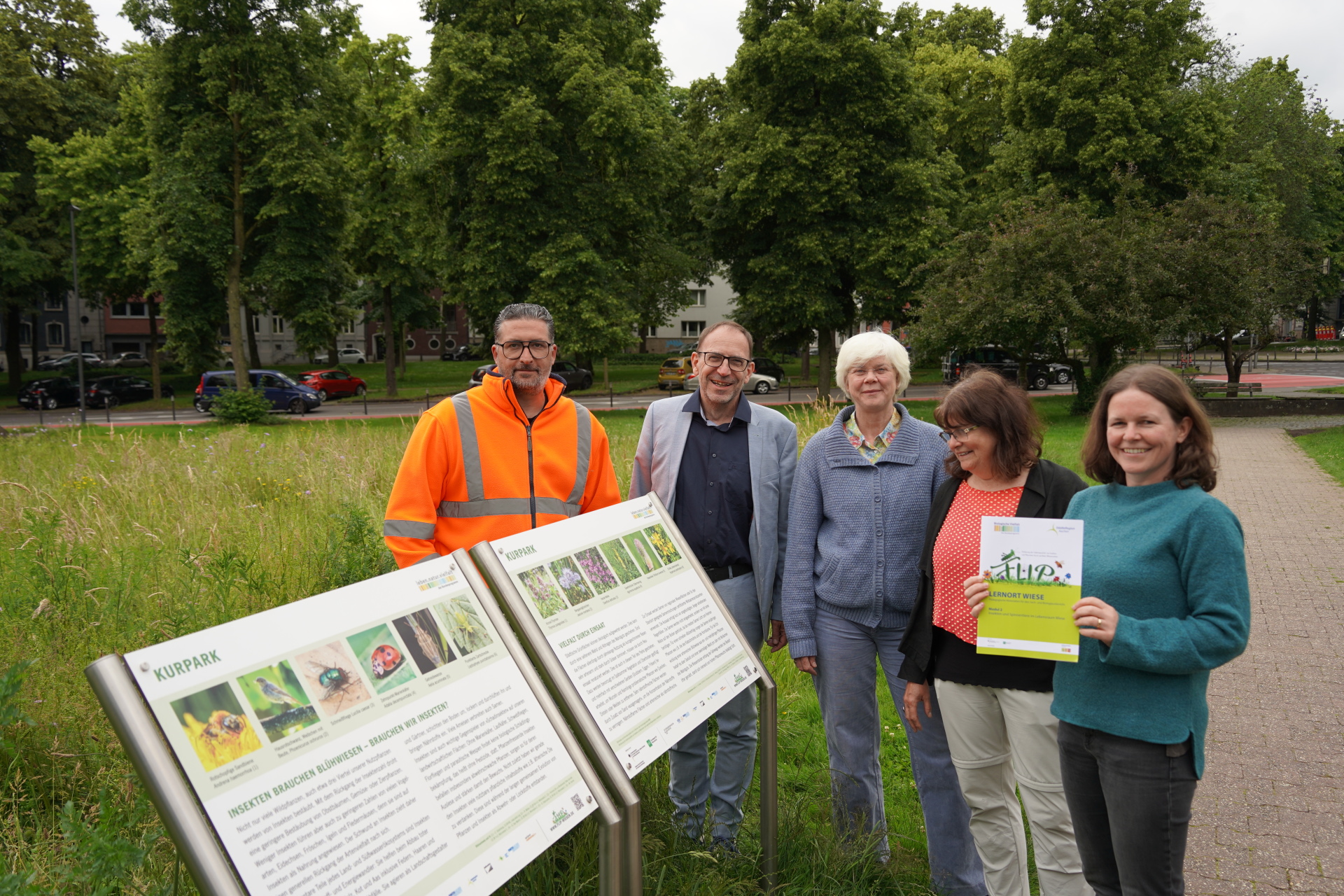
Michael Blankenheim of Aachen City Services, Heiko Thomas, Head of the Environment Department, Anika Au of the City’s Climate and Environment Division, Prof. Dr. Martina Roß-Nickoll of RWTH Aachen University, and Linda Jo Siemon of StädteRegion Aachen have all given the FLIP project a thoroughly positive review.
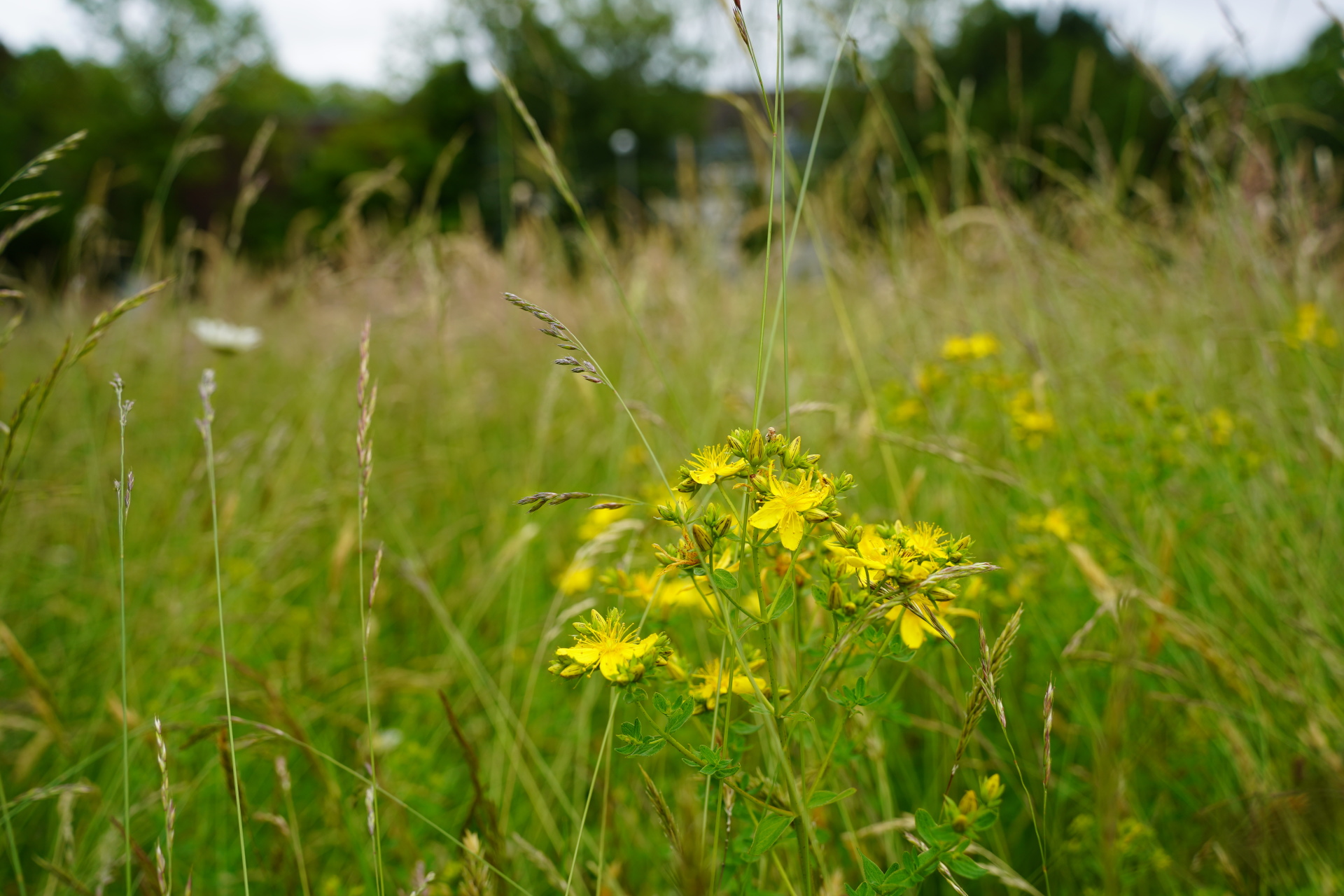
Various tall grasses and flowers, such as St. John’s wort shown here, are part of the FLIP smooth oatgrass meadows—and, of course, smooth oatgrass.
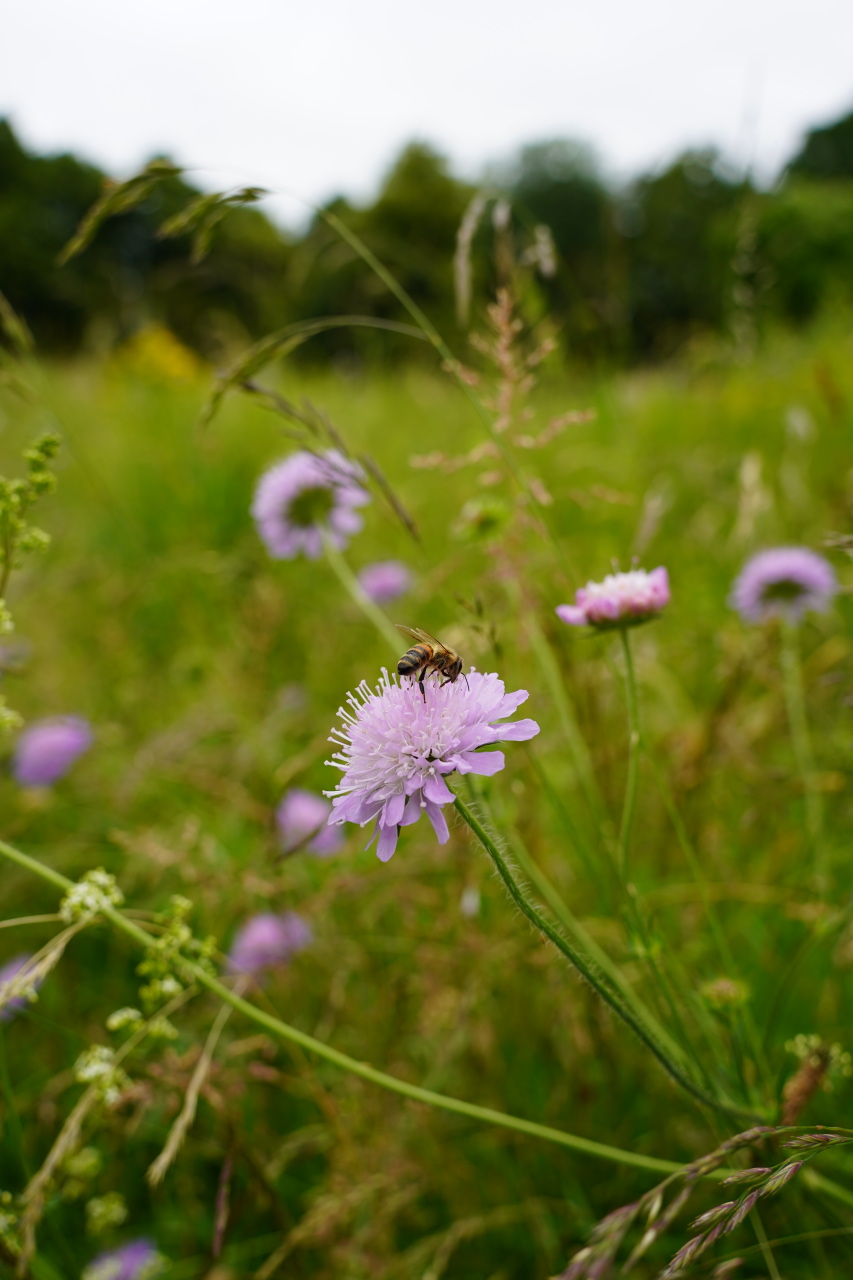
It's buzzing here: Local insects clearly feel right at home in the FLIP meadows.
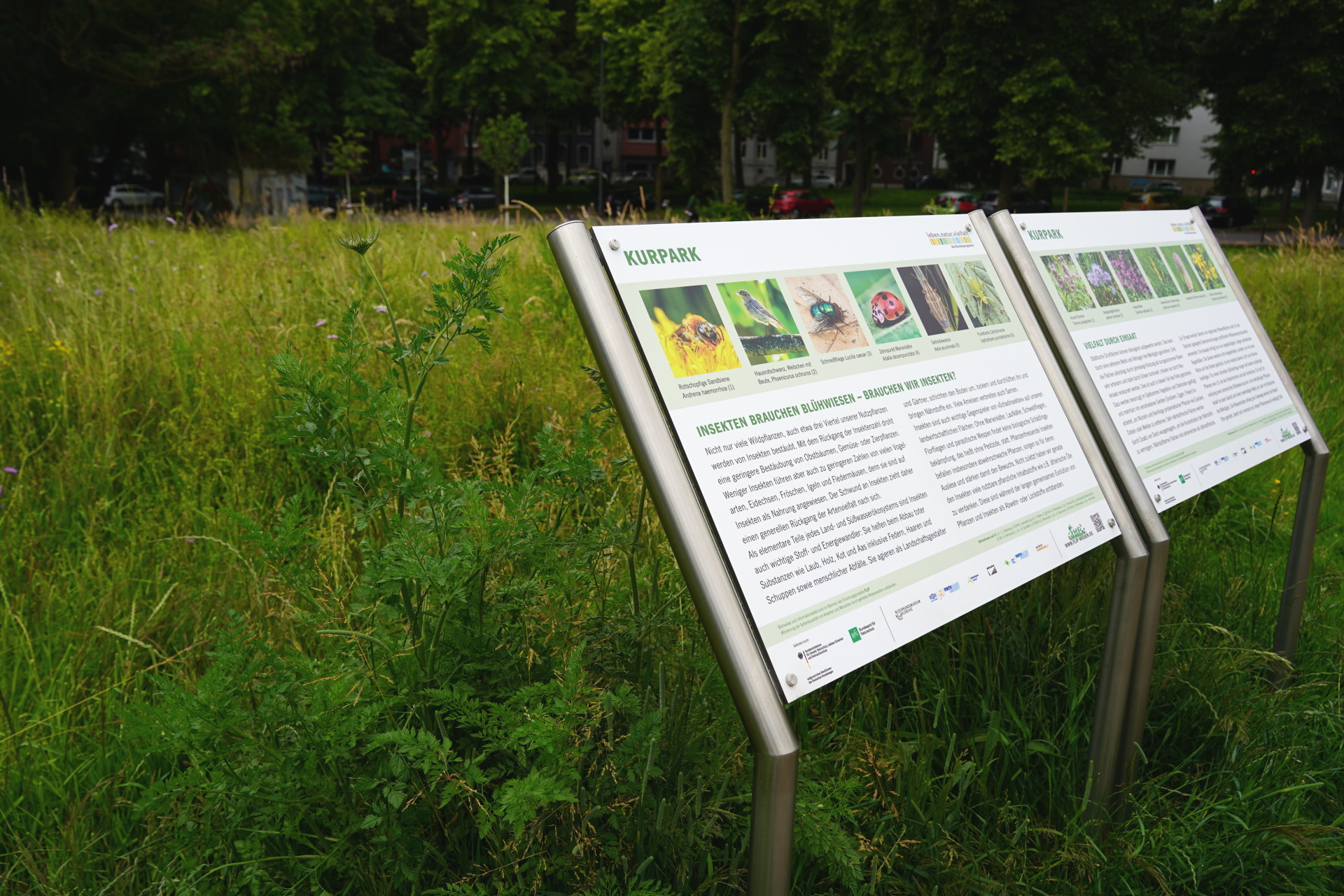
Education leads to greater acceptance: Individual information signs have been installed at over 40 meadows to explain what makes the FLIP meadows special.
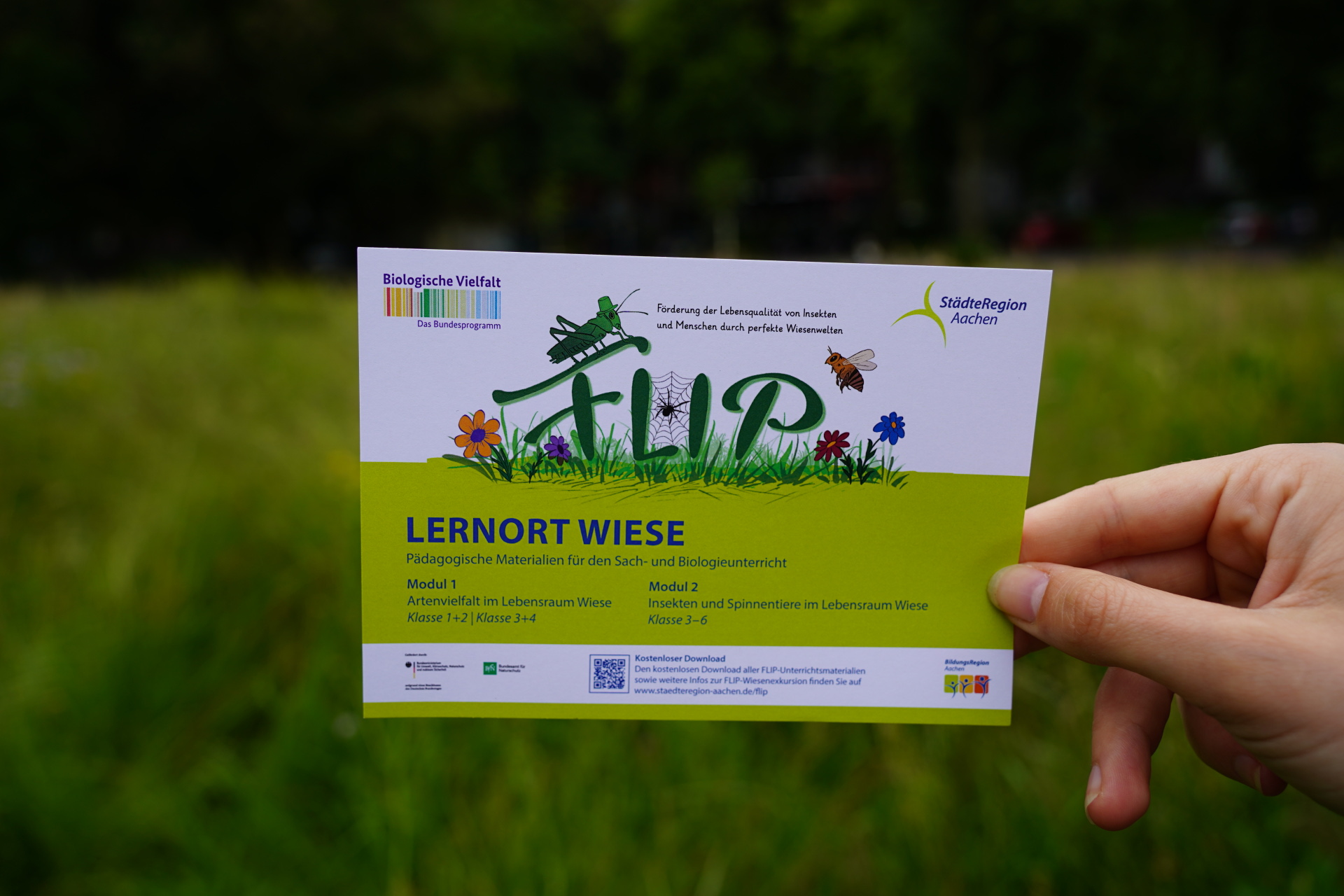
Education as a key aspect of the project: The StädteRegion Education Office provides teaching materials on FLIP.
You can subscribe to our RSS feed for our press releases here https://www.aachen.de/rss-feed-pressemitteilungen/rss.xml