The Archivale of the month January 2026...
- ... shows a restricted zone pass for an Aachen customs officer.
- In 1946, the British military government closed a strip of land about one kilometer wide on the German side of the Dutch and Belgian border in addition to the actual national border. The restricted zone was extended again in 1949 and lifted in 1952.
- Anyone who worked in the exclusion zone but lived outside it received a "temporary worker residence permit for the exclusion zone".
The Aachen City Archive regularly presents interesting items from its stacks as Archive of the Month. The item with a short accompanying text is presented in a display case in the foyer of the city archive on Reichsweg and digitally on the archive's homepage. In January 2026, it shows a restricted zone pass for an Aachen customs officer.
Border smuggling as necessary self-sufficiency and lucrative business
After the Second World War, the borders were closed. Nevertheless, people crossed them en masse and smuggled enormous quantities of consumer goods - partly for self-sufficiency in the face of material hardship, partly as a lucrative business in the immediate social environment, but partly also as a form of organized crime on a supra-regional scale and with enormous profits.
At the beginning of 1946, the British Frontier Control was responsible for monitoring the border. In doing so, it worked together with the German customs authorities, which had initially been dissolved after the end of the Nazi regime and were now gradually being given sovereign powers again.
Protests against the extended restricted zone. Lifting in November 1952
On January 29, 1946, the British military government closed a strip of land about one kilometer wide on the German side of the Dutch and Belgian border in addition to the actual state border. The regulation came into force in February 1945 and meant that several places in what is now Aachen's urban area, such as Lichtenbusch, Vaalserquartier and Horbach, were located in the restricted zone. In May and September 1949, the restricted zone was extended once again and at times included the Aachen city forest. As with other measures to close the border and combat smuggling, this provoked protests, partly because the city's population was deprived of a popular local recreation area in the form of the city forest. After this measure was withdrawn in April 1950, the restricted zone was finally lifted completely on November 20, 1952.
"Temporary Workers Entry Permit to theProhibited Frontier Zone"
Anyone living in the prohibited zone needed a new, bilingual ID card in addition to their identity card, which entitled them to stay at their place of residence but not to cross the border, and could be withdrawn in the event of violations. Those who worked in the prohibited zone but lived outside it were also issued with a "Temporary Workers Entry Permit to the Prohibited Frontier Zone". The permit allowed him to stay in the prohibited zone "from half an hour after sunrise to half an hour before sunset" and forbade him to "remain in any place other than his place of work within the prohibited zone". This was accompanied by a drastic threat: "Anyone who violates these conditions runs the risk of being shot at by customs border guards and losing their permit. Any violation will be punished by the military government and may be punished by death." On October 3, 1947, the "Aachener Nachrichten" newspaper spoke of the "Iron Curtain in the West", alluding to the beginning of the Cold War.
ID card of the Aachen customs investigator Erich Sachtler
The ID card shown here was issued on December 31, 1946 by the British Frontier Control for the Aachen customs investigator Erich Sachtler. It was valid for one year and indicated the entire administrative district of Aachen as his place of work, so that the customs officer could carry out his duties along the Belgian border on the move. Sachtler himself was 39 years old at the time and lived in Schenkendorfstraße in the Frankenberger Viertel, not far from his office in the Rote Kaserne. A membership card issued in 1949 by the "Interessenvereinigung der Ostvertriebenen" (Association of East German Expellees) indicates that he was forced to migrate at the end of the Second World War.
Neither the restricted zone nor the sanctions and threats prevented the border from being crossed en masse. Smugglers and customs authorities professionalized their methods and often resorted to violence. The escalation only ended when the economic and social situation improved, but this was not the only reason. There was also the reduction in incentives for smuggling, the opening of borders and the integration of post-war democratic Germany into the forerunners of today's European Union.
Source: Aachen City Archives, SLG 112-733
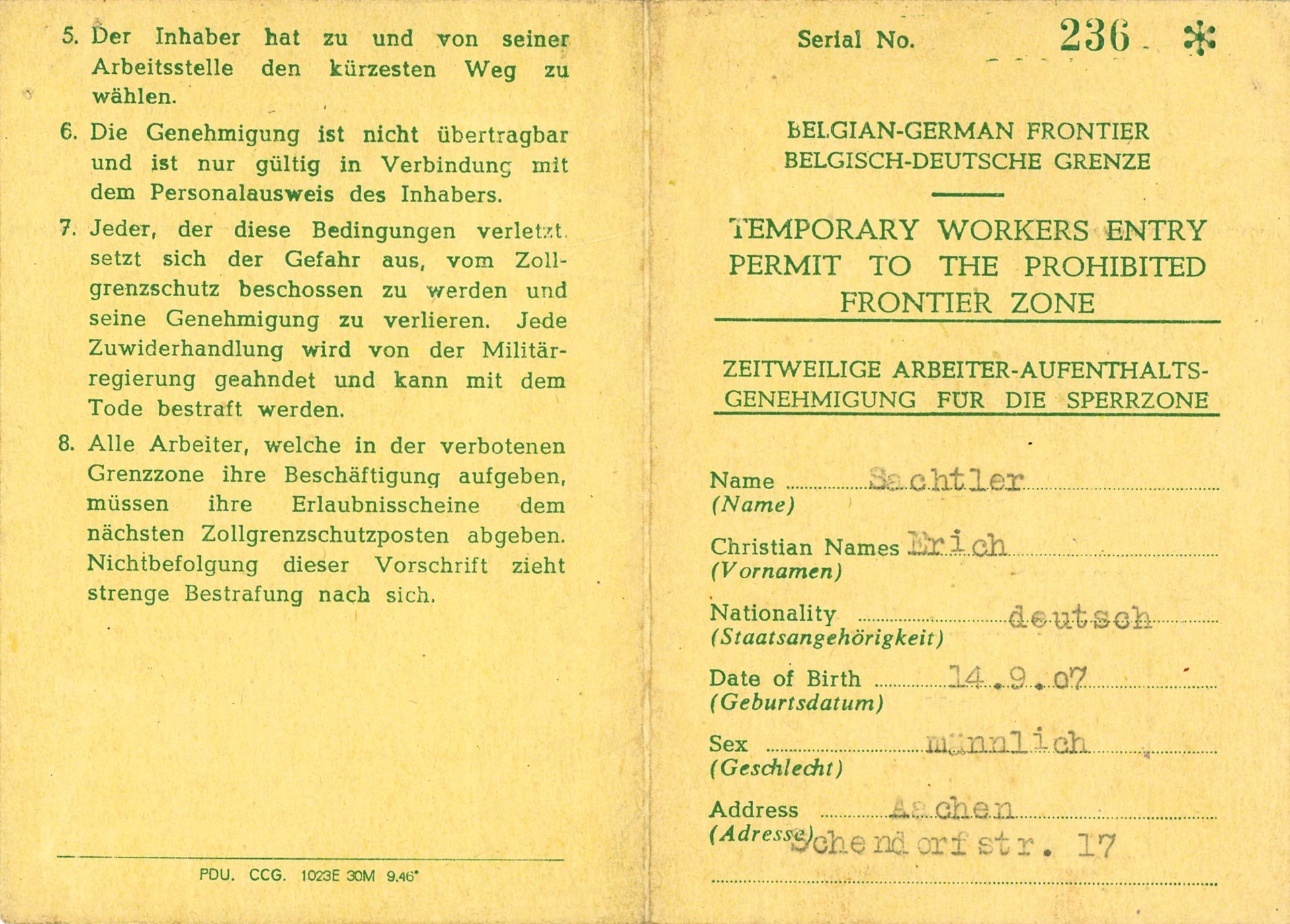
The archival image of the month July 2025 shows a restricted zone pass for an Aachen customs officer.
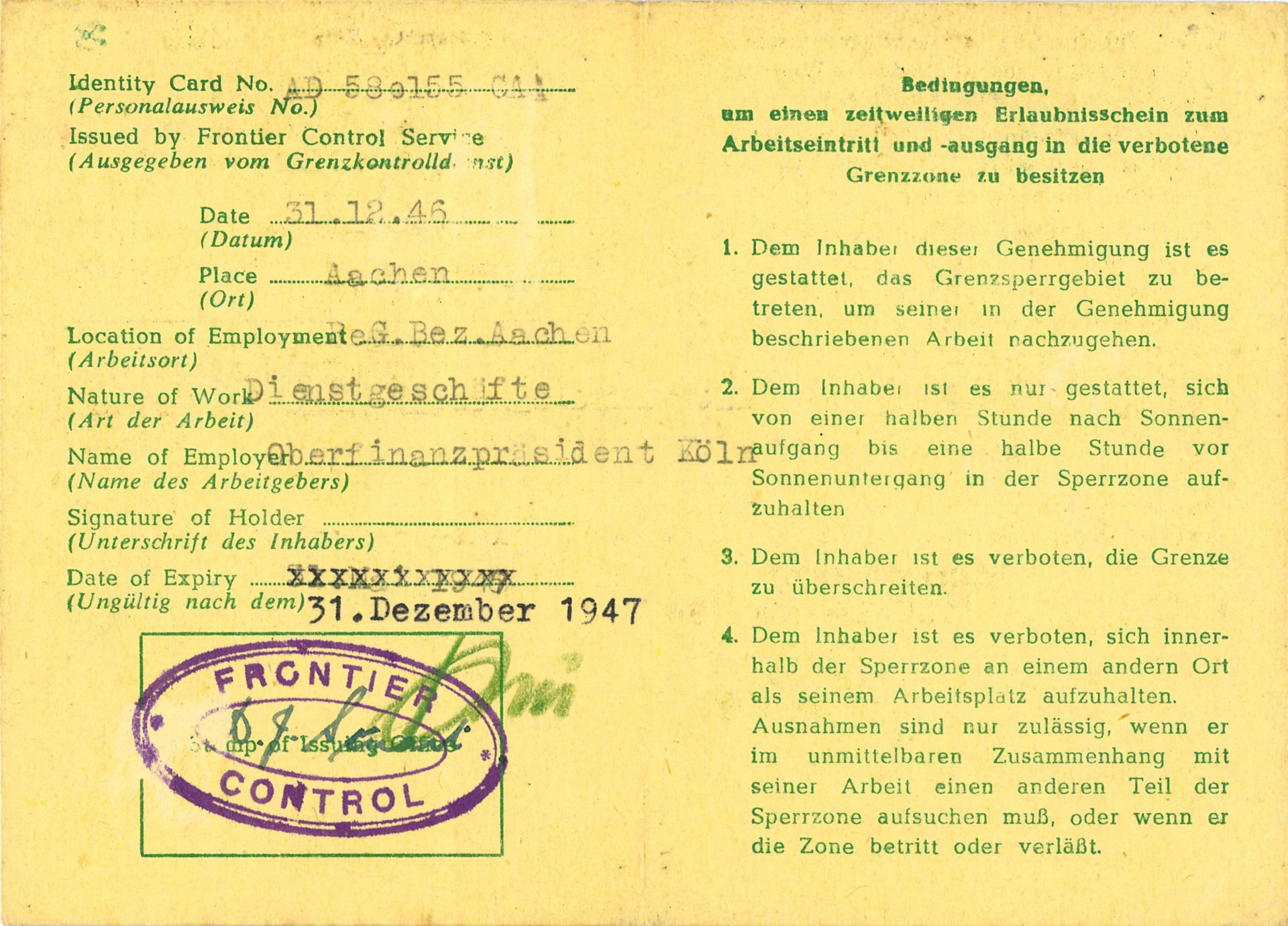
The archival image of the month July 2025 shows a restricted zone pass for an Aachen customs officer.
You can subscribe to our RSS feed for our press releases here https://www.aachen.de/rss-feed-pressemitteilungen/rss.xml