The Archivale of the month March 2026...
- ... shows the title page of the first lecturer and course directory of the Volkshochschule (VHS) Aachen from 1946.
- In the early years, lessons were organized under the watchful eye of the British occupying administration and under the impressions of the regime that had come to an end.
- The VHS should be a place where adults of all world views can meet and learn to understand each other.
The Aachen City Archive regularly presents interesting items from its stacks as Archive of the Month. The item with a short accompanying text is presented in a display case in the foyer of the city archive on Reichsweg and digitally on the archive's homepage. In March 2026, it is the front page of the first lecturer and lecture directory of the VHS Aachen from 1946.
The founding of the VHS Aachen
The Volkshochschule (VHS) Aachen was officially opened 80 years ago, on March 18, 1946, in the Talbothalle. The municipal orchestra under the direction of Thomas B. Rehmann provided the musical accompaniment for the ceremony, which came to a climax with the joint singing of the Aachen anthem "Urbs Aquensis".
About a year and a half after the end of the Second World War in Aachen, the city administration decided to offer Aacheners who had already graduated from school the opportunity to further their intellectual development and education. In view of the recent twelve-year dictatorship in Germany and the vehement indoctrination of the population, it was certainly a good idea to found an educational institute that also provided interested adults with the tools they needed to find their way in a democratic state.
"Returning intellectual freedom to the German people"
The speeches at the opening of the VHS testified to the spirit that was to characterize the new institution. Principal Josef Lang characterized the VHS as "an educational institution that enables everyone to continue working on themselves after they have left school, entered working life and thus taken up the struggle with life." The lessons were organized under the watchful eye of the British occupation administration and under the impressions of the regime that had fallen, which is why Lang emphasized: "All lecturers and their lectures are approved by the military authorities, so that the debate associated with each lecture can be unreserved. The main aim of the Volkshochschule is to return intellectual freedom to the German people."
A new beginningin the midst of ruins
The then Mayor for Schools, Education and Culture, Karl Breuer, described the new foundation as a new beginning in the midst of ruins, which was intended to turn the new learning communities into living communities in which adults of all world views could meet and learn to understand each other. Breuer wanted the VHS to appeal to people from all walks of life, to contribute to the meaningfulness of life and to protect against distractions and political radicalism: "We are calling every adult who feels responsible for their circle of life and their community to the adult education center. It is about a new attitude of mind. (...) Believe in recovery, believe in a better, more beautiful, healthy future for our German fatherland." The VHS was thus established as an element of the educational chain that was to expand access to education for all and thus form an important foundation stone for the German democracy that was being built.
Expertise, courses, lectures
The list of lecturers was already long in the first semester. The 38 people were experts in their fields, such as the composer Josef Eidens, the director of the municipal museums Sepp Schüller, the architect Wilhelm Fischer and the director of the municipal theater Kurt Sieder. The example of Professor Peter Mennicken, who offered lectures on the introduction to philosophical thought and the great thinkers of the West, shows that the first generation of teaching staff also consisted of people who were successful during the National Socialist era. At the same time, the VHS took the opportunity to have a large number of native English speakers in the city. The English conversation courses were offered by English officers.
The courses began on March 25, 1946 and took place between 6 and 9 pm, on weekends until 10 pm. The lectures were held either in the Reiff Museum, the Suermondt Museum or in the city library at its former location in Peterstraße. A fee of 5 Reichsmark was charged per course, and a general ticket, which allowed attendance at all 48 lectures, cost 45 Reichsmark.
Source: Aachen City Archive, NRW 15-17
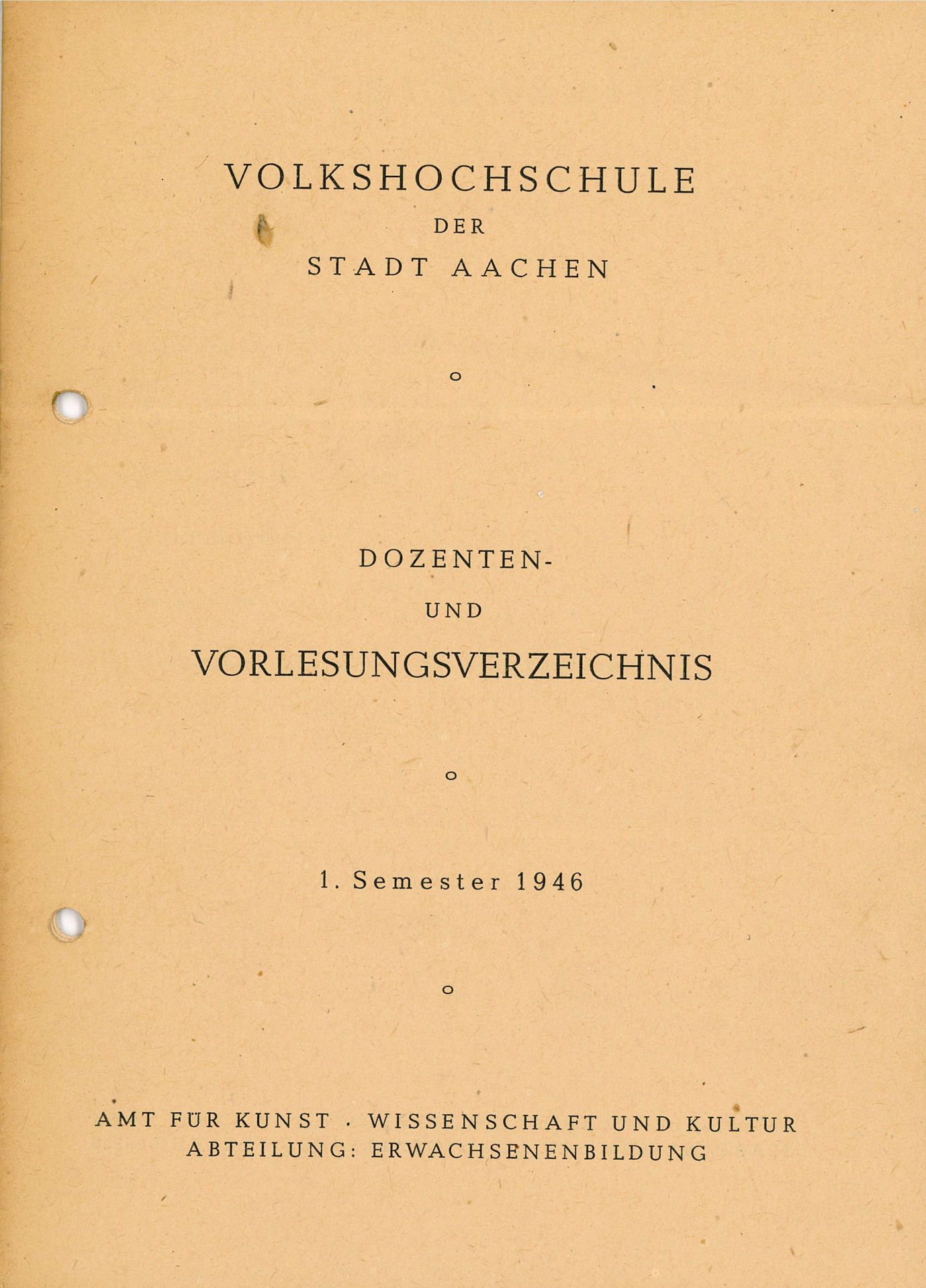
The Archivale of the month March 2026 shows the title page of the first lecturer and course directory of the Volkshochschule (VHS) Aachen from 1946.
You can subscribe to our RSS feed for our press releases here https://www.aachen.de/rss-feed-pressemitteilungen/rss.xml