The Archivale of the month February 2026...
- ... shows a colorful ticket for the costume and masked ball of the Aachener Turn-Gemeinde (ATG), which took place on February 17, 1912 at half past eight in the evening in the Hotel Kaiserhof.
- Different social classes, denominations and religions organized themselves into their own associations.
- Founded in 1862, the ATG was and is the second oldest gymnastics club in the city. Like many other sports clubs, the ATG organized its own carnival celebration in the form of a costume and masked ball.
The Aachen City Archive regularly presents interesting items from its stacks as Archive of the Month. The item with a short accompanying text is presented in a display case in the foyer of the city archive on Reichsweg and digitally on the archive's homepage. In February 2026, a colorful ticket for the costume and masked ball of the Aachener Turn-Gemeinde (ATG).
The ticket shows a woman with a red coat emerging from the open shed of a horse-drawn carriage in front of a large building, wearing a recognizable yellow carnival dress with rich ruffles underneath. A companion dressed as Pierrot helps her out of the carriage; two other ladies with red hats can also be seen.
Costume and masked balls as carnival celebrations
The jolly season has long been celebrated in Aachen. Carnival comes in many different forms: as a street and pub carnival, as a foolish meeting, at the various events of the carnival clubs. It presents itself in its parades, for children and adults and actually everywhere where Öcher Jecke think it would be a good thing to celebrate carnival. Aachen companies and organizations also celebrate carnival, as do many Aachen clubs - and have been doing so for a long time.
A special form of event in the past were the costume and masked balls offered by clubs for their members and friends. These parties required large halls, which were mainly found in Aachen's hotels and restaurants. The fashionable Hotel Kaiserhof, which no longer exists today and used to be located on the corner of Theaterstraße (then Hochstraße)/Wallstraße, was one of the hotels in Aachen that was rented for such events. Like many other Aachen hotels, it also offered its own carnival program to attract the Aachen revellers to its rooms. Almost all of Aachen's self-respecting sports clubs organized their own carnival celebrations, which were usually costume and masked balls - including the Aachener Turn-Gemeinde (ATG).
The history of gymnastics clubs in Aachen
Founded in 1862, the ATG was and is the second oldest gymnastics club in the city. The gymnastics movement, which can be traced back to the Berlin educator, author and politician Friedrich Ludwig Jahn, was first taken up in Aachen in 1815/16. Jahn espoused an extremist ideology that is regarded as a precursor to ethnic nationalism and was intended to mobilize young men for the war against Napoleonic France. As the Prussian authorities feared the emergence of political opposition, they initially prevented the establishment of gymnastics and only allowed it within a strictly controlled framework from the 1830s onwards. In Aachen, this began in 1839 with the introduction of school gymnastics, which was initially restricted to male pupils at a secondary school. In the 1840s, an inter-school gymnastics ground was created. The Aachen Gymnastics Club emerged from these efforts in 1847, but only existed for a few years and was re-founded in 1860. With the founding of the ATG two years later, which mainly brought together smaller merchants, the gymnastics clubs began to expand and differentiate.
A wide range of gymnastics clubs and sports
When the ATG hosted the carnival ball in 1912, gymnastics clubs existed not only in Aachen, but also in the surrounding communities. Different social classes, denominations and religions organized themselves into their own clubs. Women's gymnastics clubs had existed for a few years, while summer youth games attracted thousands of children and young people year after year. In addition to gymnasiums and sports grounds, "playgrounds" were laid out around the city, which later became sports fields. The initially ideologically motivated separation of gymnastics clubs from modern sports had also long since become permeable: Most clubs had switched to a wide range of physical activities and competitions, which were supplemented by cultural and social activities.
Source: Aachen City Archives, SLG 119-28
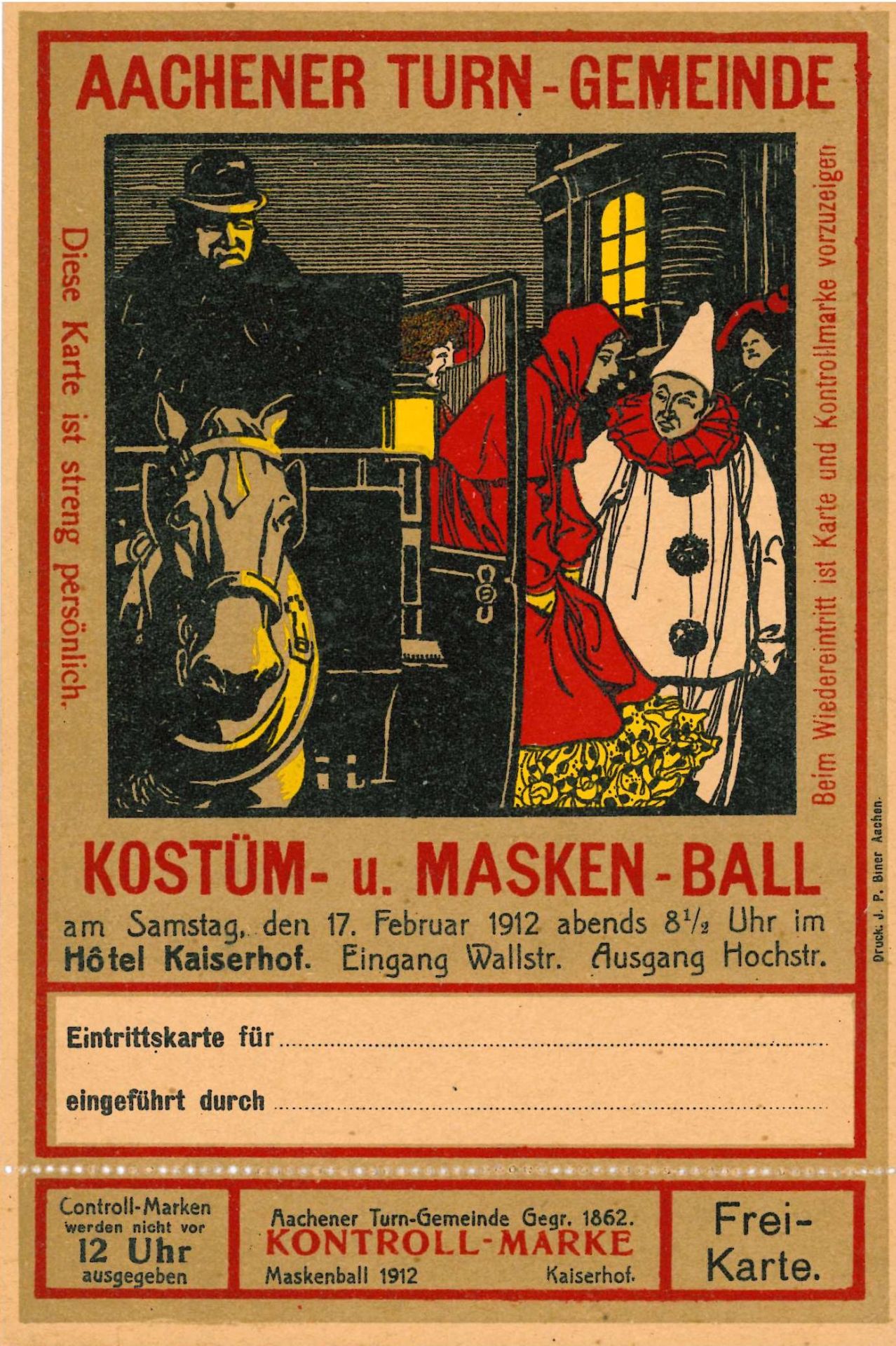
The archival item of the month February 2026 shows a colorful ticket for the costume and masked ball of the Aachener Turn-Gemeinde (ATG), which took place on February 17, 1912 at half past eight in the evening at the Hotel Kaiserhof.
You can subscribe to our RSS feed for our press releases here https://www.aachen.de/rss-feed-pressemitteilungen/rss.xml