Final preparations for the "winter service adventure"
- Winter service vehicles are already driving through the city. These are test drives to give the drivers confidence for the operations from November.
- During full operations, the processes have to be routine. This is when the work of 300 municipal employees interlocks.
- The latest gritting technology is being used on cycle paths this year.
"It really is an adventure." When Uwe Pabst talks about winter service operations, about mornings that start at 3 a.m., about freshly fallen snow, about that special calm that then hangs over the city, you get the impression of sitting opposite a passionate driver. He likes being out and about in Aachen at night. Uwe Pabst has been driving his snowplough truck for 13 years and is looking forward to the upcoming winter service season.
For weeks, employees of Aachen's municipal services have been upgrading the winter service vehicles, checking snow ploughs, gritting trucks, equipment carriers, tractors and small vehicles. Vehicles that are used in the summer for watering the city's trees are being converted and road sweepers are being fitted with road salt attachments. Everything has to be ready for use when the first inspection runs become necessary and possibly when full deployment is called. The winter service season begins on November 1.
But it's not just the vehicles that need to be fit. "Our drivers also receive refresher training," says Uwe Pabst. He has been providing this training voluntarily for several years. "We focus on our staff. Someone who feels safe in the vehicle is much calmer on the road and can react confidently in different situations." He is happy to give tips and share his years of experience. Maneuvering vehicles weighing up to 14 tons through residential streets or on arterial roads during rush hour requires one thing above all: calm. "Winter road maintenance depends on it. There must be no stress, no unrest. That only causes problems."
And so the weeks before the start of the official winter service season are used intensively for test drives, refreshing driving safety and operating the technology. Winter service vehicles on Aachen's roads during these weeks are therefore not uncommon.
Asking questions, getting to know the different vehicles, internalizing procedures - this applies to experienced drivers as well as new colleagues. "They have to be introduced slowly," emphasizes Uwe Pabst, "you have to be able to read the weather. It's an adventure every year." He says again and smiles.
Topographical differences in the city
Outside of winter maintenance, Uwe Pabst is a sweeper driver and knows the entire city area and the various topographical challenges inside out. "Bridges are often critical points." In addition, the weather conditions vary greatly within the city. "We sometimes have temperature deviations of five degrees. It can happen that there is nothing on Lütticher Straße, but we have to grit in Laurensberg."
In order to better assess the situation in the urban area, control trips are undertaken. The drivers report the weather conditions they encounter to the operations manager, who coordinates the deployment in the dispatch office on Madrider Ring. Based on this, a decision is made as to whether a full deployment needs to be called.
300 employees are required to work full-time
"We are very well positioned with our winter service team," says winter service manager Dieter Bohn. In concrete terms, this means that around 300 employees of the mechanical and manual winter service of Aachen's municipal services are required to work in two shifts to ensure road safety throughout the city of Aachen.
The winter service is divided into three levels of urgency. Level one involves keeping main roads and through roads as well as access roads to hospitals, schools and fire stations clear and passable. Priority level two primarily includes connecting roads and residential collector roads. Priority level three includes purely residential roads and residential streets with a stretch of around 420 kilometers. The municipal company is also responsible for winter road maintenance on cycle paths, with a total of 115 kilometers in priority levels one and two.
"Cycle paths are a high priority for us, which is why we use the latest technology there," says Dieter Bohn, "namely the so-called FS-100." The newly acquired vehicles, which only apply pre-wetted salt, will initially be used on cycle paths. "The advantage of pre-wetted salt is that it takes effect immediately. It works faster and can also be used preventively." The usual mixing ratio to date is a combination of 70 percent dry salt and 30 percent pre-wetted salt. The dry salt is moistened with brine shortly before it hits the road. "When it comes to preventive spreading, for example to prevent freezing wetness, the FS-100 technique is a good method. However, due to its high water content, pre-wetted salt can only be used at temperatures down to minus six degrees. We still need to gather our experience to see whether this technology will cover all our needs in the future. If it proves successful, we will consider extending it to the large vehicles." This is the assessment of the winter service professional.
Routine, calm and consideration
There are currently 1,000 tons of road salt stored in the hall on Madrider Ring, plus 150 tons of granulate and 35,000 liters of pre-wetted salt. This is used to load the vehicles as required during operations. One employee is always at the salt store, filling the vehicles with the wheel loader or operating the silo. "All the cogs have to mesh so that everything runs smoothly in the event of an emergency," says Dieter Bohn. Here too, routine and calm are the keys to good and successful cooperation.
"There are many factors that come into play during an operation," says Uwe Pabst. This also includes other road users. "My experience is that they show consideration for us as soon as it starts to rain. Then everyone is very happy when we arrive." Mirrors and cameras give the drivers a good overview of the large vehicles; "you can't see the sign without the camera, for example," explains Uwe Pabst. "That's another reason why the test drives are important, so that the drivers can be experienced and safe on the road." Residential streets, through one-way streets, past central islands and parked vehicles - the conditions are different everywhere and the drivers have to react individually. "Yes, it's sometimes exhausting," admits Uwe Pabst. "We always have to be focused. But it's fun." He feels that he and his colleagues are well prepared - for the next winter and the adventure that comes with it.
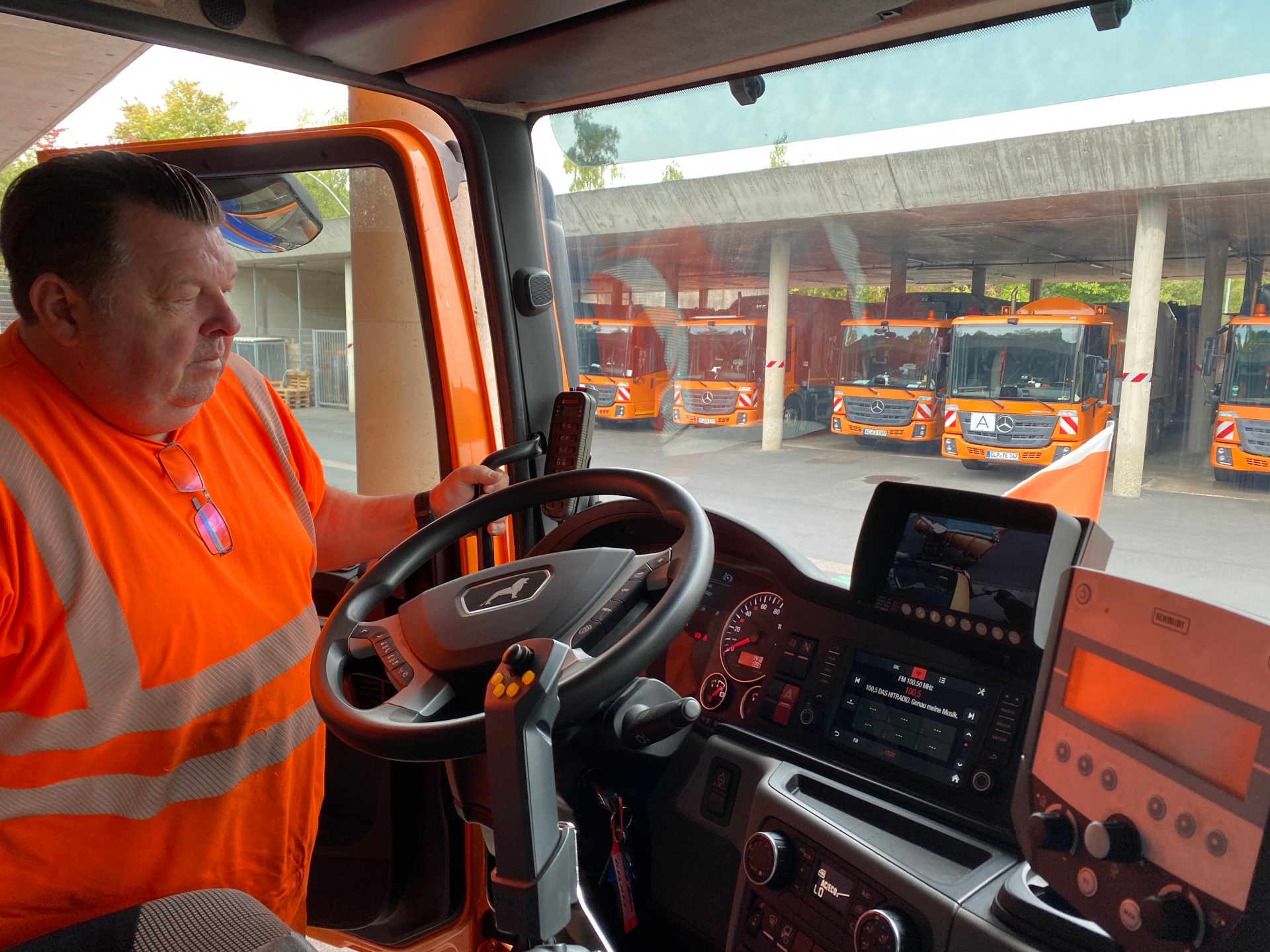
Uwe Pabst has been a winter service driver at Aachener Stadtbetrieb for 13 years.
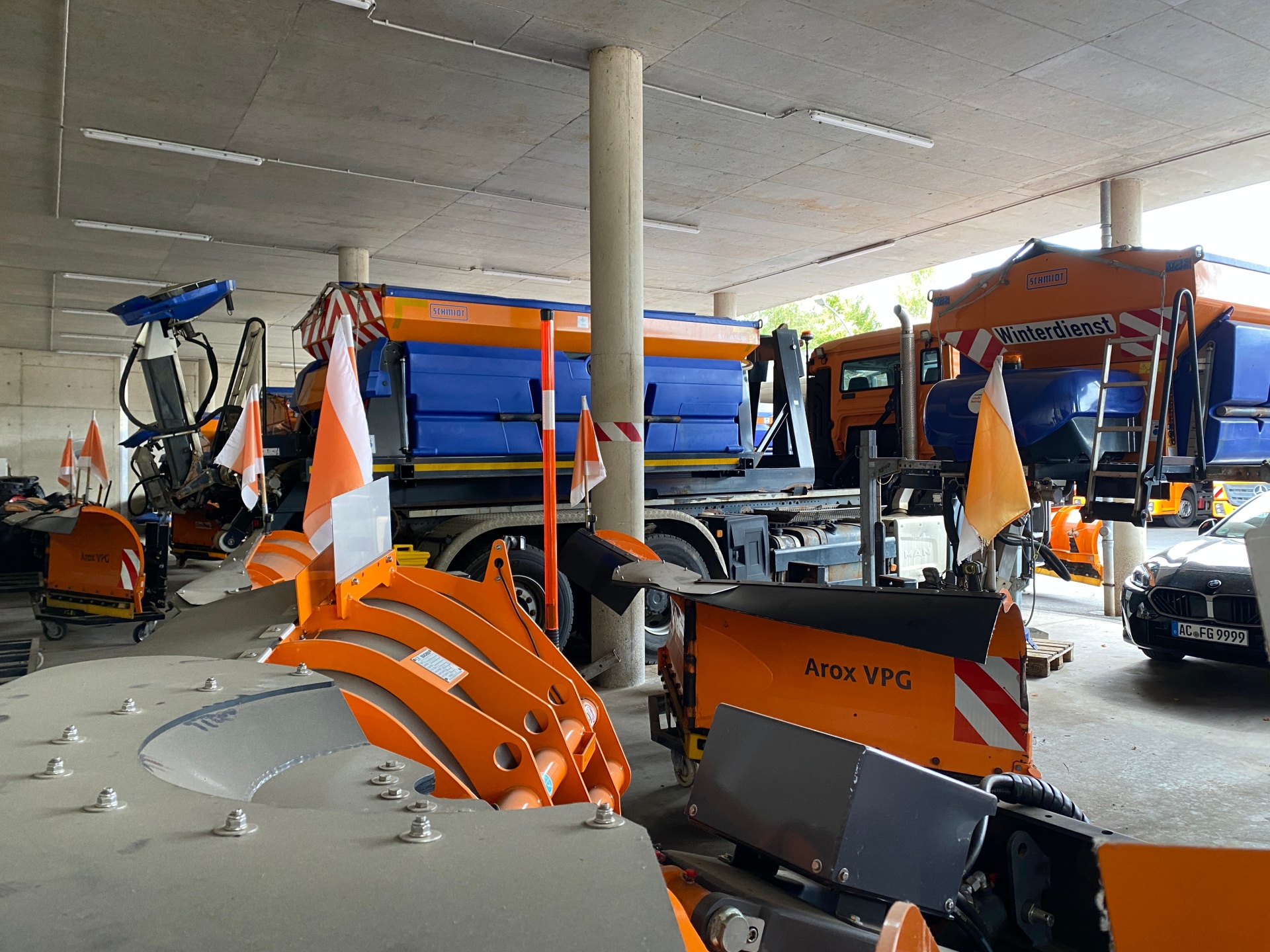
Ready for action: The municipal vehicle fleet has been prepared for the upcoming winter service season.
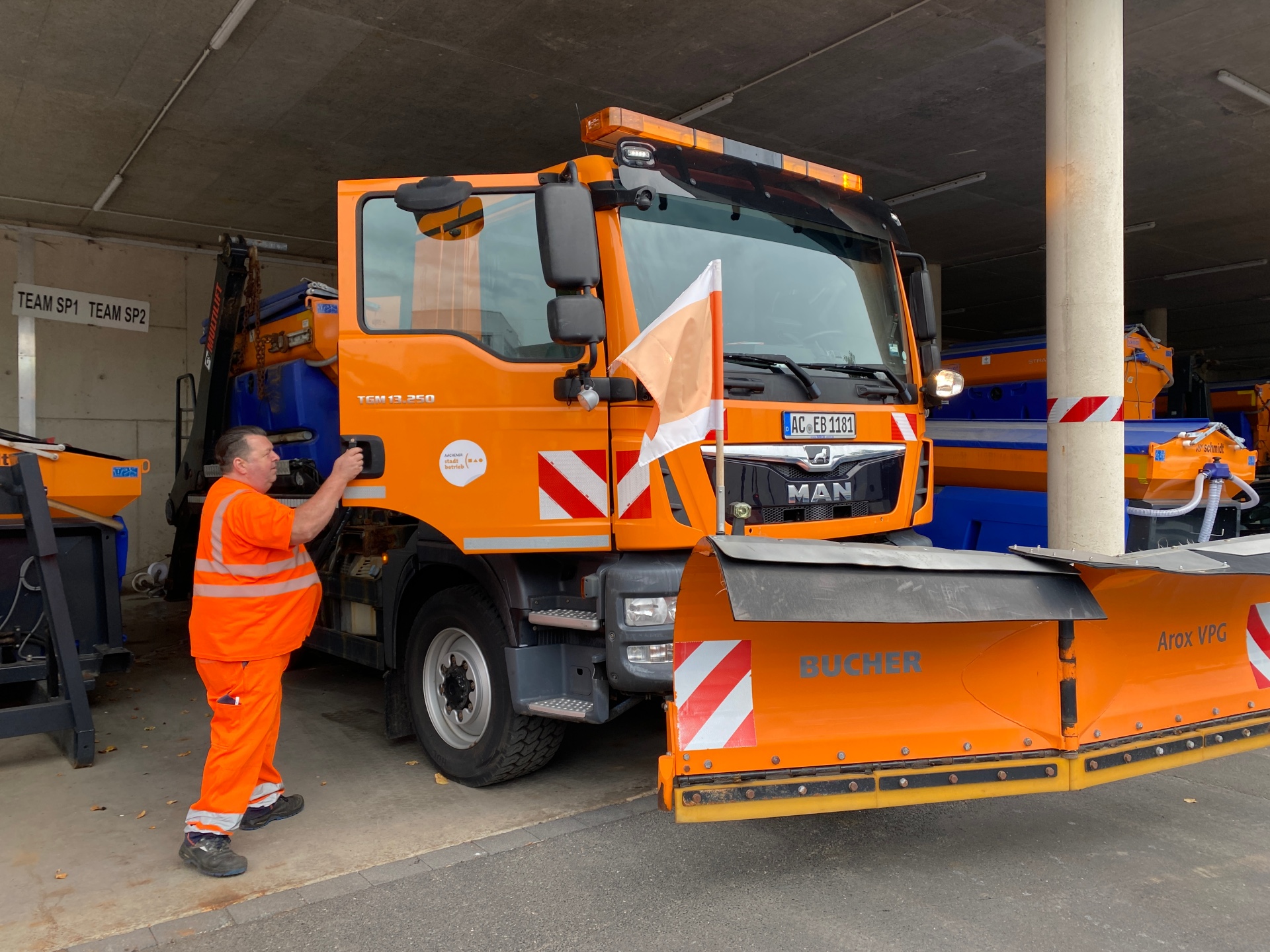
Test drives and school lessons: In one of these gritting trucks, Uwe Pabst patiently explains to his colleagues what they need to know for their potential deployment.
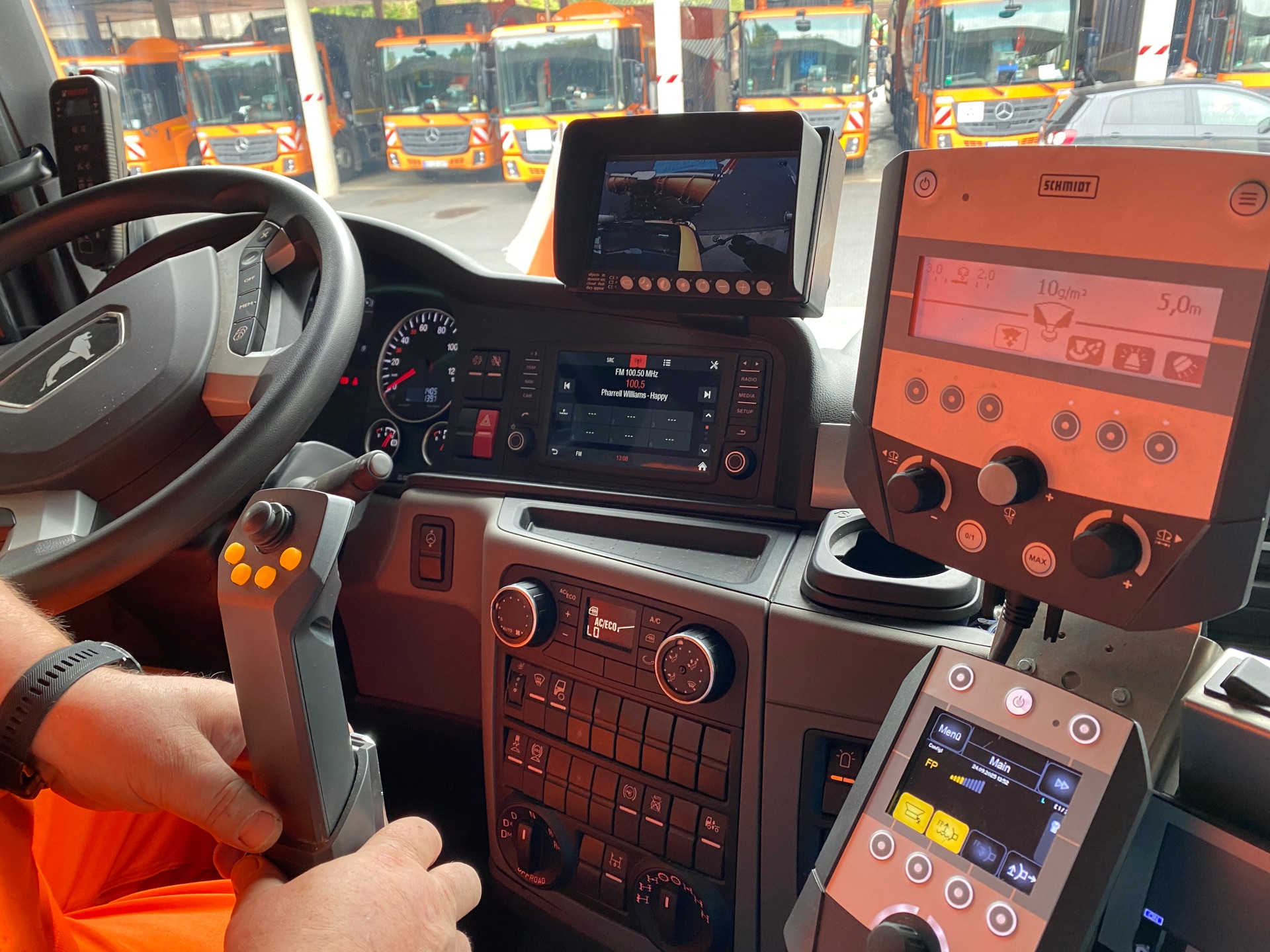
Camera technology supports all-round visibility on the spreader truck.
You can subscribe to our RSS feed for our press releases here https://www.aachen.de/rss-feed-pressemitteilungen/rss.xml