STAWAG continues seismic investigations between Beverau and Stolberg
The four measurement vehicles currently on the road in Aachen on behalf of STAWAG completed their first measurement route from Kornelimünster to Krefelder Straße on Wednesday, December 10. From Thursday, December 11, they will continue on the second selected measurement route from Beverau via Eilendorf to Stolberg. The measurement runs on line 2 are expected to last until Saturday, December 13.
The vehicles started on Monday, December 8, at Napoleonsberg in Kornelimünster and have since traveled along Trierer Straße, Madrider Ring, Berliner Ring and Prager Ring to Krefelder Straße.
"We will be on the roads in the Aachen region with the vibro-trucks for a total of two weeks," explained Gorig Quaas, STAWAG's project manager for deep geothermal energy at the start on December 8.
Line 2 from Beverau to Stolberg main station will be followed by lines 3 (Stolberg to Würselen) and 4 (Rothe Erde to the Aachener Land highway service area). In total, STAWAG will operate the four selected lines over a distance of 39 kilometers in the Aachen region. The measurements are to be completed on Saturday, December 20.
How the measurements work
During the measurements, the vibro-trucks stop for a few minutes at each measuring point - approximately every 20 meters - and send sound waves into the ground. The oscillations can be felt as vibrations close to the vehicles, and the noise of the compressor that generates the sound waves is particularly noticeable. This heralds the start of the measurement convoy and after around two hours it is all over again. During the measurements, the slow-moving convoy, which is around 60 meters long, may cause temporary traffic obstructions, similar to a roadworks site. STAWAG asks residents for their understanding for any inconvenience during the measurement phase.
The 2D seismic method was developed to investigate the deep subsurface as gently as possible - i.e. without interfering with it. Measuring vehicles send vibrations into the subsurface via a lowerable plate, which are reflected differently by the various rock layers at depth. At the earth's surface, the reflected signals are recorded using special microphones (geophones). The data obtained can then be used to create two-dimensional (2D) images of the subsurface - comparable to an ultrasound image.
Saturday first test measurements
Before the 2D measurements could begin on Monday, December 8, a so-called parameter test was carried out in advance. This involved setting and calibrating the measurement parameters of the vibro-trucks - in particular the intensity and length of the individual vibration cycles - on site. With the optimum settings, the measurements provide precise and reliable data on the geological subsurface. To this end, the measurement convoy was on the road on Würselener Straße in Stolberg on Saturday, December 6.
The investigations are an important step towards a climate-friendly and independent heat supply for the future of the Aachen region. Project manager Quaas: "Please support us and leave the geophones, which store the data from the seismic measurements, on site. They are equipped with GPS and are essential for data evaluation."
All information about the measurements can be found on Stawag's social media channels and on the website at
www.stawag.de/tiefengeothermie
Source: STAWAG
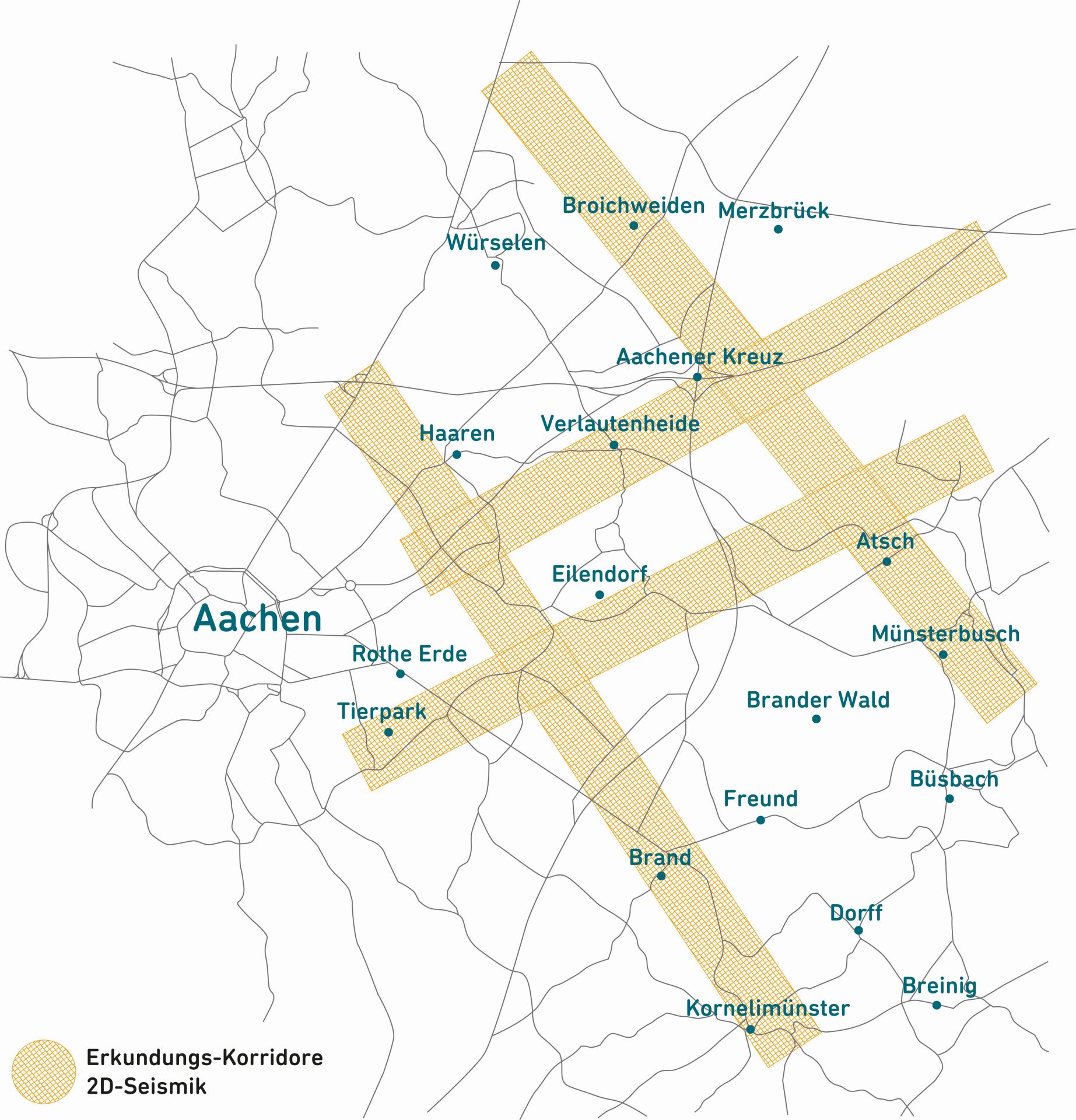
STAWAG is carrying out seismic surveys along four corridors in Aachen and the region.
You can subscribe to our RSS feed for our press releases here https://www.aachen.de/rss-feed-pressemitteilungen/rss.xml