Neighborhood development
In collaboration with the municipal development company Aachen GmbH und Co. KG, the City of Aachen is developing the Büchel historic district.
The comprehensive development of the district is guided by procedures set forth in the German Building Code (BauGB). A key component of this is the implementation of an urban renewal project in accordance with Sections 136 et seq. of the BauGB.
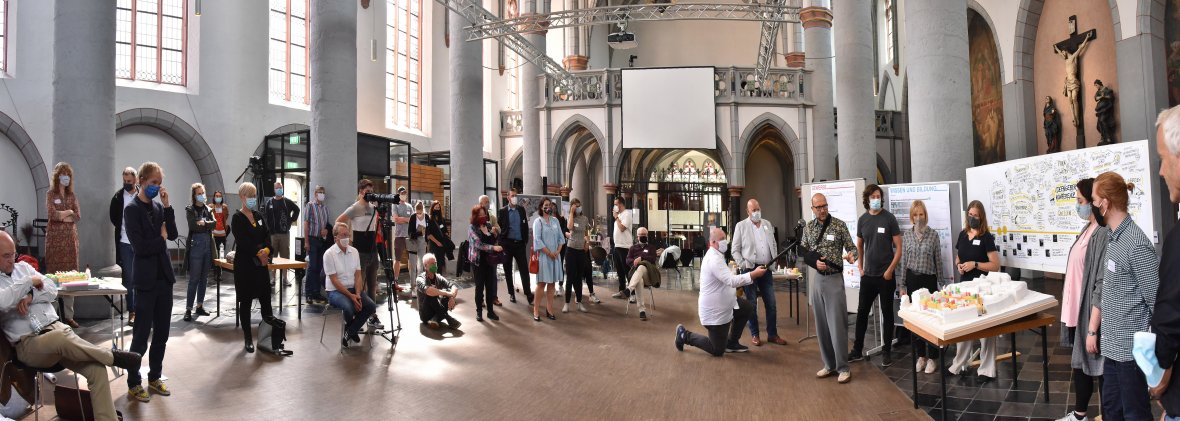
Andreas Herrmann, © SEGA / Andreas Herrmann
Redevelopment process in the old town district of Büchel
On April 22, 2026, the Aachen City Council adopted a redevelopment ordinance pursuant to Section 142 of the German Building Code (BauGB) for the “Altstadtquartier Büchel” area.
A redevelopment procedure is limited in time and scope and is intended to ensure that so-called “urban planning deficiencies” (including functional, structural, design, and climatic shortcomings) are remedied through cooperation between the private sector and the public sector. The ordinance is initially limited in time until December 31, 2040.
This is a “full-scale” redevelopment procedure (also known as a “comprehensive procedure” or “standard procedure”). Property owners should take the following into account:
- In the Büchel old town district, private construction projects and property transactions, among other things, are subject to approval. This means that separate approval under redevelopment law is required for building applications, demolitions, property encumbrances, property sales and similar transactions. The legal basis is § 144 BauGB.
- For the entire area, the increase in the land values of private properties that is causally attributable to the redevelopment measure with its public investment and regulatory measures is also used to finance the redevelopment measure. As a rule, this takes place after completion of the redevelopment measure. The legal basis is §§ 152-156a BauGB.
- Building owners and other affected parties are obliged to provide the municipality with the information required to carry out the redevelopment. The legal basis is § 138 BauGB.
- When selling land, the municipality has a right of first refusal, which must first be examined for each case of sale. The legal basis for this is § 24 BauGB. In addition, sales can only be made at the land value unaffected by redevelopment in order to prevent land speculation in the redevelopment area. A price check is therefore carried out for sales on the basis of Section 153 (2) BauGB.
If you wish to apply for a project or legal proceeding, please use the designated form, “Application for a Redevelopment Permit Pursuant to Section 145 of the BauGB.”You can find
out which specific projects and legal transactions are subject to the requirement for a redevelopment permit in the “Explanatory Sheet for the Application for a Redevelopment Permit pursuant to Section 145 of the BauGB.” Here you will also find further information on the required attachments.
If you have any questions regarding the approval process or the application for a redevelopment permit, please contact the responsible department (you can find the relevant staff members under “Contact”):
Department of Contract, Procurement, and Grant Management
; Administration, Projects, Services, and IT (FB 60/100)
sanierung@mail.aachen.de
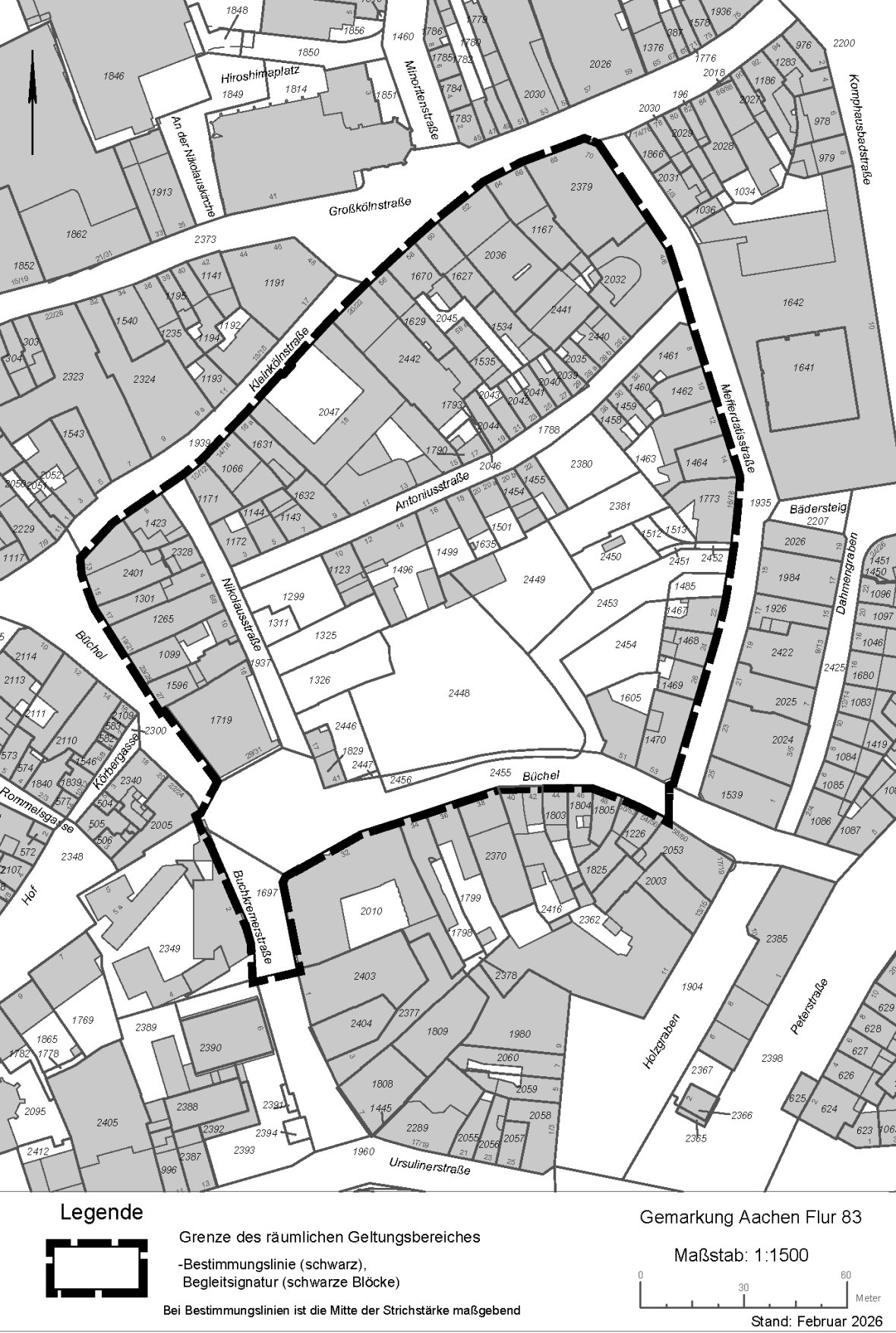
The redevelopment area is defined as follows:
City of Aachen
Redevelopment process 2022 to 2025
The old town district of Büchel had already been part of the "inner city" redevelopment area for many years. On 08.06.2022, the Aachen City Council had already adopted further-reaching redevelopment law instruments for the "Altstadtquartier Büchel" sub-area. In April 2024, the Higher Administrative Court (OVG) of Münster declared the 1st amendment statute in the formally defined "inner city" redevelopment area for the "Altstadtquartier Büchel" sub-area invalid. In spring 2025, the Federal Administrative Court (BVerwG) confirmed the decision.
Result of the preparatory investigations in accordance with Section 141 of the German Building Code
In order to re-examine the feasibility of an urban renewal project for the area, the City of Aachen conducted preliminary studies (VU) from late 2024 to early 2026 in accordance with Section 141 of the German Building Code. The Planning Committee had adopted the corresponding resolution to initiate the process on June 20, 2024.
As part of the preliminary study, extensive public engagement was conducted and a detailed assessment of the neighborhood was carried out. Based on the findings, so-called “urban planning deficiencies” were identified, and a redevelopment concept was developed.
Consequently, the final report recommends carrying out an urban redevelopment project in the Büchel Old Town neighborhood through the full procedure, i.e., in accordance with the specific legal provisions governing redevelopment. To this end, the city council approved the enactment of a redevelopment ordinance on April 22, 2026. All results of the preliminary studies can be found in the final report of the preliminary studies (see Downloads) along with the accompanying first volume of appendices.
What goals are to be achieved with the restructuring process?
Following the demolition of the parking garage in 2022 and the lessons learned from the temporary “ZwischenZeit” site design, the “Altstadtquartier Büchel” urban development concept is now set to be gradually refined and implemented. This will create a new public green space, enhance the urban environment, and facilitate the development of new buildings. In addition, a mix of uses typical of a city center is to be promoted, and existing conflicts of use are to be resolved. Private investment
will also be strengthened through the redevelopment process. Through collaboration between private stakeholders and the public sector, the aim is thus to address structural, design, and environmental shortcomings.
The detailed redevelopment goals can be found in Section 6.1 of the final report.What measures are planned to achieve the renovation goals?
To achieve the renovation goals, a comprehensive action plan was developed as part of the renovation strategy.
The measures cover the following areas:- Urban development, buildings and land
- Uses
- Public spaces
- Mobility
- Environment, climate protection and climate adaptation
In addition, there are further measures outlined in the planned Integrated Urban Development Concept (ISEK) titled “Büchel Old Town District and Surrounding Area: House of Curiosity” (Document No. FB61/0050/WP19).
All measures, along with their detailed project descriptions, can be found in Section 6.2 of the final report, and the corresponding project summaries are included in the public appendix.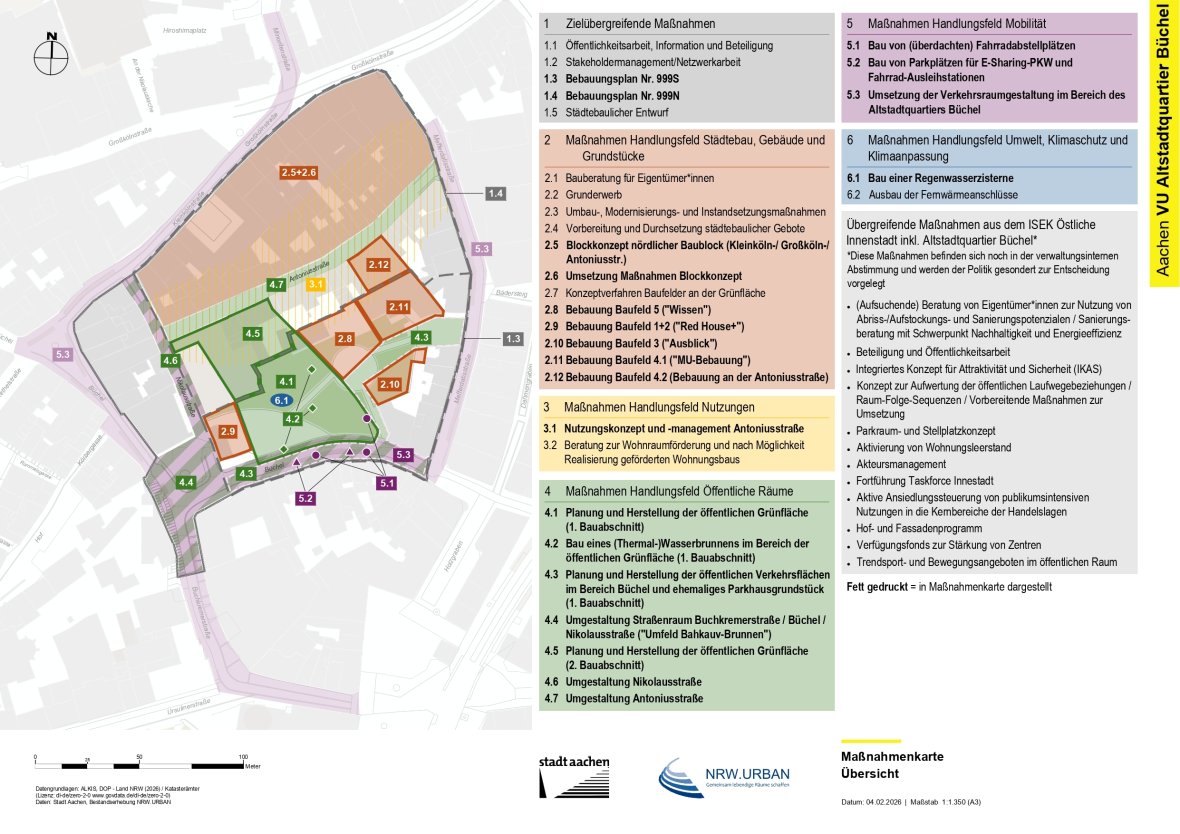 City of Aachen
What is involved in the implementation of a full-scale remediation measure and why is this necessary?
In a redevelopment area, the legislator generally assumes the application of the special redevelopment law provisions pursuant to Sections 152-156a BauGB if and to the extent that redevelopment-related increases in land value are to be expected, which is why the comprehensive procedure/full procedure is also referred to as the "standard procedure".
Pursuant to Section 142 (4) BauGB, however, the application of the special redevelopment regulations is to be excluded if this is not necessary for the implementation of the redevelopment and the implementation is not likely to be made more difficult as a result. The question of the possible application of this "simplified procedure" is not a discretionary decision.
As part of the preliminary assessment, an evaluation was conducted to determine whether land value increases resulting from the redevelopment are to be expected. The evaluation found that land value increases are generally to be expected, with significant increases anticipated in certain areas.
If—as in the present case—land value increases resulting from the redevelopment are to be expected, it is important to assess the applicability of the standard procedure with regard to the following criteria:- Intended or necessary acquisition of land by the city at the redevelopment-influenced land value
- Influence on land prices and prevention of speculation
- Use of redevelopment-related increases in land value for financing (compensation amounts)
The relevance of these criteria to the redevelopment project in question can generally be affirmed. Consequently, the redevelopment project must be carried out through the full-scale procedure to ensure its feasibility.
For this reason, the specific redevelopment regulations set forth in Sections 152–156a and the approval requirements under Sections 144 and 145 automatically apply.What specific effects does the restructuring process have for me as an owner?
Permit RequirementsSince
the full planning procedure applies in the Büchel historic district, projects and property-related legal transactions are subject to permit requirements under Section 144 of the German Building Code (BauGB). This is intended to ensure that nothing occurs in the redevelopment area that would jeopardize or prevent the achievement of the redevelopment goals.
The following, among others, are subject to permit requirements:- Projects and other measures in accordance with Section 14 BauGB (construction and conversion measures)
- Agreements on the use or utilization of land, buildings and parts of buildings (contractual relationships under the law of obligations such as rental and lease agreements)
- The legal sale of a property and the creation and sale of a heritable building right, including the underlying contracts under the law of obligations
- The creation of a right encumbering the property
- The establishment, amendment or revocation of a building charge
- Property divisions
Property sales are subject to the so-called price review in accordance with Section 153 (2) BauGB. If an agreed purchase price for a sale or an agreed equivalent value of a heritable building right is clearly above the value unaffected by redevelopment, this constitutes a significant impediment to redevelopment. In this case, the municipality must refuse to approve the corresponding contracts under redevelopment law. The City of Aachen itself is also bound by this purchase price limitation when acquiring land in accordance with Section 153 (3) BauGB.Here you will find the application for a redevelopment permit under Section 145 and the accompanying explanatory sheet.
Compensation
paymentsIn addition, in redevelopment areas, compensation payments (Sections 152–156a) are levied under the comprehensive procedure to ensure that property owners contribute to the redevelopment.
It should be noted that under the standard procedure, compensation payments are only levied if redevelopment-related increases in land value have actually occurred. This must be distinguished from changes in general market values on the real estate market. The
basis for this is a property-specific comparison of the so-called initial and final values at the end of the redevelopment process. It is planned to have these land values assessed by the Expert Committee of the Aachen Urban Region.
In addition, as a property owner, you have the option of entering into modernization agreements during the renovation of your buildings in order to claim tax benefits. You will find further information on this in the next section.How can I get involved and be supported as an owner in the Altstadt district?
Modernization agreements
Property owners in redevelopment areas have the option of concluding modernization agreements with the city in order to claim tax deductions for renovations, modernizations or repairs to their property. There are some requirements for this, which you can find out about here.
To the modernization certificates
Consulting and FundingYou
are welcome to contact altbau plus e.V. at any time to schedule an initial consultation regarding the renovation and modernization of residential buildings. The organization also regularly hosts informative presentations on topics such as funding programs and various renovation-related issues.Please
visit the altbau plus e.V. website for more information.Housing
Assistance The State of North Rhine-Westphalia supports housing through long-term, low-interest, and in some cases interest-free loans. Upon application, repayment reductions may also be granted on the loans provided.
In return, this creates rent and occupancy restrictions that particularly benefit groups of people who are disadvantaged in terms of housing availability and who, due to their income situation, are dependent on affordable housing.
If you are interested in housing subsidies for your property, you can find further information here.What other plans are there for the Büchel old town district?
Land-Use Planning
: Land-use planning is a key instrument for guiding the urban development of neighborhoods. As part of general urban planning law, land-use planning is responsible for preparing and guiding the construction and other uses of land in accordance with the Building Code.
For the Büchel Old Town neighborhood, the 999S zoning plan is currently being prepared to establish the planning-law framework for the urban development of the southern part of the Old Town.
About the 999S Zoning PlanUrban Development and Open Space Planning
: The Büchel Old Town district is set to become a vibrant and forward-looking neighborhood in the heart of Aachen. At the heart of the project is an open space to be developed between Büchel and Antoniusstraße. The open space plan was approved by policymakers in the summer of 2024, and the first construction work will begin in the summer of 2026.Building construction is also part of the urban development at Büchel. To this end, SEGA’s plots of land will not be awarded to the highest bidder, but to the urban developers with the best concept.
The first step in this building development is the “Knowledge Module,” in which the Fraunhofer Institute for Energy Infrastructure and Geotechnologies (IEG) will establish a “Center for Energy and Climate Technology in Aachen,” which will provide space for research, exhibitions, and public discourse.
Further steps will include the development of the “RedHouse+” and “Ausblick” construction sites, where a mix of commercial and new residential space typical of the city center is to be created.
About the planning process
Further topics
Political proposals
Search results are loaded
No templates found.
Download
Supported by

Contact us
Urban redevelopment
Search results are loaded
No employees found.
Administrative and
Contractual matters
Search results are loaded
No employees found.