Archival Item of the Month for November 2026…
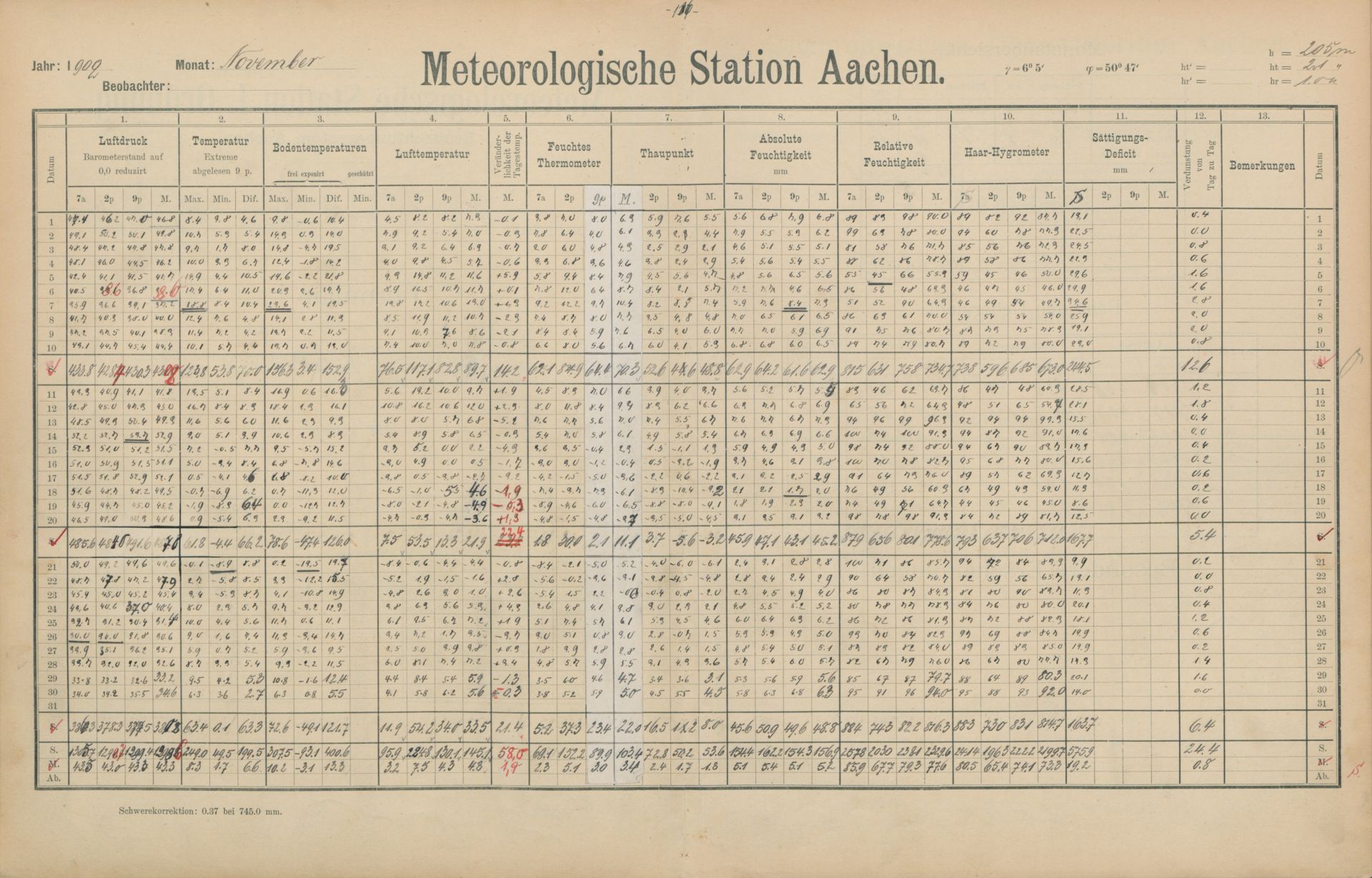
- … shows a table of meteorological measurements for November 1902 from the observation log of the Meteorological Observatory.
- Weather data was already being recorded in Aachen as early as the first half of the 19th century. With the establishment of the Meteorological Observatory in 1900, data began to be collected systematically on a scientific basis.
- Peter Polis (1869–1929) was the driving force behind the construction of the meteorological observatory, which was destroyed in 1944.
The Aachen City Archives regularly features interesting items from its collections as “Archival Item of the Month.” The item, accompanied by a brief description, is displayed in a showcase in the foyer of the City Archives on Reichsweg and is also featured digitally on the Archives’ website. In November 2026, the featured item will be a table of measurements from the 1902 observation log of the Meteorological Observatory.
World Climate Conference in November 2026
In November 2026, the World Climate Conference (COP 31) took place in Antalya, Turkey. To understand global warming, assess its extent and consequences, and develop countermeasures, scientists around the world also draw on historical data.
Weather Data: Worth Archiving or Not?
Such data can also—and especially—be found in archives. However, historical weather data was long considered of little archival value because it was assumed that it would not be of great significance for current or future research. Historical weather data is therefore a good example of the challenge facing archival work: when deciding what is worthy of preservation and what can be destroyed, archivists must not be guided solely by current interests. The problem remains: How can we know what will be of interest in the next century or the one after that?
The Work of the Meteorological Observatory Since 1900
Weather data had already been recorded in Aachen during the first half of the 19th century. With the opening of the Meteorological Observatory on the Wingertsberg in September 1900, an institution was established that systematically collected data on a scientific basis.
In its daily operations, the observatory kept detailed records of air pressure, humidity, temperature, cloud cover, wind, and precipitation. Measurements were taken hourly, around the clock, seven days a week. In addition to the actual data, records were kept of who collected it using which measurement methods or instruments, and who processed, calculated, and revised the data. This ensured that the integrity of the data remained easily traceable.
Pioneer Peter Polis Professionalizes Weather Observations in Aachen
Peter Polis (1869–1929) was the driving force behind the construction of the meteorological observatory, which was destroyed in 1944. Even while attending the Realgymnasium, he began keeping weather records and ventured into weather forecasting, which were published regularly in the local newspaper *Aachener Politisches Tageblatt* starting in 1887. Starting in 1889, Polis studied meteorology in Freiburg im Breisgau and Bonn, but after three years he returned to Aachen to work in his parents’ cloth factory. At the same time, he began setting up a private weather station, first at Heinrichsallee 8, then at Alfonsstraße 29. In October 1894, this station was incorporated into the observation network of the Prussian Meteorological Institute, headquartered in Berlin. Peter Polis professionalized weather observations in Aachen, and through his dedication, he helped institutionalize meteorology as a university discipline at the Technical University of Aachen around 1900.
By the end of the 19th century, Polis was already an internationally recognized seismologist and a founding member of the German Seismological Society. He also conducted extensive research on weather conditions for maritime navigation and was a pioneer in aviation meteorology.
Data for November 1902 from the observation log
The oldest observation log from the Meteorological Observatory preserved in the city archives dates from 1902. The image shows a table summarizing the daily and hourly measurements of temperature, air pressure, and humidity for the entire month of November in a condensed format. Together with hundreds of other data sheets, it was later bound into a book.
According to the records, in November 1902, the temperature ranged from a low of -8.9 degrees on November 21 to a high of 18.8 degrees on November 7. It rained on eleven days, snowed on one day, and was foggy on six days.
Source: StAAc, PRZ 9; Katja Eßer: “On the Beginnings of Professional Meteorology in Aachen: Peter Polis (1869–1929) and His Predecessors,” in: Journal of the Aachen Historical Society (2015/16), No. 117, pp. 176–187.
You can subscribe to our RSS feed for our press releases here https://www.aachen.de/rss-feed-pressemitteilungen/rss.xml