Archival Item of the Month for July 2026…
- …shows a half-burned 500-mark emergency banknote from 1922 and a letter to the then-mayor, Wilhelm Farwick.
- In it, railroad worker Michael Winand writes a petition to the mayor asking him to replace the city's rating.
- Like many other residents of Aachen, Winand and his family of seven found themselves in dire straits in the years following World War I.
On November 18, 1922, railroad worker Michael Winand wrote to Aachen’s mayor, Wilhelm Farwick, regarding a mishap. “Due to an unfortunate mistake,” he wrote, “I recently threw a 500-mark city note into the fire”. By “city note,” he meant the emergency currency issued jointly at the time by the city and district of Aachen, and indeed, a half-burned emergency currency note was enclosed with his letter.
In his letter, Mr. Winand described the dire social circumstances in which many residents of Aachen found themselves during the economic and political crises following World War I, and used this as the basis for an unusual request: “Since I find myself in a very dire situation—my family consists of my wife and five minor children—I respectfully ask the mayor to kindly honor the enclosed damaged banknote.” In other words: The city of Aachen should compensate him for the loss of the 500 marks.
Vouchers to Combat the Crisis
: Just under two weeks later, on November 30, the city granted this request: Mr. Winands received a letter stating that he could have the value of the damaged bill reimbursed at the city treasury.
As early as the end of World War I and in the first postwar years, the city of Aachen had issued emergency currency in the form of vouchers to address the shortage of means of payment. With the onset of hyperinflation in 1922, the need for means of payment rose once again.
The damaged 500-mark voucher originally bore the date October 5, 1922, along with the seals and signatures of the mayor of the city of Aachen and the chairman of the Aachen district committee. It also bears printed instructions on the use of the emergency currency: “This voucher is accepted as payment by all public offices in the city and district of Aachen. It loses its validity four weeks after an announcement is published in the official gazettes of the city and district of Aachen.” Like government banknotes, this note was numbered and the paper bore a watermark.
Extent and Cause of Hyperinflation
: As early as February 1923, the city and county were forced to put emergency banknotes worth 5,000 marks into circulation. Five months later, a 50,000-mark note followed, and just six months after that, a 500,000-mark note. On October 12, 1923, at the height of hyperinflation, a series of emergency banknotes with face values ranging from one billion to 25 trillion marks was issued.
Hyperinflation was the result of a massive expansion of the money supply, which the German Empire used to pay off the national debt incurred as a result of its defeat in World War I. This made it possible for the Reich, for example, to repay the war bonds issued to the public during the war with the promised profits as stipulated in the contracts—albeit in currency that was becoming increasingly worthless. When French and Belgian troops occupied the Ruhr region in early 1923 to secure outstanding reparations claims, the Reich financed what was known as “passive resistance” in the same manner, which caused inflation to escalate and created a breeding ground for political unrest, crime, and violence. Finally, a currency reform brought an end to the acute crisis in November 1923. In Aachen, which had been severely affected by the crisis, people even feared at that time that the food supply would collapse, leading to a famine. Although inflation had catastrophic consequences for countless people, the situation stabilized in the following year, 1924.
As early as the 1920s, a new hobby had emerged centered on emergency currency coins and banknotes. Thus, in addition to Michael Winands’ letter, the designs for the emergency banknotes, the orders placed with the printing companies, and overviews of the amounts of money issued, the mayor’s files also contain several magazines for emergency currency collectors.
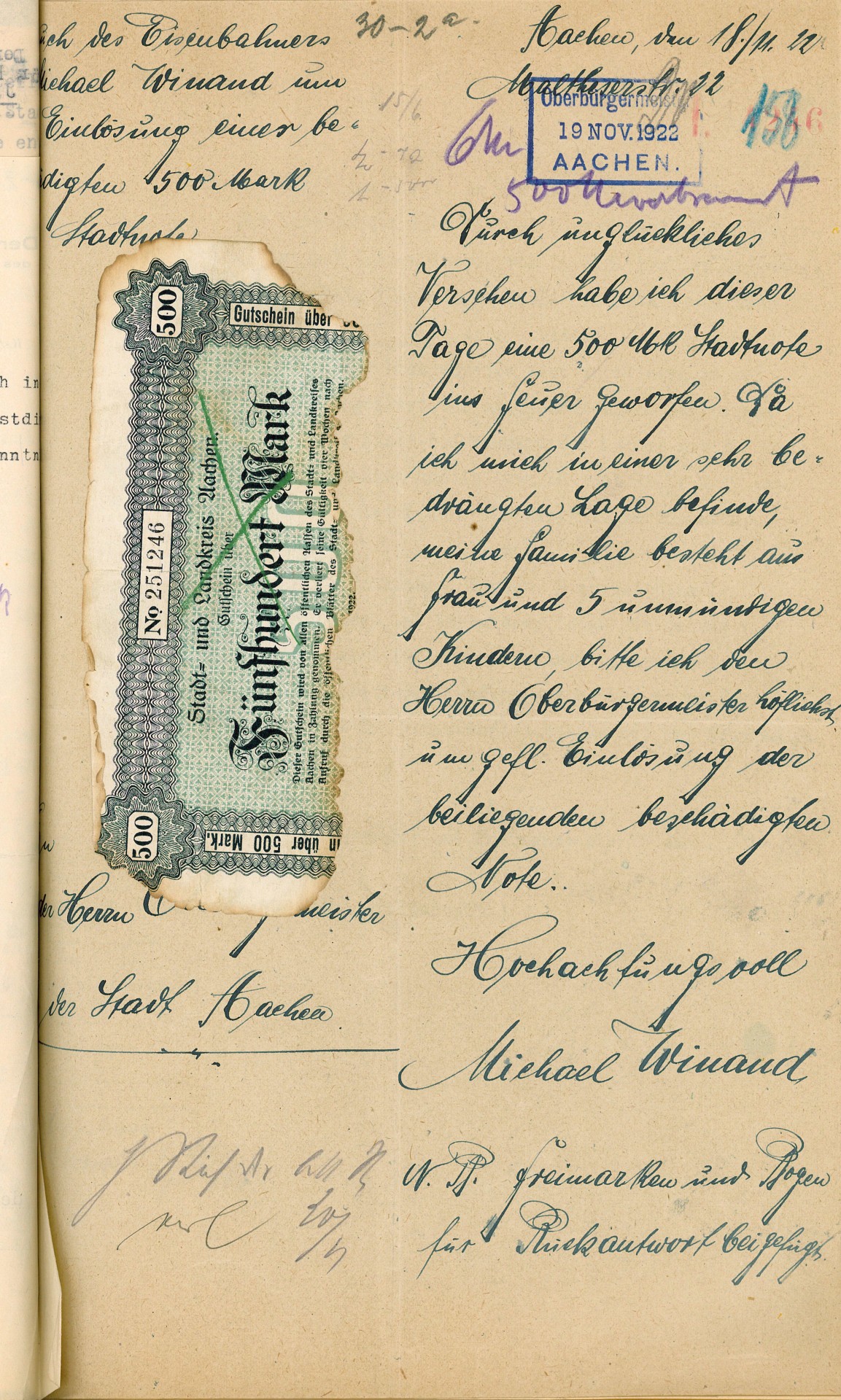
The "Archival Item of the Month" for July 2026 features a half-burned 500-mark emergency banknote from 1922.
You can subscribe to our RSS feed for our press releases here https://www.aachen.de/rss-feed-pressemitteilungen/rss.xml