NRW education projects on the road to success: Ministry representative recognizes innovative AI integration at the Euregional Centre for Digital Education in Aachen
- Innovative technologies from the state of NRW are linked with AI applications in a meaningful way.
- Dr. Tanja Reinlein, Head of Department at the Ministry of Education, visits the #placetobe(e) experience space in Aachen.
- The Euregional Center for Digital Education and the Teacher Training Center at RWTH Aachen University are developing AI-supported teaching ideas.
Last year, the state of North Rhine-Westphalia also equipped the Euregional Center for Digital Education with technologies for modern educational work using funds from the Digital Pact. This includes 60 VR glasses, drones, robotics, assistive technologies and a 3D printer for the Aachen region. A lot has happened since then. The center's media education instructors have integrated the digital tools into an experience space, which was affectionately named "placetobe(e)" in reference to the facility's first rental film. A homage to the natural history film "Maya the Bee" from the 1920s. The experience room offers teachers and specialists from the catchment area an exciting introduction to digital and virtual educational worlds. Technology and nature are combined in an educationally meaningful way and further teaching and learning materials are made available.
"In our nationwide 'Digital Making Place' project, we want to use local structures so that teachers can try out the technology for modern, innovative teaching. The Euregional Centre shows very impressively how this can be achieved with a great deal of creativity and specialist knowledge," says Dr. Tanja Reinlein, Head of Department 3, "Vocational Education, Teaching and Learning in the Digital World, Prevention and Integration, International Affairs" of the Ministry of Schools and Education of the State of North Rhine-Westphalia, praising the practical implementation in Aachen. The various stations in the experience space provide an exciting way of showing how sensitive processes in flora and fauna can be brought to life with the help of innovative technologies. At three stations, the technology is usefully supplemented with AI applications. "AI has long since found its way into our schools," reports Heinrich Brötz, Aachen's Councillor for Education, Youth and Culture. For him, it goes without saying that the central media center develops educational scenarios in this area, because: "Children and young people should know how artificial intelligence works and the potentials and risks involved".
Cooperation with RWTH Aachen University strengthens regional educational offerings
The MediaLab at RWTH Aachen University and the Euregional Center for Digital Education have joined forces to develop modern teaching concepts and offer joint training courses. "With our MediaLab, we not only want to make prospective teachers media-competent, but also focus on all three phases of teacher training and further education," explains Prof. Dr. Sven Kommer. He is a university professor in the teaching and research field of "General Didactics" with a focus on "Technology and Media Education" at RWTH Aachen University and head of the Teacher Training Center. His research assistants have developed a 360-degree application that can be used to create tours for VR glasses.
Conquering the world of artificial intelligence with animals
With the help of this application and the state's VR glasses, the "High Fens" adventure area can be explored without being on site. To make the tour an exciting and educational nature excursion for secondary school pupils, animals were placed in the moorland landscape in a deceptively realistic way using image-generating AI. However, the children and young people have to critically examine which of them actually belong in this natural environment and which do not. The great thing about it is that both the glasses and the 360-degree software can be brought into the classroom quickly and easily. This allows teachers and learners to become active themselves and create their own content.
The adventure room also offers numerous creative learning opportunities for elementary school children. For example, a floor mat with AI mythical creatures serves as the basis for programming exercises with robot bees. In addition, a text-generating chatbot enables interaction with a virtual bird chick. This chatbot was first configured using specific prompts and then trained. "Clear and context-rich prompts are crucial in order to achieve a high-quality result with generative AI models. Just like all other digital skills, this ability can also be learned. That's why we regularly offer prompting training for teachers and specialists," says Lara Langfort-Riepe, Head of the Euregional Center for Digital Education. Experimenting often goes before studying. The first step is to get to grips with the new technologies, which the #placetobe(e) invites you to do.
All schools in NRW are currently receiving a free AI application for the classroom. The Euregional Center for Digital Education is supporting the introduction with numerous events for teachers and specialists on the topic of artificial intelligence.
Further information and contact details for the Euregional Center for Digital Education can be found at: www.medienzentrum-aachen.de
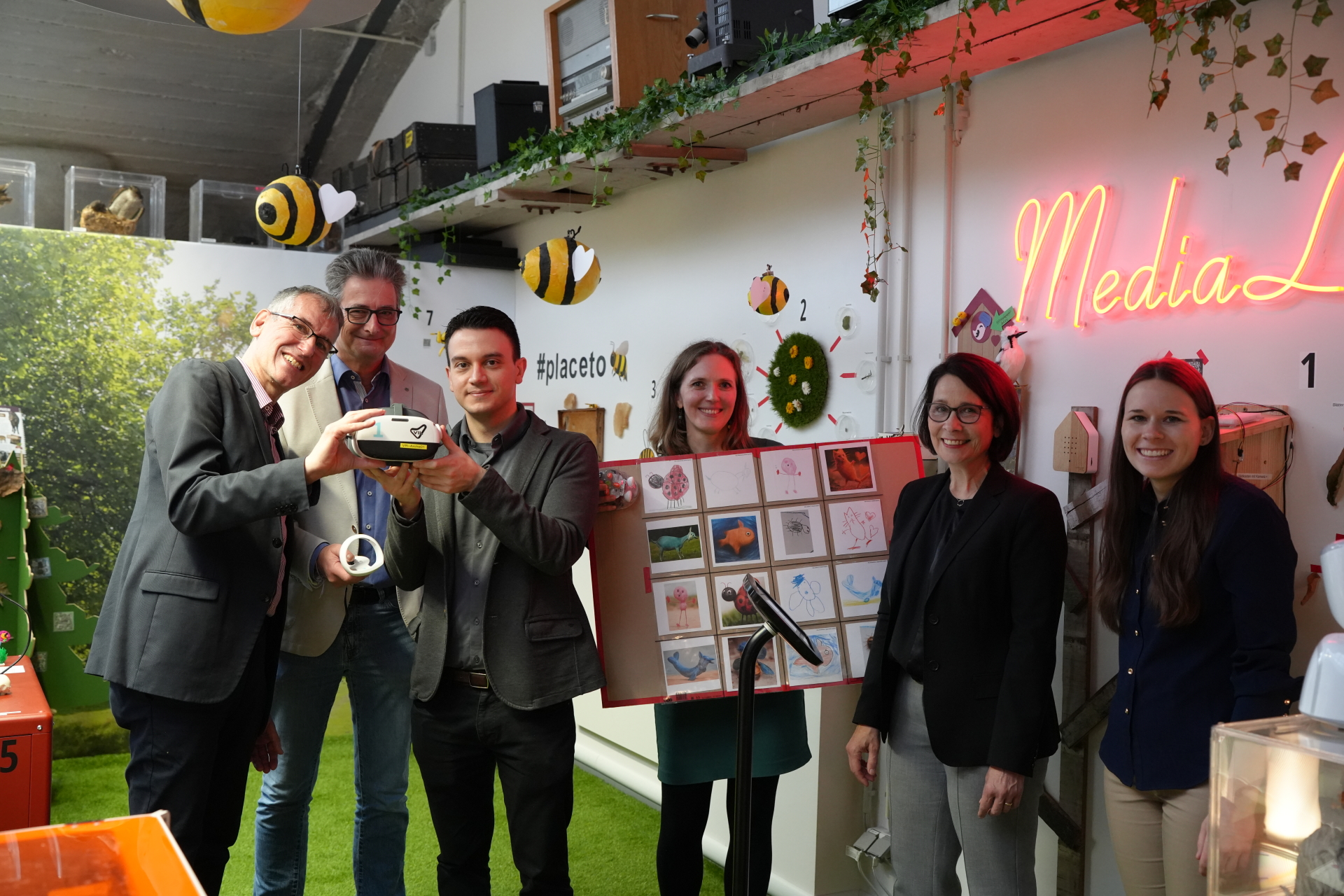
The Deputy for Education, Youth and Culture of the City of Aachen Heinrich Brötz, University Professor at RWTH Aachen University and Head of the Teacher Training Centre Prof. Dr. Sven Kommer, Head of Media and Information Technology Orhan Genc, Head of Media Education Anna Metzger, Dr. Tanja Reinlein from the Ministry of Schools and Education of the State of North Rhine-Westphalia and Head of Media Education Lena Sonntag were delighted with the innovative teaching and learning materials.
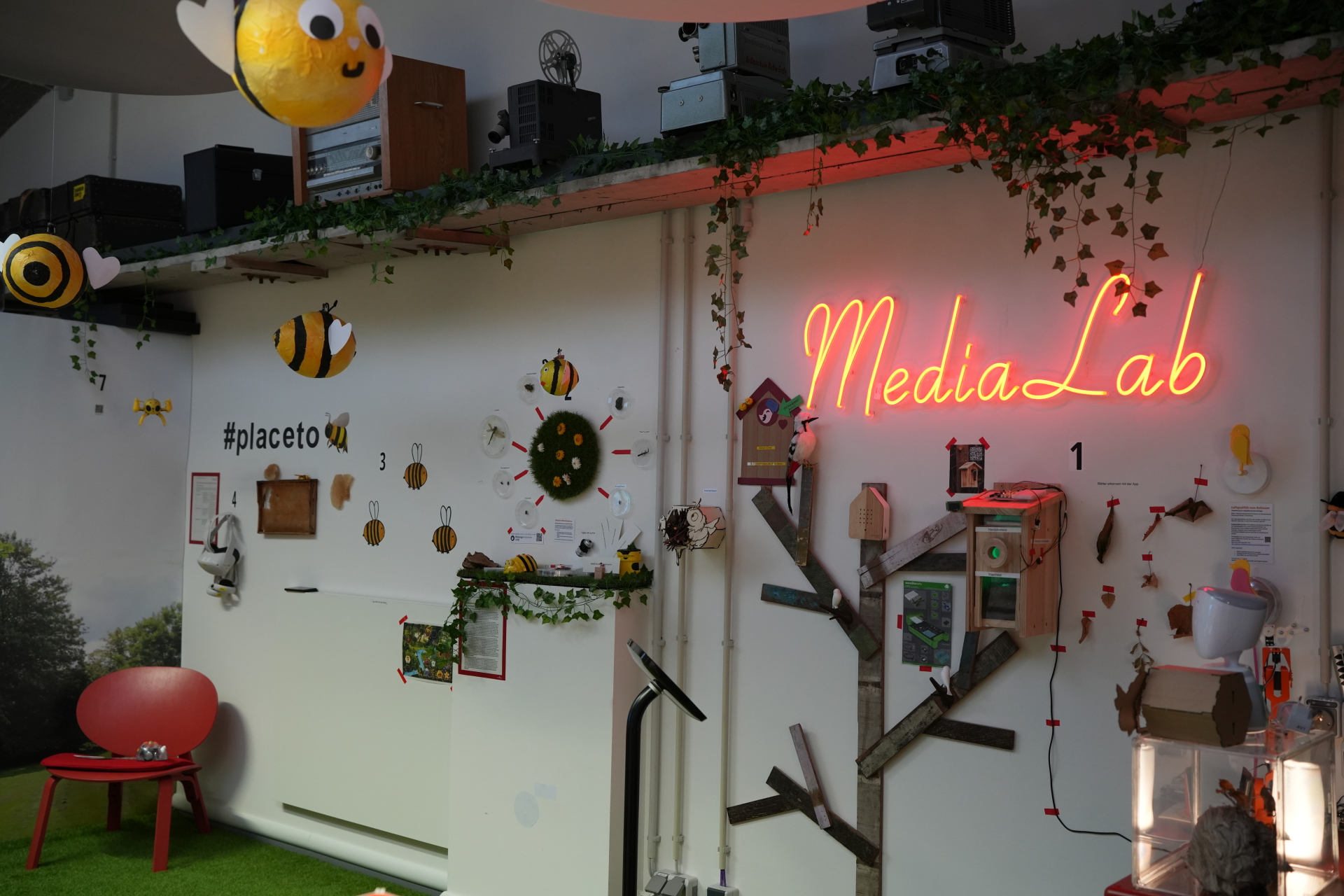
The name says it all: the lovingly designed "placetobe(e)" experience room in the Euregional Center for Digital Education.
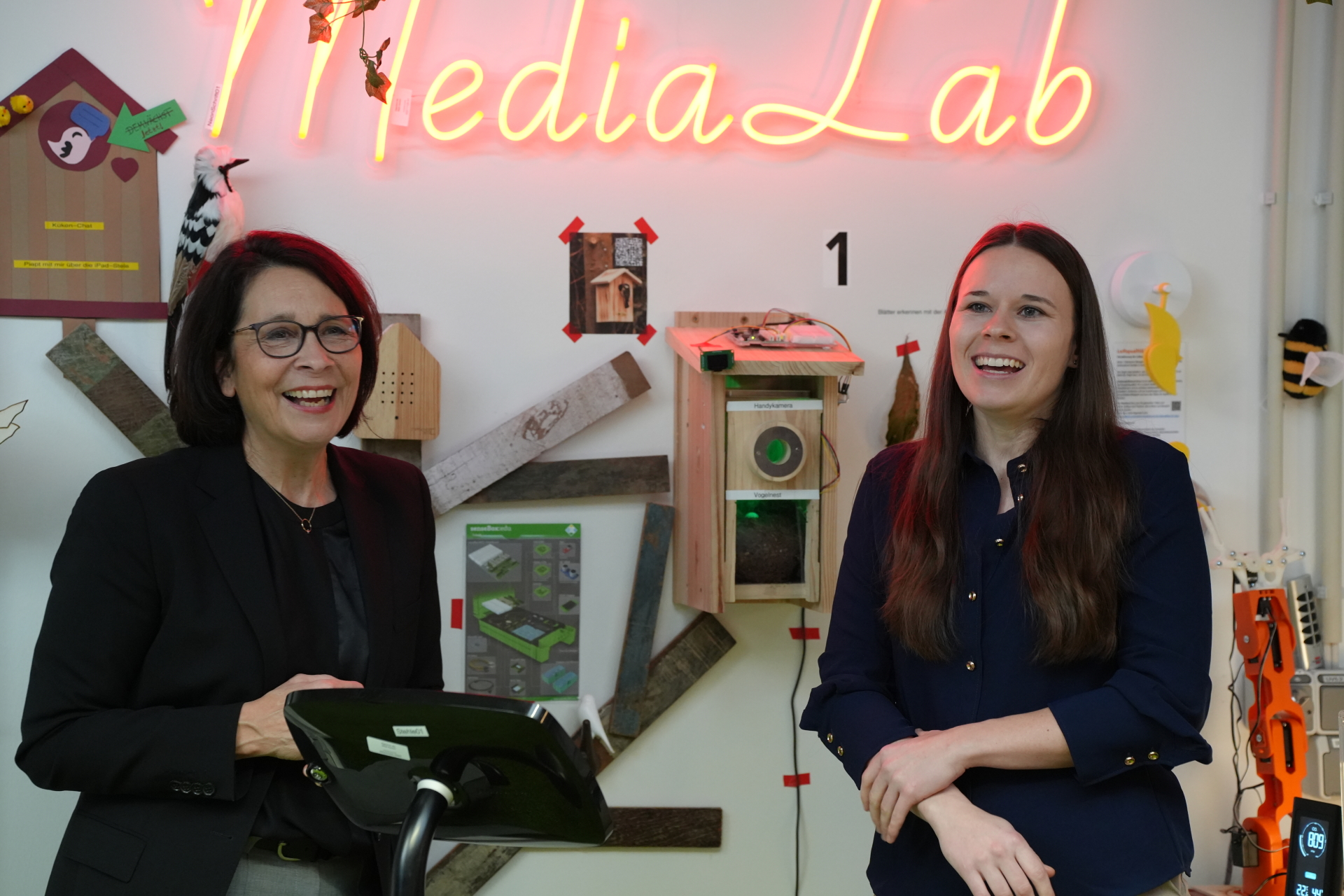
Dr. Tanja Reinlein from the NRW Ministry of Schools and Education (left) receives a demonstration of the AI-based bird nesting station from media education officer Lena Sonntag from the Euregional Centre for Digital Education.
You can subscribe to our RSS feed for our press releases here https://www.aachen.de/rss-feed-pressemitteilungen/rss.xml