Cooperation between the city and RWTH Aachen: Impetus for the former Beginenstraße special school
- In close cooperation with the city administration, students at RWTH Aachen University have developed conceptual approaches for a possible emergency shelter and daytime accommodation in the former special school in Beginenstraße.
- Designs were developed together with people affected by homelessness.
- The students have now presented three rooms as prototypes.
Can a day shelter and a new emergency sleeping facility be realized in the extension of the former Beginenstraße special school? And if so, how? Students from the Chair of Housing and Design Principles at RWTH Aachen University have been working on these questions for two semesters and have now presented their designs to the public. They were supported by staff from the city's building management department and the Department of Housing, Social Affairs and Integration. In a participatory process with people affected by homelessness, the students developed spatial constellations for the dormitories and their furnishings. Since October, the students have built a 1:1 mock-up from these results, tested it and implemented final prototypes.
Concrete designs for the emergency shelter and contact café
The result is a well thought-out overall concept: the emergency shelter is to be housed in the extension to the former special school, while a contact café will be located in the former sanitary building in the inner courtyard. This structural separation of uses creates more space for both the contact café and the emergency shelter - and also provides additional emergency sleeping places.
Rolf Frankenberger, Head of the Housing, Social Affairs and Integration Department of the City of Aachen, was enthusiastic about the designs for the café as a meeting place in the former schoolyard: "The ensemble shows that there is the potential to create more beds and at the same time create a semi-public space with a high quality of stay." At the same time, he made it clear that the city will need a new emergency shelter in the coming years, as the current temporary accommodation in Reumontstraße can only be used for another five years. The drafts now available are therefore a valuable basis for further planning. "The fact that the city was able to make the existing premises available for the students' designs has proven to be very valuable," added Stephan Ganser, Head of the Building Maintenance Department.
Participation as a central element of the design process
The students, led by Professor Florian Fischer-Almannai, Chair of Housing and Design Principles and Institute of Housing, and Sophia Branz, project manager and research assistant at the chair, invited homeless people to actively participate in the design process from the outset. "We went directly into the field and asked homeless people: What are your needs?" explained Fischer-Almannai. The desire for two-bed rooms quickly emerged. These can be easily implemented in the form of elongated rooms in the existing building. The rooms are spread over four floors, each with separate areas for men and women. On the first floor, which has barrier-free access, there are also sleeping spaces for people with limited mobility.
The continuous exchange between students and homeless people enabled the development of three different prototypes, which were set up in the former special school. "I am very pleased with this participatory approach, which focuses on specific needs," emphasized Rolf Frankenberger. The contacts were made via the Café Plattform. Its director Mark Krznaric summarized: "We are all part of a society. The exchange between those affected and the students was very lively. I'm very pleased that the city jumped on board with the idea."
Three different prototypes
One of the results is a prototype with minimal equipment: two beds with a locker between them. The second variant has an elongated bench on the wall opposite the beds to provide additional space for socializing. Between the beds are two cupboards with a small niche that serves as a bedside table with a light and socket. In the third version, a wall separates the two beds. Two cupboards with integrated sockets provide storage space. There is also space for a small seating area with a table by the window. The students placed particular emphasis on hygienic and easy-care surfaces, harmonious color concepts and privacy.
At the end of the joint presentation to representatives of the City of Aachen and RWTH Aachen University, it became clear that the two advanced prototypes were particularly convincing and will be included in further planning.
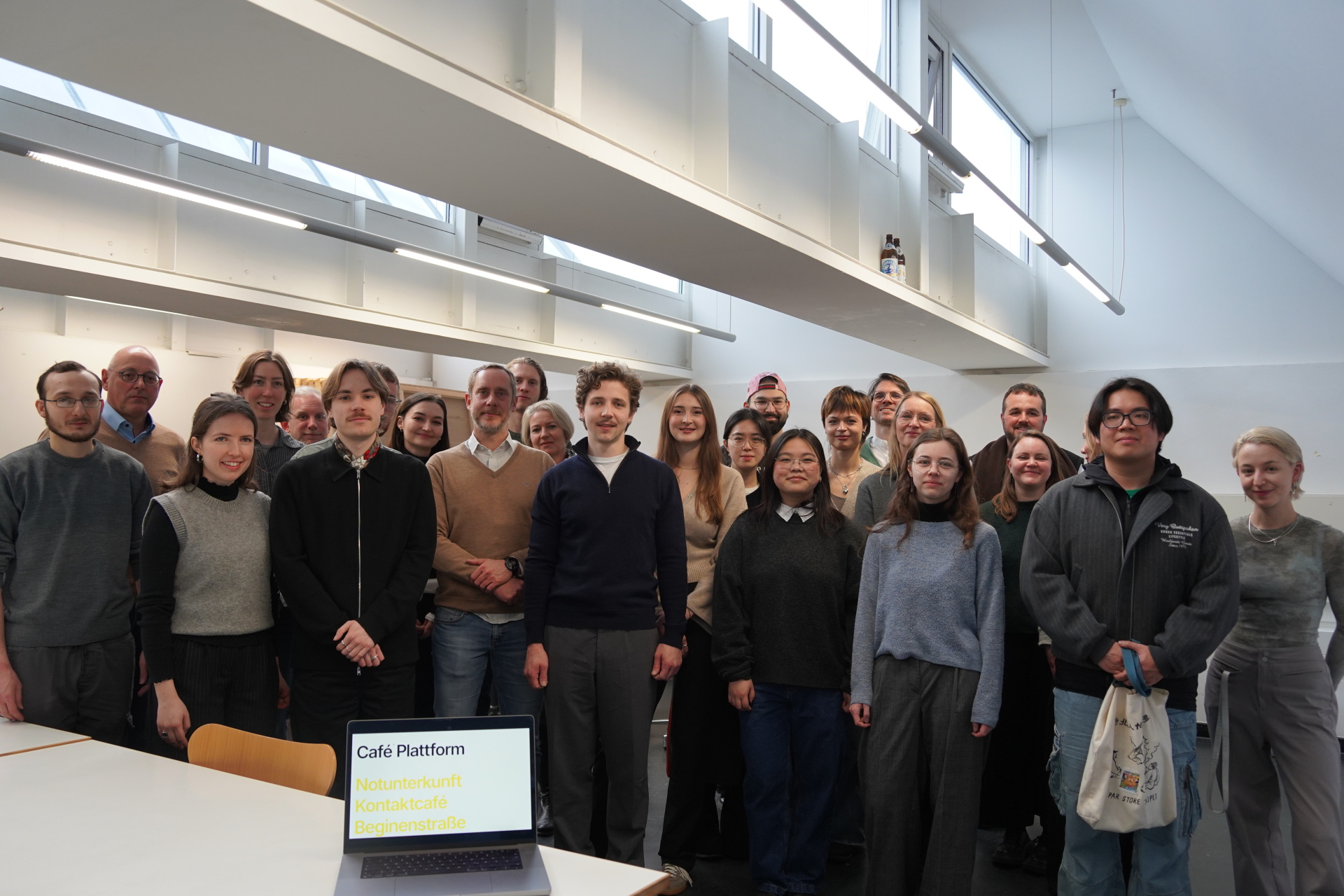
RWTH Aachen University students presented the results of the semester project to those responsible at the City of Aachen, RWTH Aachen University and the management of Café Plattform.
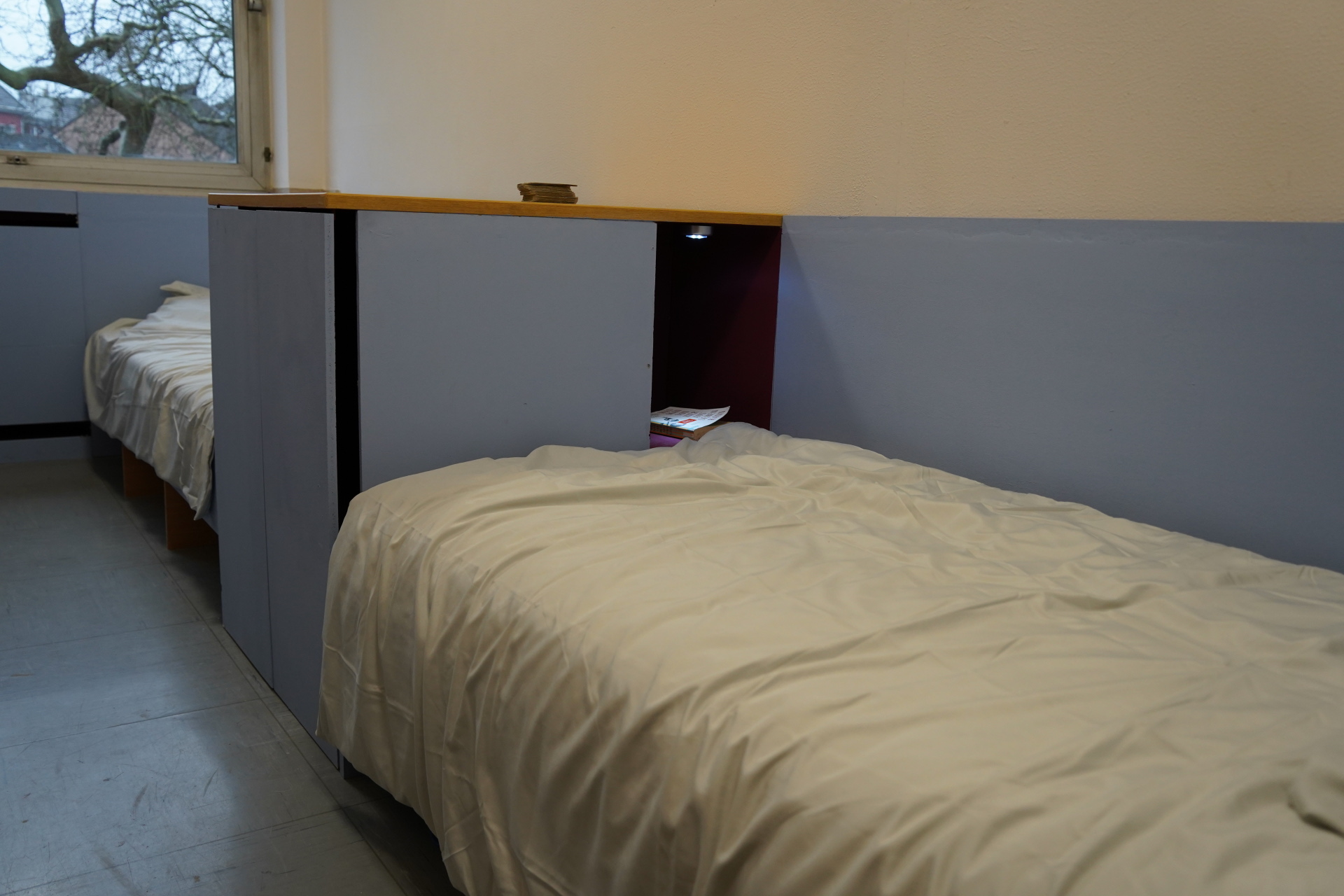
In this prototype, a small niche in the cupboard provides a storage area with light and socket.
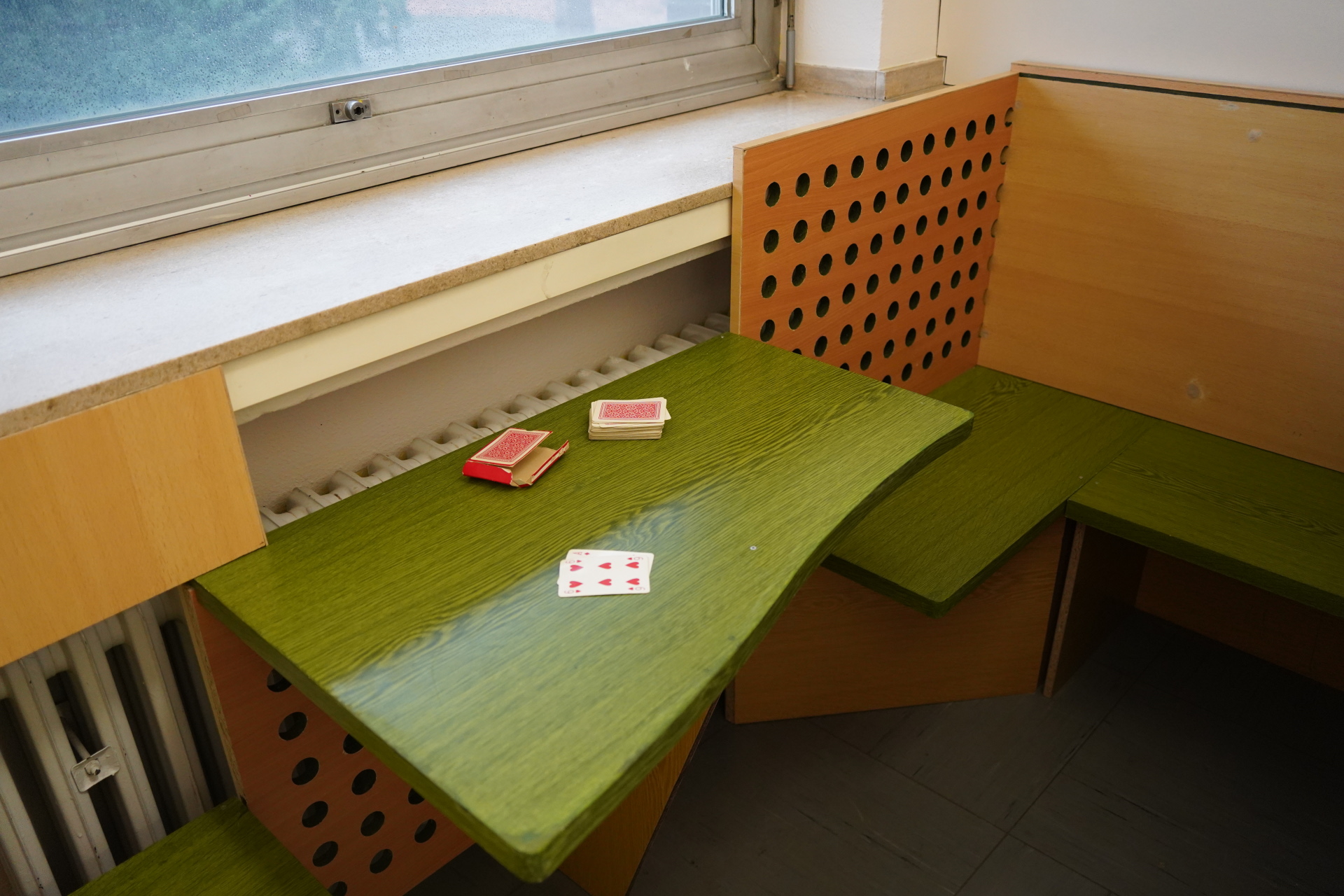
Another design envisages a seating area with space to chat or play cards.
You can subscribe to our RSS feed for our press releases here https://www.aachen.de/rss-feed-pressemitteilungen/rss.xml