Archival Item of the Month for August 2026…
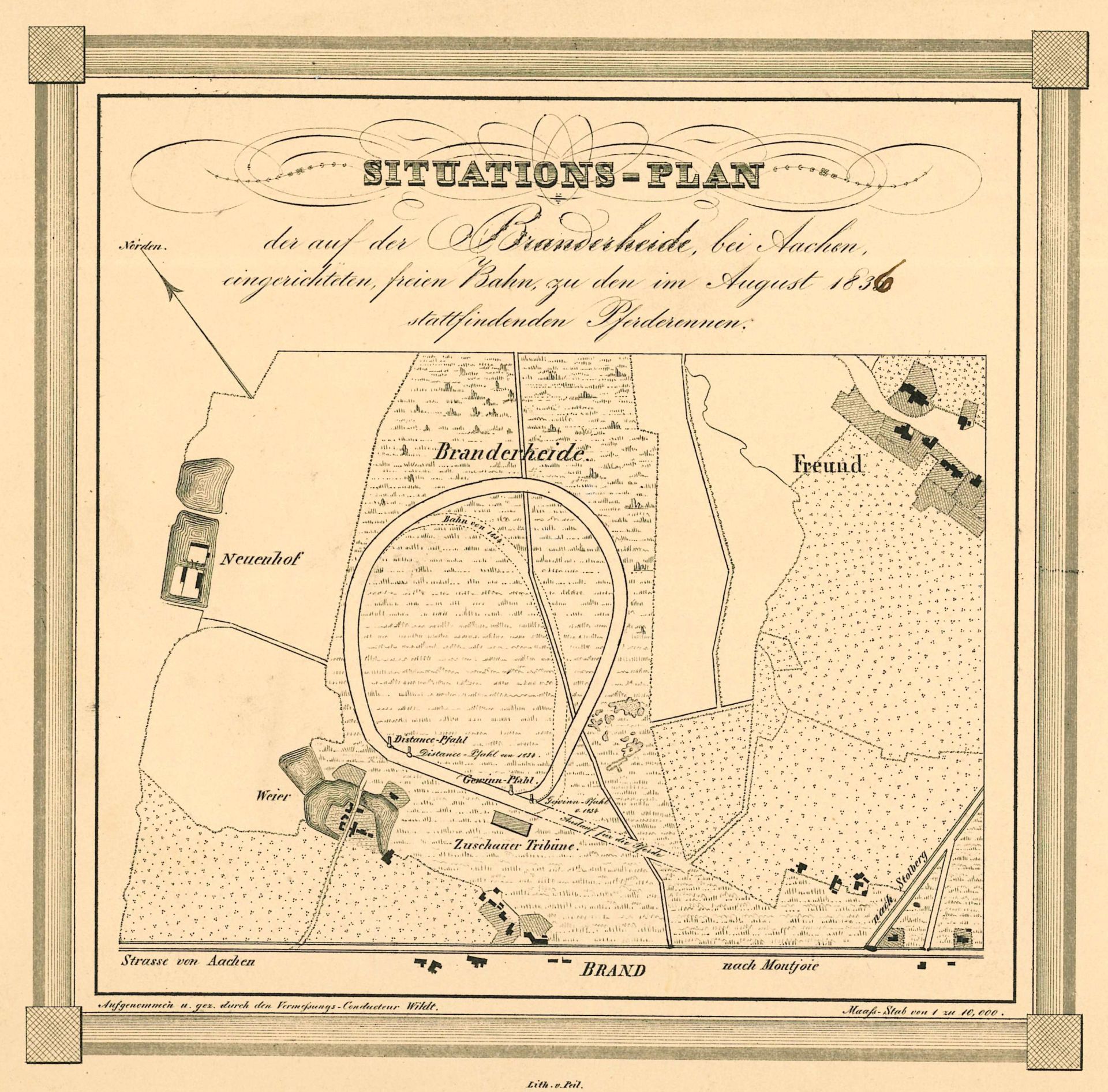
- …shows a site plan of the racetrack on the Brander Heide from 1836.
- The first horse race modeled after the English style took place as early as 1821. It is considered one of the earliest, and perhaps even the earliest, on German soil.
- In 1896, the Aachen Racing Club discontinued its races for various reasons. The idea of a “Laurensberg Racing Club” was born.
The Aachen City Archives regularly features interesting items from its collections as “Archival Item of the Month.” The item, accompanied by a brief description, is displayed in a showcase in the foyer of the City Archives on Reichsweg and is also presented digitally on the Archives’ website. In August 2026, the featured item is a site plan of the original racetrack on the Brander Heide, drawn to a scale of 1:10,000, showing the new track layout from 1835–36 in comparison to the dashed-line layout from 1834. To the west of the racetrack, the Neuenhof estate is marked; to the northeast, houses in the village of Freund; and to the south, buildings in Brander can be seen. The map was surveyed by surveyor Wildt and produced by lithographer Peil.
Horse Racing as an Important Part of the Spa
Industry: Horse races modeled after the English style were an important part of urban bourgeois culture in the 19th century, and in particular of the spa industry. The first horse race modeled after the English style took place on July 15, 1821, “on the great heath in the Brand forest district.” The race, organized by the newly founded Aachen Racing Club, is considered one of the earliest—perhaps even the earliest—on German soil. The race was held with “racehorses and local draft horses.” An English stablemaster oversaw the conduct of the competition.
The race was held in honor of King Frederick William III, who sent his second-eldest son, Wilhelm—later Emperor Wilhelm I—to Aachen as his representative. The rules, written in German and French, were first adopted by the Committee for the Administration of Horse Races in 1821 and revised for all subsequent competitions; they laid out in detail the conditions for the race, such as the start, the track, the responsibilities of those involved in the race, the use of the horses, and much more.
Huge Crowds and Great
Enthusiasm: In its July 17, 1821, issue, the *Stadt-Aachener Zeitung* reported enthusiastically on the first race: “[…] the influx of the crowd was so great that not only was the entire circuit—which spanned one English mile in circumference—already packed solid with thousands of spectators by around 3 o’clock, but also the neighboring fields and trees were packed with people right up to the highest branches, which, combined with the hundred or more carriages—mostly carrying foreign nobility—and an innumerable retinue of horsemen […], provided a sight that lifted the spirits.”
After a hiatus, horse races were held annually on the Brander Heide starting in 1834. On August 17, 1836, the *Stadt-Aachener Zeitung* reported: “This year’s season is one of the most popular Aachen has ever seen. With each passing day, the number of visitors is growing, as the highlight of the entertainment the city is striving to offer its guests—the horse races—draws nearer. And indeed, so many visitors have already been announced that, despite the numerous and magnificently appointed hotels, there will be a shortage of room for the guests.”
Cancellations, Suspension of Races, and the Beginnings of the ALRV
: Starting in 1841, the race was canceled on several occasions; from 1846 onward, it was suspended for 23 years, until the Brander Heide grounds were once again used for regular horse races beginning in 1869. In 1896, the Aachen Racing Club discontinued the races for various reasons. The idea of a “Laurensberg Racing Club” was born, and the club was founded in 1898. In 1923, this club evolved into the Aachen-Laurensberg Racing Club.
The Aachen Horse Show as the
CHIO: The new association began organizing new racing and tournament events, which quickly grew in scale. In 1933, the Aachen Equestrian Tournament was held for the first time as the “Concours Hippique International Officiel” (CHIO), a title awarded by the International Equestrian Federation to tournaments that met certain criteria. From 1930 to 1936, races were once again held at “Brander Heide” as part of the equestrian tournaments, though not on the historic racecourse but on the grounds of the Krummerück parade ground.
Sources:
Aachen City Archives, PRZ 12-70; PRZ 20-8; Stadt-Aachener Zeitung; Fusenig, Anette: “How to Invent a ‘World Festival of Equestrian Sports’—The Aachen Show Jumping, Riding, and Driving Tournament from 1924 to 1939,” Ph.D. dissertation, Aachen, 2004
You can subscribe to our RSS feed for our press releases here https://www.aachen.de/rss-feed-pressemitteilungen/rss.xml