The Archivale of the month May 2026...
- ... shows Alcide de Gasperi after being awarded the Charlemagne Prize on September 24, 1952, as he signs the Golden Book of the City of Aachen.
- de Gasperi was the first high-ranking politician to receive the Charlemagne Prize, which was awarded in 1950. The awarding of the prize to de Gasperi thus also marked a reputational gain for the Aachen award.
- Mario Draghi is the third Italian politician to receive the International Charlemagne Prize on May 14.
The Aachen City Archive regularly presents interesting items from its stacks as Archive of the Month. The item with a short accompanying text is presented in a display case in the foyer of the city archive on Reichsweg and digitally on the archive's homepage. In May 2026, it is a photo of former Italian President Alcide de Gasperi after being awarded the Charlemagne Prize on September 24, 1952, as he signs the Golden Book of the City of Aachen.
From De Gasperi to Carlo Azeglio to Mario DraghiWhen
Mario Draghi receives the Charlemagne Prize on May 14, he will be the third Italian politician to be honored with this award. In 2005, Carlo Azeglio Ciampi, the former President of Italy, received the prize for his contributions to European integration. And 53 years earlier, on September 24, 1952, the third Charlemagne Prize had already been awarded to the then Italian Prime Minister Alcide de Gasperi (1881–1954).
“Great Architect of a Europe in the Making” Aachen
Mayor Albert Maas paid tribute to de Gasperi in the City Hall’s Coronation Hall—still bearing the scars of war—as a shrewd negotiator among European nations, calling him a “great architect of a Europe in the making” —all this while the impressions of the first assembly of the European Coal and Steel Community, the precursor to today’s European Union, held 14 days earlier in Strasbourg and just seven years after the end of World War II, were still fresh. This marked an important milestone in the so-called Schuman Plan, which was intended to establish supranational control over coal and steel production in Europe to prevent a renewed arms race among the European powers. The founding members of the European Coal and Steel Community were Germany, France, Belgium, the Netherlands, Luxembourg—and Italy.
The Charlemagne Prize certificate logically recognized de Gasperi as a committed and realistic statesman. It states that the prize is awarded to him "in recognition of his constant promotion of European unification. His tireless dedication to the political and economic cooperation of the European peoples with the ultimate aim of supranational unity has achieved significant practical results."
A Call for a Shared European
MindsetIn his acceptance speech, De Gasperi emphasized that the establishment of the European Coal and Steel Community was intended to be only the first step toward European unity, which “might gradually extend to other areas, leading to the creation of a single European market with a common currency and the free movement of goods and people.” The laureate was well aware, however, that these developments would take time, and he called for the development of a European mindset that would transcend individual interests and act in the common European interest.
A Boost to the Charlemagne
Prize’s ReputationAlcide de Gasperi was the first high-ranking politician to receive the Charlemagne Prize, which had been awarded since 1950. His two predecessors, Richard Coudenhove-Kalergi (1950) and Hendrik Brugmann, were honored as the intellectual pioneers of European unification. The awarding of the prize to de Gasperi thus also marked a boost to the reputation of the Aachen award. He was followed by some of the most significant politicians of their time: Jean Monnet (1953), Konrad Adenauer (1954), Winston Churchill (1955), Paul-Henri Spaak (1956), and Robert Schumann (1957). Alcide de Gasperi himself died in August 1954, a good two years after receiving the honor in Aachen. In the months leading up to his death, he served as President of the Parliamentary Assembly of the European Coal and Steel Community, which would later become the European Parliament.
Sources: Aachen City Archives, photo collection XXV.11; print collection K9
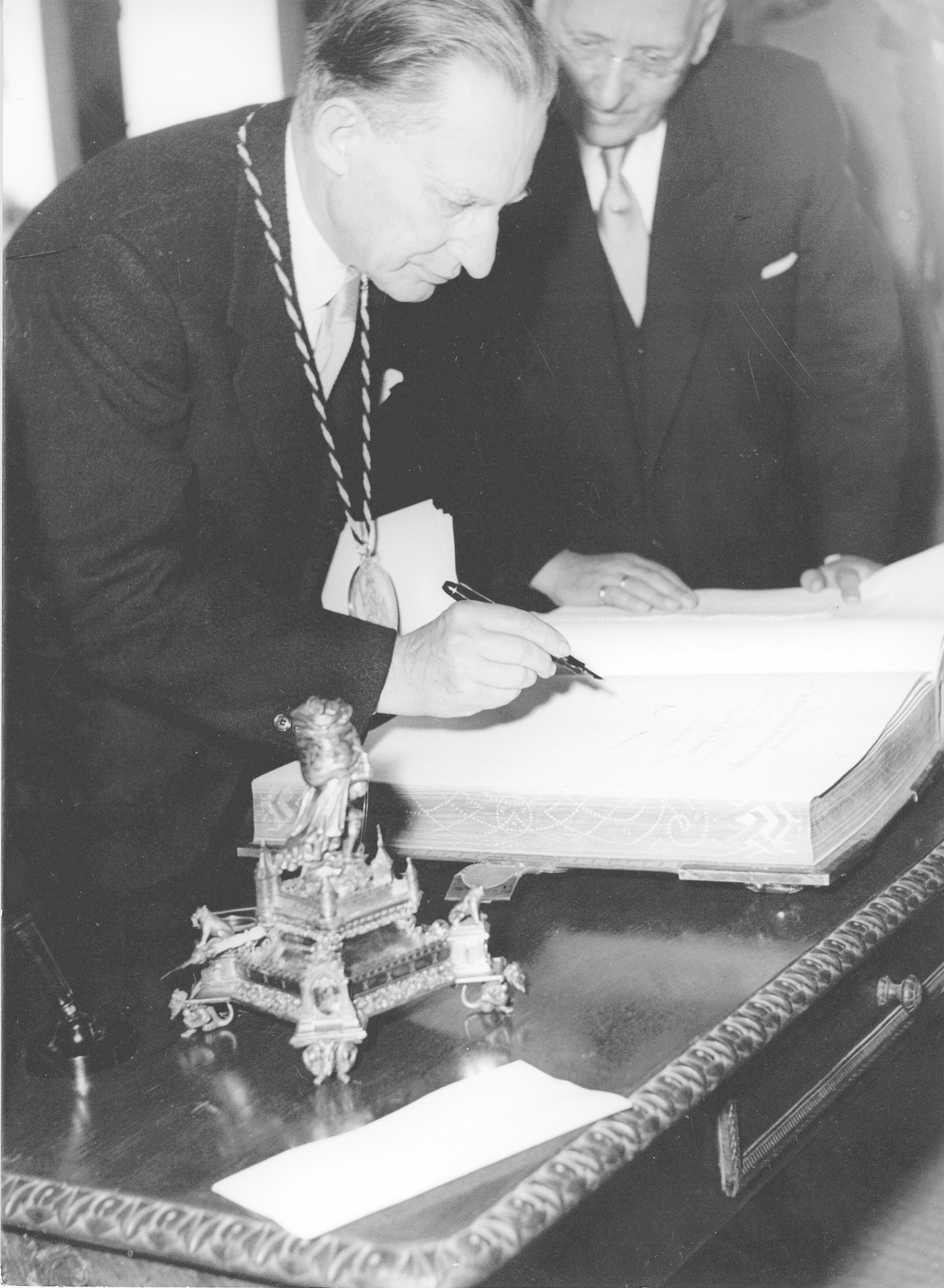
The archival painting of the month May 2026 shows Alcide de Gasperi signing the Golden Book of the City of Aachen after being awarded the Charlemagne Prize on September 24, 1952.
You can subscribe to our RSS feed for our press releases here https://www.aachen.de/rss-feed-pressemitteilungen/rss.xml