Completion of the cemetery development concept
9,040 square meters of new meadows and flowering areas, 188 trees planted, 597 square meters of unsealed areas; plus 631 square meters of newly planted perennial beds planted with insect-friendly species - this is part of the balance sheet that the Aachen municipal company has drawn after four years of successful implementation of the cemetery development concept.
As part of the "Municipal model project for the implementation of ecological sustainability goals in regions undergoing structural change" funding program, Aachen's district cemeteries were examined and further developed with a view to sustainably increasing biodiversity and peaceful recreation. "We had a comprehensive cemetery development concept drawn up that takes into account the different aspects and requirements of the respective district cemeteries," explains Ilse Savelsbergh, Head of Green and Open Space Maintenance at Aachen's municipal services. The measures implemented thus cover the ten largest municipal district cemeteries in Brand, Schildchenweg, Schleckheim, Walheim, Haaren, Eilendorf, Verlautenheide, Hand, St. Laurentius and Richterich. 457,458.68 euros were invested in the project, 80 percent of which was funded by the Federal Ministry for the Environment, Climate Protection, Nature Conservation and Nuclear Safety and 20 percent by Aachener Stadtbetrieb. The concept will be transferred to the smaller district cemeteries in future, provided the small cemeteries have the potential.
A survey of cemetery visitors in the run-up to the measures revealed, among other things, a strong demand for additional seating. The project participants responded to this request: 28 individual benches and seven groups of seats were installed in suitable locations.
The need to develop the areas is due to the history and current cultural changes: When the cemetery areas were planned in the 1970s, it was assumed that a much larger area would be required for burials. However, the sharp increase in urn burials, which also results in significantly smaller burial areas, means that numerous areas are no longer needed - a situation that not only affects Aachen, but also occurs nationwide. "With this project, we are showing what possibilities there are for designing and using the areas differently," says Heiko Thomas, Aachen's Councillor for Climate and Environment, City Operations and Buildings. "It is important that we lay the foundations today and take this path with calm and consistency."
"The completion of the funding project is therefore only the beginning of the development of our cemetery areas," says Wolfgang Berg, Head of Cemeteries and Crematorium at Aachener Stadtbetrieb. "In the following years, we will continue to develop the areas and involve the citizens in the process."
While the cemetery development concept for the district cemeteries has now been completed, the project for the city of Aachen's inner-city cemeteries will run until the end of 2026. Here, too, the areas have been and will be developed in order to strengthen the ecological potential and biodiversity of fauna and flora, for example; the measures are a contribution to climate adaptation. "The burial plots will of course remain untouched," emphasizes Ilse Savelsbergh.
As the cemetery development plan is being finalized, we would like to hear from residents. You are invited to take part in a survey: Resident Survey on District Cemeteries – City of Aachen Service Portal.
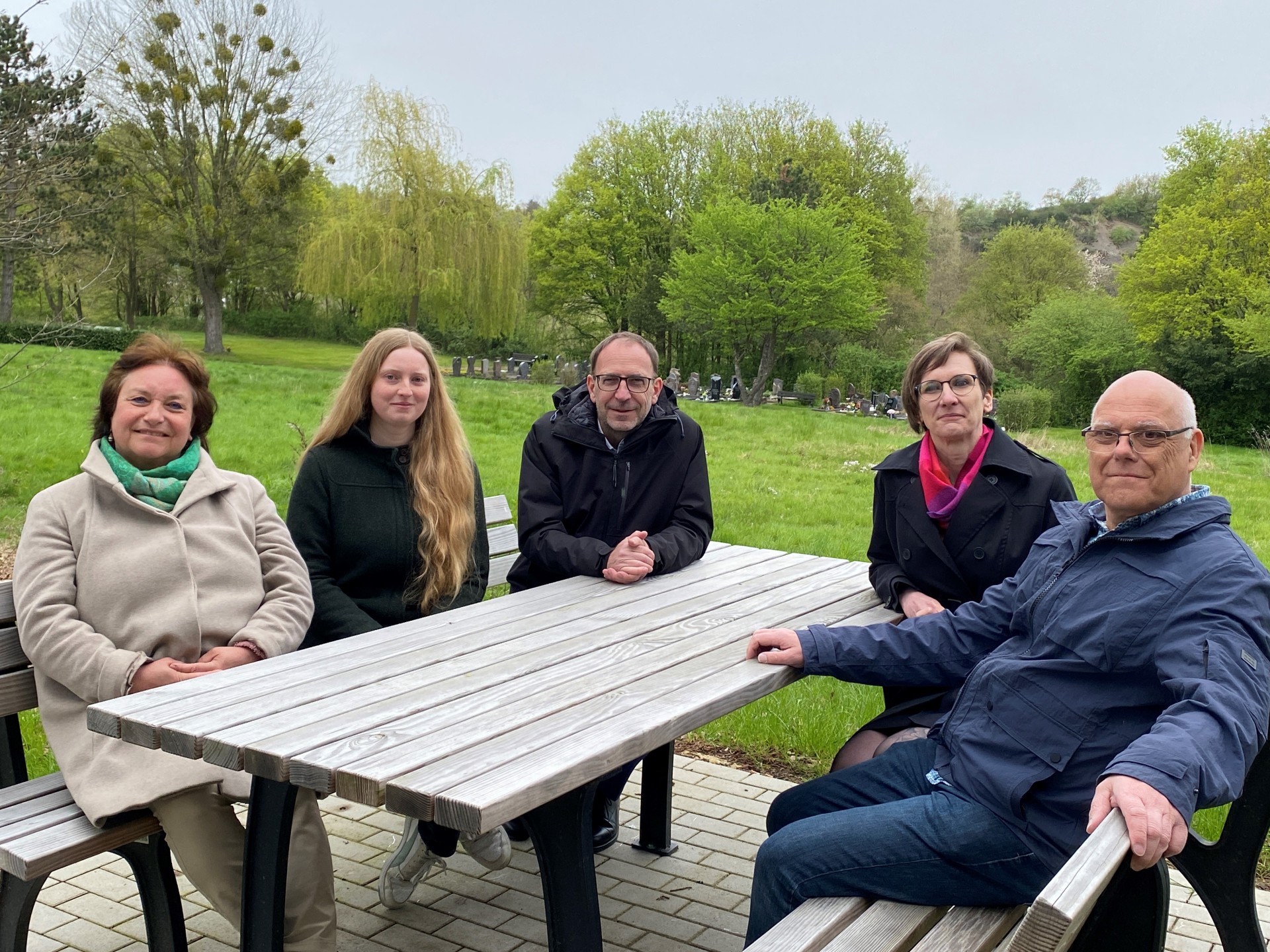
Successful project completion: Ilse Savelsbergh, Rieke Wolters, Heiko Thomas, Indra Balsam and Wolfgang Berg are delighted with the results.
You can subscribe to our RSS feed for our press releases here https://www.aachen.de/rss-feed-pressemitteilungen/rss.xml