Information on meadow worlds: Panels tell about the animal and plant world
Wild plant meadows, which were created as part of the "FLIP" project, thrive in many places in the city. The vast majority of them are to be preserved in the long term and contribute to greater biodiversity in urban areas.
Passers-by were regularly asked by the Chair of Communication Science at RWTH Aachen University how they perceived the meadows. It became clear that the meadows are well received, but that more information on the aims of the project, the special features of the meadows and their maintenance is desired. Enquiries from the public to the City of Aachen have also shown that information is needed to create understanding for this new type of green space.
New information boards at selected meadows
Since summer 2025, information boards at selected "FLIP meadows" have been providing information about various aspects of these meadow worlds. Which plants make up these typical regional wild meadows and which animals have settled here? What value do wild plant meadows have and how are they maintained by the city? Information is also provided on the ecological developments on the project areas: The Institute for Environmental Research at RWTH Aachen University has incorporated the results of its monitoring of the flora and fauna into the texts. The panels were created by entomologist Dr. Manfred Verhaag, a former employee of the State Museum of Natural History in Karlsruhe. The location of the meadow areas is shown on the geoportal of the city of Aachen and on the family city map. The locations of the information boards are also marked there.
"We are convinced that the wild plant meadows in our city are a good service to people and animals. With the information boards, we are rounding off our offer to citizens, which will continue beyond the end of the project in March 2026 with further training, events and a meadow rucksack to borrow," explains Heiko Thomas, Head of Climate and Environment, Municipal Operations and Buildings of the City of Aachen.
The FLIP project is funded by the Federal Agency for Nature Conservation with funds from the Federal Ministry for the Environment, Climate Protection, Nature Conservation and Nuclear Safety as part of the Federal Biological Diversity Program. Further information can be found at www.flip-wiesen.de.
Internet:
www.geoportal.aachen.de/extern/ (right column: family city map)
www.flip-wiesen.de
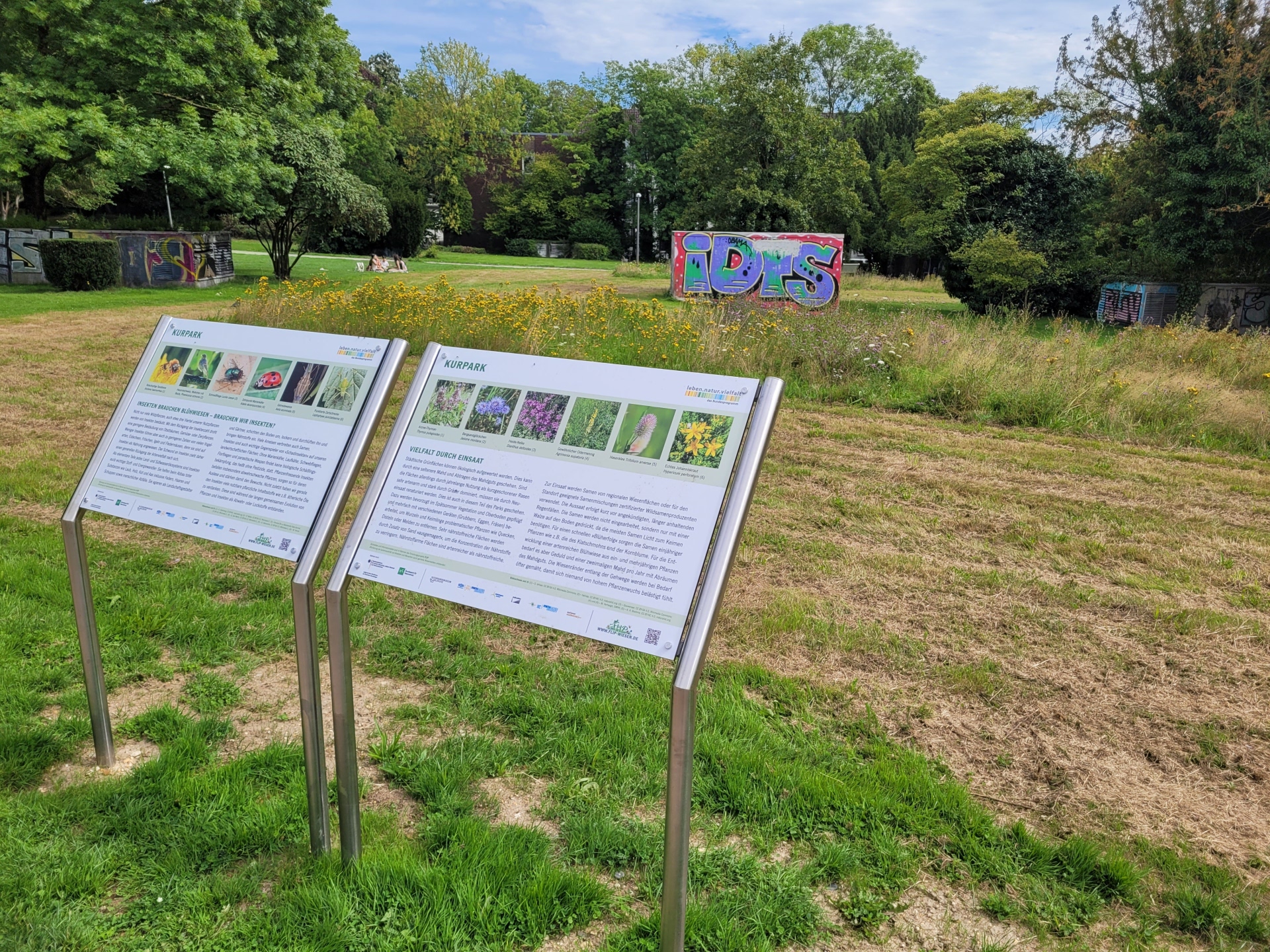
A total of 41 boards at around 20 locations - here in the Kurpark - in the city and city region are intended to provide information about the meadow worlds of a FLIP meadow.
You can subscribe to our RSS feed for our press releases here https://www.aachen.de/rss-feed-pressemitteilungen/rss.xml