The Archivale of the month July 2025...
- ... shows the ceremonial transfer of the civilians from Richelle who were executed in Aachen in 1914 to their homeland.
- The death certificates issued in Aachen, newspaper reports and Belgian sources made it possible to establish the identity of the five men.
- The solemn funeral procession was intended to pay tribute to them as "martyrs" and bring them back to their homeland with honor. At the same time, they made the victims visible to the people of Aachen.
The Aachen City Archive regularly presents interesting items from its stacks as Archive of the Month. The item with a short accompanying text is presented in a display case in the foyer of the city archive on Reichsweg as well as digitally on the archive's homepage. In July 2025, the Archivale of the Month features a photograph from July 20, 1920, showing a funeral procession passing the municipal theater. This is the ceremonial repatriation of five Belgian and Dutch civilians who had been executed in Aachen in 1914.
Grand procession with church and military honors
On July 20, 1920, an impressive funeral procession passed through Aachen. In the photo by an unknown photographer, it passes the city theater, in front of which onlookers have gathered. At the head of the procession marches a formation of Belgian soldiers, behind them walk three bishops in regalia. The flower-bedecked carriages carrying the mortal remains of five men are pulled by seven horses each and led on both sides by Belgian soldiers.
The funeral procession made its way to the cathedral, where the deceased were honored with a high mass. Other photos show Belgian soldiers carrying the coffins through the main portal of the cathedral after the mass. The opening of the portal, known as the Wolf's Door, is traditionally rare and represents a special honor. Who were the five men who were honored in Aachen in this way, both militarily and ecclesiastically, in a highly visible public act?
Arrested in 1914 and executed at the shooting range
Their identities can be determined from the death certificates issued by the Forst registry office, newspapers of the time and Belgian sources. They were the field guard Guillaume Fafra and his son, the gunsmith Henri Fafra, as well as the merchant and sexton Jean Trinon, the worker Guilleaume Ackens and Joseph Monix, whose profession is unknown. They all came from the village of Richelle near the Belgian town of Visé. Four of them were Belgian nationals and one, Ackens, was Dutch.
The five men were arrested by German soldiers on August 6, 1914 and accused of firing shots at fellow soldiers. They were court-martialed in Aachen and executed at the shooting range in Forst on August 11, 1914. Their bodies were buried on the spot.
German war crimes in Berneau, Belgium
This had happened in the first days of the German invasion of neutral Belgium, which had begun on August 4 and constituted a violation of international law. In this way, the German general staff attempted to bypass the French defenses and, after quickly capturing the fortress ring around Liège, to advance into the interior of France via Belgium, but this failed. Aachen was an important logistical hub for this attack. The Aachen garrison force, Infantry Regiment 25, was involved. It was supposed to cross the Meuse at Visé, but encountered resistance and initially had to halt its advance in front of the river. A war crime was committed there on August 5: Residents of the village of Berneau had allegedly fired on German soldiers, whereupon they killed ten inhabitants*, including the mayor Walthere Bruyere, and destroyed 67 houses. Berneau is near Richelle, where the five men who were later executed in Aachen were arrested the following day.
"Exemplary punishment" of hundreds of people
The Aachen newspapers repeatedly reported on alleged atrocities committed by the Belgian civilian population against German soldiers, justifying the violence perpetrated against them. In fact, war crimes were repeatedly committed against Belgian civilians in the first months of the war. Actual or alleged acts of resistance, but also coincidences and misunderstandings in chaotic situations as well as the fear of so-called francs-tireurs - meaning Belgian partisans in German parlance - were the reason for "exemplary punishments", which in some cases claimed the lives of several hundred people.
Recognition as a "martyr" and honorable return home
After the end of the war, the Belgian occupation authorities found out about the graves on the site of the Forster shooting range. During excavations, they discovered the remains of the five men from Richelle. The solemn funeral procession was intended to honor them as "martyrs" and bring them back to their homeland with honor. At the same time, they made the victims visible to the people of Aachen. In public statements, which were reproduced in Aachen's newspapers, they emphasized the unlawfulness of the executions and considered them to be war crimes.
In Richelle, the names of the five men are mentioned on the war memorial and on the grave monument near the church. The two surviving wives are also included in this commemoration. The Belgian flag is still flown over the grave today.
Source
Stadtarchiv Aachen, SLG 107-212
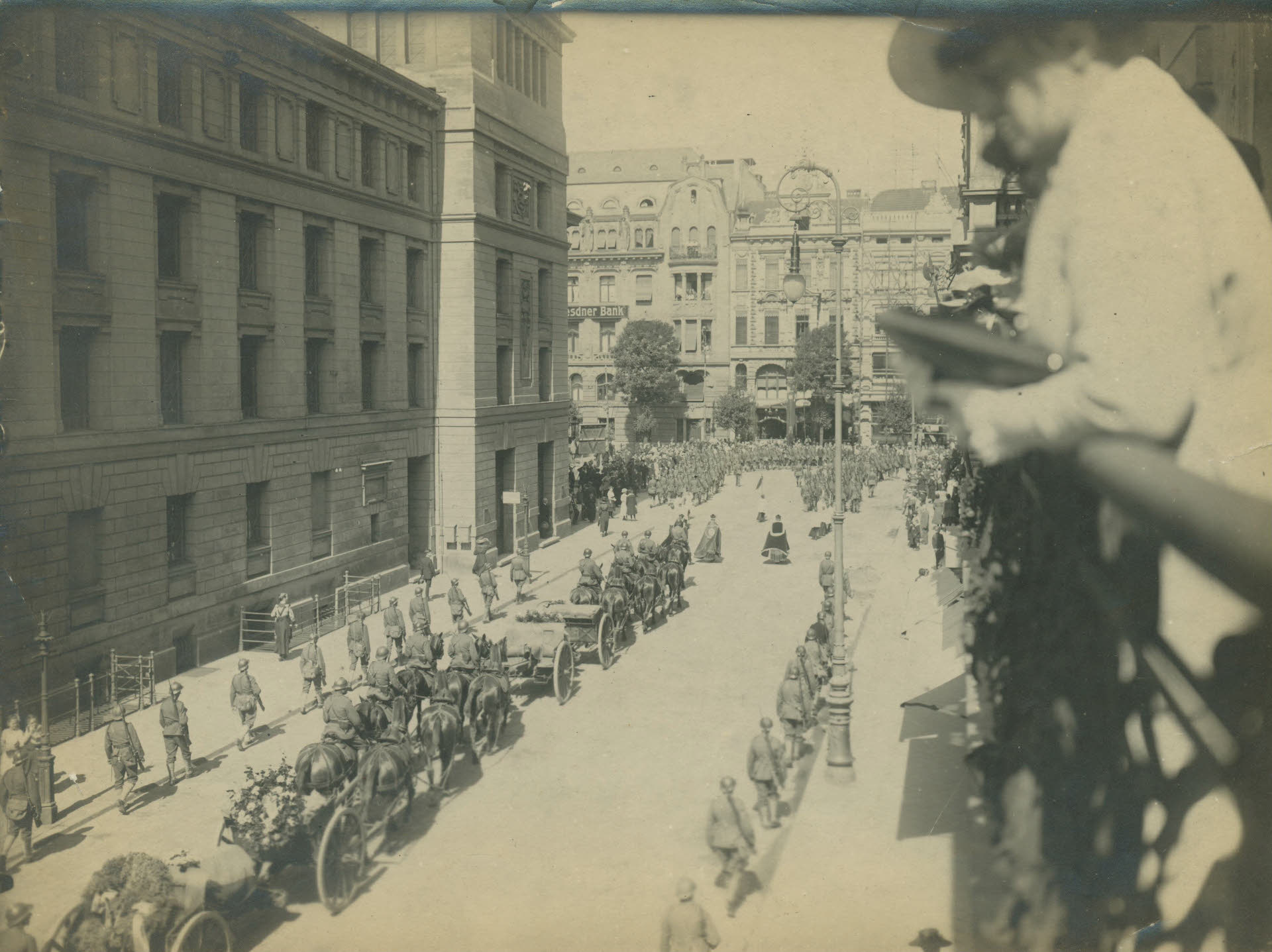
105 years ago: Ceremonial repatriation of the civilians from Richelle executed in Aachen in 1914
You can subscribe to our RSS feed for our press releases here https://www.aachen.de/rss-feed-pressemitteilungen/rss.xml