The Archivale of the month December 2025...
- ... shows an advertising graphic of the "Gebrüder Kaufmann" from 1908.
- An idealized depiction of the cityscape and Christian motifs were intended to attract more attention to the reopening.
- The history of the department store reflects the importance of Jewish entrepreneurs in Aachen's economic history, but also the violence of the Nazi regime and its anti-Semitic measures.
In February 1908, the Aachen department store "Gebrüder Kaufmann" published an elaborate advertising graphic in newspaper format. It shows Großkölnstraße - albeit in an idealized form as a wide shopping street with numerous small stores. The "Gebrüder Kaufmann" department store can be seen on the right-hand edge of the sheet: A richly decorated Art Nouveau building with shop windows on all floors. Across the roadway is the inscription: "The year 1908 opens up a new sphere of activity for Kaufmann Brothers Aachen".
Idealized representation and Christian motifs for more attention
The rest of the cityscape is also idealized: Großkölnstraße runs - quite unlike in reality - in a straight line towards the town hall façade with its two massive towers. The towers of the cathedral, the church of St. Foillan and the administrative building at Katschhof, on the other hand, have been omitted for reasons of composition. For the same reason, a tower that does not actually exist has been placed behind the towerless Church of St. Nicholas on Großkölnstraße. This creates the image of a wintery old town with three romantic towers in front of a snow-covered landscape. The night sky is adorned with several comets, the largest bearing the name "Gebr. The iconography is reminiscent of the Christian motif of the Star of Bethlehem, which indicated the birth of Jesus.
However, the Christmas motif was not published for the Christmas season. Instead, in February 1908, the sheet was attached to several daily newspapers and announced the reopening of the department store at Großkölnstraße 59-63. The irritating use of Christmas symbolism outside the Advent season was obviously used deliberately to generate attention. The use of large-format and detailed advertising graphics was one of the company's trademarks.
Former Tietz department store as a customer-oriented "modern specialty store"
The Aachen-based company was founded on May 14, 1907 by Hermann Kaufmann (Berlin) and Alfred Kaufmann (Mönchengladbach). Until 1906, the building in Großkölnstraße had served as a department store for the Cologne-based department store company Leonhard Tietz, which moved into a spectacular new building on the market in 1906, making it the largest department store in the city. After a conversion, the Kaufmann brothers opened at the old Tietz location on March 18, 1908.
The department store was designed as a "modern specialty store" with numerous departments for women's, men's and children's clothing and other textile goods. An advertising text printed on the back of the illustrated graphic emphasizes the high quality, variety and modernity of the product range and describes a customer-oriented corporate philosophy. The building itself had an atrium with a vaulted glass roof, side galleries and open staircases.
After several changes of ownership, the department store was absorbed into the group of Hamburg entrepreneur Max Emden in 1913, who already owned the second largest department store in Aachen with the "Hammonia". In January 1927, Leonhard Tietz AG took over the Aachen branches of the Emden Group and relocated the "Geka", as "Gebr. Kaufmann" was now commonly known, to the much larger "Hammonia" building at Adalbertstraße 20-28, where it remained until the Second World War.
The importance of Jewish entrepreneurs and the violence of the Nazi regime
The history of "Geka" reflects the importance of Jewish entrepreneurs in Aachen's economic history, but also the violence of the Nazi regime and its anti-Semitic measures. As part of Leonhard Tietz AG, Gebr. Kaufmann GmbH was also "aryanized". In contrast to the parent company, which had been called "Kaufhof" since 1933, it initially kept its name. It was then renamed in 1941, retaining the established abbreviation "Geka" but removing the names of the two founders. The company now traded as "Geka Das Kaufhaus für Mode und Heim GmbH" and formally existed until 1967/68. After the end of the war, the Kaufhof Group temporarily used the abbreviation Geka for part of its range, but the store itself was never reopened. The building in Adalbertstraße was replaced in 1955 by today's new Kaufhof building.
Source: Aachen City Archives, SLG 116-5010
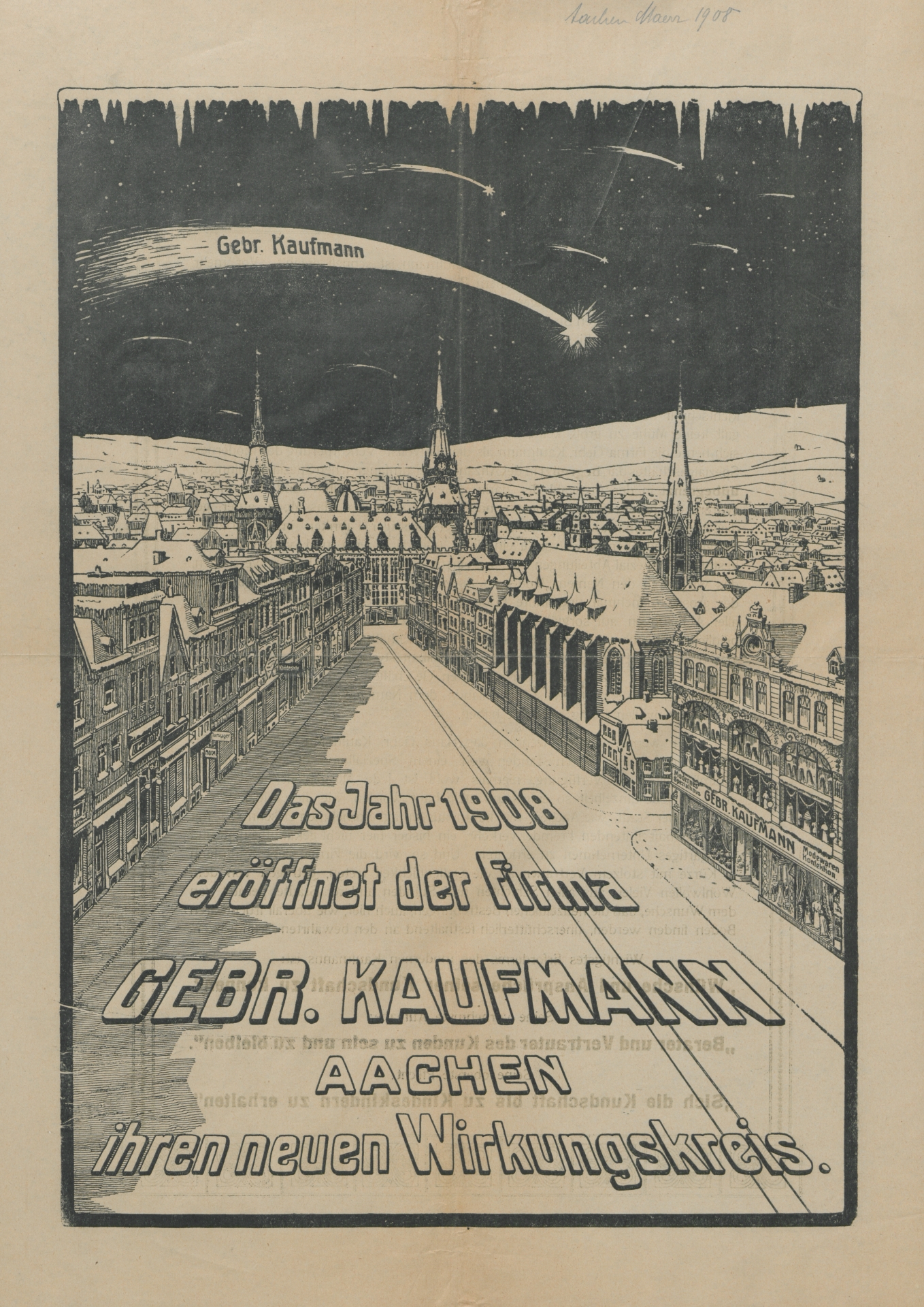
The Archivale of the month December 2025 shows an advertising graphic of the "Gebrüder Kaufmann" from 1908.
You can subscribe to our RSS feed for our press releases here https://www.aachen.de/rss-feed-pressemitteilungen/rss.xml