Elections are the cornerstone of every democratic society. They offer citizens the opportunity to actively participate in shaping their society by electing political representatives at the local, national, or international level. Participating in democratic elections is a privilege—an opportunity that every eligible voter can take advantage of.
In Germany, voting is not mandatory: If you receive a notice to vote, you may participate in the election, but you are not required to do so. Whether or not to participate is entirely up to you.
The fundamental principle of every democratic election is that members of parliament are elected by “universal, direct, free, equal, and secret ballot” (Article 38, Section 1 of the Basic Law). But what does that mean?
General: Every eligible voter may participate in the election.
Direct: Every eligible voter exercises the right to vote personally; no vote may be cast on behalf of another person.
Free: Every eligible voter decides for themselves which person or party they want to vote for.
Equality: Every vote cast counts equally.
Secret: Voting is conducted in such a way that voters are not observed, and they do not reveal—either through words or gestures—who they are voting for or have voted for, even while inside the polling place.

© Generated using AI
European Elections
The European elections are held every 5 years. They are the largest democratic election in the world: over 700 representatives from the member states are elected to represent the interests of approximately 450 million Europeans. Representatives are elected to the European Parliament in proportion to each country’s population; for Germany, this most recently amounted to 96 members.
The European Parliament establishes the legal framework that governs how all people live together within Europe and interact with the rest of the world.
Who is eligible to vote?
All EU citizens who are at least 16 years old on Election Day are eligible to vote. You can vote either in the EU country where you live or in your country of origin. You will automatically receive a notice to vote from the municipality where you are registered.
In Germany, anyone who
- has reached the age of 16 (to be eligible to vote, a person must still have reached the age of 18 by Election Day);
- is a German citizen or a citizen of another EU member state;
- is a resident of Germany and has also been residing in the EU for at least three months;
- has registered on the voter rolls (for EU citizens).
Who can be added to the voter registration list upon request?
If you usually reside in another EU country (e.g., as a cross-border commuter) but would like to vote in the European elections in Germany, you must submit an application to be added to the local voter registry. You can do this at the municipality where you last resided in Germany. Germans who have never lived in Germany should contact the Mitte District Office in Berlin, 13341 Berlin.
“Germans living abroad on a permanent basis who are not excluded from voting are entitled to vote if they have either, after reaching the age of 14 (that is, from the day of their 14th birthday onward), have lived in the Federal Republic of Germany for at least three consecutive months, and this period of residence occurred no more than 25 years ago, or if, for other reasons, they have personally and directly become familiar with the political conditions in the Federal Republic of Germany and are affected by them.” Germany – How Do I Vote?
EU citizens residing in Germany can also be added to the voter registry of their place of residence upon request. This is required for your first participation in a European election; after that, you will be automatically registered in the voter registry.
An application for registration on the voter roll must be received by the Aachen Election Office, located at Blücherplatz 43, no later than the 21st day before the respective European election!
How do people vote?
Each state is free to conduct its own election, but there are some common principles that must be followed.
- The election must take place over a four-day period from Thursday through Sunday.
- The number of members of a political party in the European Parliament is proportional to the number of votes it receives.
- EU citizens who live in another EU country can vote there and run for office.
- Every citizen may vote only once!
In Germany, the European elections are generally held on a Sunday. Voters can cast their ballots at a polling place between 8:00 a.m. and 6:00 p.m., or vote in advance by mail.
How many votes does each eligible voter have?
In the European elections, every voter has one vote. Voters choose from a fairly large number of lists that are running for election—the number of which varies from country to country. In Germany, there is a single ballot that is distributed to all eligible voters.
Seats in the legislature are allocated in proportion to the percentage of the vote received by each party or slate.
Ultimately, all elected members of the European Parliament form political groups—that is, alliances of several European parties that share the same ideals.
What are the deadlines?
- Application for registration on the voter roll: by the 21st day before the election
- Minimum stay in Europe: 3 months before the election
- Minimum period of residence in Germany after the age of 14: 3 months—this must have taken place no more than 25 years ago, or the applicant must be able to demonstrate a verifiable, personal, and direct familiarity with, and involvement in, the political situation in Germany

© Generated using AI
Federal Election
Federal elections are generally held every four years. Members of the German Bundestag are elected to represent the people. The Bundestag’s most important task is to enact laws that apply to all of Germany.
Who is eligible to vote?
Anyone who is a German citizen within the meaning of the Basic Law on Election Day is eligible to vote. (Article 116, Section 1 of the Basic Law)
The minimum age is 18.
In addition, you must have been registered as having your primary residence in Germany for at least 3 months prior to the election.
Who can be added to the voter registration list upon request?
- Retroactive registration on the voter rolls is possible for German citizens without a permanent residence who usually reside in Aachen and are not registered as having their primary residence anywhere else. This is possible up to the 21st day before the election.
- German citizens who live abroad but have a direct connection to and are affected by the political situation in Germany may also be added to the voter registry upon request.
To do so, please contact the municipality where you were last registered in Germany.
The deadline for submitting such a request is the 21st day before the election.
Currently, there are two different types of applications for Germans living abroad:
Appendix 2: Persons who have lived in the Federal Republic of Germany for at least three consecutive months after reaching the age of 14 and whose stay occurred no more than 25 years ago.
In this case, it is possible to submit the application—which must be personally and handwritten—via fax, email, or another verifiable electronic method.
Appendix 2.a: Persons who, for other reasons, have acquired personal and direct familiarity with the political situation in the Federal Republic of Germany and are affected by it.
In this case, you are still required to submit the original application, signed in person and in your own handwriting, to the municipality. A fax or email is not sufficient!
For Germans living abroad, an application for registration on the voter rolls also serves as an application for a mail-in ballot; no separate application is required.
An application for registration on the voter rolls for the federal election must be received by the Aachen City Election Office, located at Blücherplatz 43, no later than the 21st day before the election!
Moving right before the election—where am I eligible to vote?
As a general rule, you are eligible to vote where you are registered as having your primary residence.
--- Moving until the 42nd day before the election
Anyone who moves within Germany or moves to Germany from abroad by the 42nd day before the election (the day on which the voter registration list is compiled) will automatically be added to the voter registration list, will generally receive a notice to vote, and is eligible to vote. The municipality where you are registered as having your primary residence is the determining factor. If you have already moved but have not yet updated your registration, you will vote at your former place of residence.
--- Moving between the 42nd and 21st day before the election and returning from abroad
If you change your primary residence between the time the voter registry is compiled and the 21st day before the federal election, you will be automatically added to the voter registry of your new place of residence. This usually happens automatically. However, if you want to be sure you can vote, you can contact the Aachen Election Office at Blücherplatz 43 in person, by phone (0241 432 1600), or by email (wahlen@mail.aachen.de) to check whether you have already been registered and to find out where your polling place is located.
Individuals who return to Germany from abroad during this period must submit a separate application: 2025 Federal Election: Application for Registration on the Voter Roll for Returnees from Abroad
The deadline for this application is the 21st day before the election!
--- Moving after the 21st day before the election
People who change their registered address after the 21st day before the election remain eligible to vote in their “old” electoral district.
How many votes does each eligible voter have?
In a federal election, every eligible voter has 2 votes.
The first vote (left column) is used to elect the direct candidates in the congressional districts.
With your second vote (right column), you select a party's state list.
Your first and second choices do not have to be the same. You may mark a box in each column, but you are not required to do so.
There is no option to abstain from voting. If you do not participate in the election, the overall voter turnout will decrease. If you submit a blank ballot (no mark or only a first or second choice), your vote will be counted as invalid (either the entire ballot or the column where no mark is present).

© Generated using AI
North Rhine-Westphalia State Election
The Federal Republic of Germany consists of 16 federal states. Each federal state has its own parliament, which is called the Landtag in North Rhine-Westphalia. State elections in North Rhine-Westphalia are usually held every 5 years.
Who is eligible to vote?
There are approximately 13 million eligible voters in North Rhine-Westphalia, who live in a total of 128 electoral districts.
The electoral districts for the city of Aachen in the state election are: Aachen I and Aachen II.
All German citizens aged 16 and older who have their primary residence in Aachen at least 16 days before Election Day are eligible to vote.
Anyone who moves to Aachen at a later date is not eligible to vote in Aachen in the state election. If your “former” electoral district is located in North Rhine-Westphalia, you are eligible to vote there, provided you move within North Rhine-Westphalia.
If you move away from Aachen after the 16th day before the election, you will retain your right to vote here, provided you continue to live in North Rhine-Westphalia.
What matters here is not the date of the actual move, but the date on which the primary residence was registered in Aachen.
Important information if you are moving to Aachen or moving to another municipality within North Rhine-Westphalia:
You must submit an application for inclusion in the local voter registry! You will not be automatically added! (Section 10 of the North Rhine-Westphalia State Election Regulations)
Who else can be added to the voter registration list upon request?
Homeless individuals aged 16 or older who are German citizens and who normally reside in Aachen may be added to the voter registry upon application. The relevant deadlines will be publicly announced.
Important:You must not be registered as having your primary residence in any other municipality!
How many votes does each eligible voter have?
As in the federal election, every eligible voter has 2 votes.
- Your first vote is for a representative from your own district (direct mandate)
- The second vote is for a party's state list

© Generated using AI
Local elections
In the local elections, voters elect more than just a mayor for Aachen. In addition to the city council, which is responsible for the entire city of Aachen, a district council is elected in each of the 7 city districts.
Since Aachen is part of the Aachen Urban Region, eligible voters can also participate in elections for the Urban Region Assembly and the Urban Region Council.
Local elections are generally held every 5 years.
Who is eligible to vote?
There are approximately 186,000 eligible voters in a total of 162 municipal voting districts.
All German or EU citizens aged 16 or older who have their primary residence in Aachen at least 16 days before Election Day are eligible to vote.
Anyone who moves to Aachen or moves away from Aachen at a later date is not eligible to vote in the local elections in Aachen.
What matters here is not the date of the actual move, but the date on which the primary residence was registered in Aachen.
- Special Provision: Voting Eligibility When Moving Within the Aachen Metropolitan Region
Anyone who moves from a municipality in the Aachen Urban Region to the city of Aachen after the 16th day before the election is eligible to vote only in the elections for the Urban Region Council and the Urban Region Assembly. That person will then not be eligible to vote in any other elections in the City of Aachen.
Who can be added to the voter registration list upon request?
EU citizens who are not required to register their residence, as well as homeless individuals who habitually reside in Aachen, may be added to the voter registry upon application. The relevant deadlines will be publicly announced.
What or who is being elected?
Local elections in North Rhine-Westphalia are held every 5 years.
In Aachen, there are 5 ballots, each of which allows voters to cast one vote.
In the local elections in the city of Aachen, the following bodies and positions will be filled:
- Mayor of the City of Aachen
The mayor represents the city and heads the administration.
Voters have one vote, which they use to elect a candidate.
A runoff election for the office of mayor is required if no candidate receives more than half of the valid votes on Election Day. The two candidates with the highest vote totals face off again in the runoff election.
- Aachen City Council
The City Council is the central representative body for all Aachen citizens and makes key decisions on all matters of importance to the entire city of Aachen.
Voters have one vote, which they can use to elect their direct candidates in their respective electoral districts and, at the same time, the parties' reserve lists.
- District Councils (Brand, Eilendorf, Haaren, Kornelimünster/Wahlheim, Laurensberg, and Richterich)
The district councils make decisions on all matters whose significance does not extend significantly beyond the respective city district. In doing so, however, they must take into account the interests of the city as a whole and make decisions within the framework of the general guidelines adopted by the City Council.
The elected district councils elect the district mayors from among their members.
Voters have one vote, which they use to elect a party or slate in their respective city districts.
- City Region Council Member and City Region Assembly
The StädteRegion Aachen is an association of municipalities and consists of the cities of Aachen, Alsdorf, Baesweiler, Eschweiler, Herzogenrath, Monschau, Stolberg and Würselen as well as the municipalities of Simmerath and Roetgen. The StädteRegion is the legal successor to the district of Aachen.
The city of Aachen occupies a special legal position and retains its status as an independent city. It has transferred some tasks, for example in the areas of youth, schools and healthcare, to the StädteRegion.
Städteregionstag:
Voters have one vote to elect the direct candidate in their constituency and the parties' reserve lists.City Region Council Member
: Voters have one vote, which they use to elect the City Region Council Member. A runoff election for the office of City Regional Council member is required if, on Election Day, no candidate receives more than half of the valid votes. The two candidates with the highest vote totals will face off again in the runoff election.Absentee Voting for the Runoff Election—Same or Different Mailing Address?
In local elections, a runoff election may be held if none of the candidates for the office of mayor or city region council member receives an absolute majority of more than 50% of the votes cast in the first round.
Anyone who applied for an absentee ballot for the first election day and did not provide any additional information will automatically receive absentee ballot materials for the runoff election at the same address; therefore, there is no need to submit a new application.
If you would like to receive your absentee ballot materials at different addresses for the two election dates, please indicate this on the absentee ballot application for the general election.
You may also request an absentee ballot for only the primary or runoff election if you wish to vote in person at “your” polling place on the other date.
Other Elections and Referendums
Elections to the Committee on Equal Opportunity and Integration—formerly the Integration Council elections
The members of the Committee on Equal Opportunity and Integration are elected at the same time as the local elections. The committee represents the interests of Aachen residents with international backgrounds. It may address any municipal matters and submit proposals or statements to the City Council, a district council, or another committee.
You can find detailed information here: Aachen Integration Council | City of Aachen
- Who is eligible to vote, and how is the election conducted?
There are about 65,000 eligible voters in Aachen.
All persons who are at least 16 years old and who have had their primary residence in Aachen for at least 16 days prior to Election Day AND who are foreign nationals or who have acquired German citizenship through naturalization or pursuant to Section 4(3) of the Nationality Act are eligible to vote. In addition, individuals whose parents did not initially hold German citizenship are also eligible to vote.
Every eligible voter has 1 vote.
Senior Citizens' Council Election
Every five years, the Senior Citizens’ Council is elected in Aachen. All residents of the city of Aachen aged 60 and older are eligible to vote in this election. For more information on the responsibilities, services, and composition of the Senior Citizens’ Council, please visit: Senior Citizens’ Council of the City of Aachen | City of Aachen
The election for the Senior Citizens' Council will be conducted entirely by mail. You do not need to submit a special application. The election materials will be sent to you automatically.
(City Council) Referendum
A referendum is the most direct form of citizen participation at the local level. However, it is not an election, but a vote in which you can answer a question only with YES or NO.
A (city council) referendum is governed by the rules of a local election. For Aachen, this means that anyone with German or another EU citizenship who is registered in Aachen or usually resides there may vote, provided they are at least 16 years old.
If a referendum does not take place on the same day as a regular election, voting may be conducted entirely by mail. In that case, there are no “regular” polling places; the mail-in voting materials are sent out automatically.
- How is a referendum initiated?
A referendum can be initiated in two ways:
- The City Council would like to let citizens vote on a specific issue in order to secure the broadest possible support. This is known as a council-initiated referendum, such as the one held on April 19, 2026, regarding Aachen’s potential bid to host the Olympic Games.
- From a Citizens' Initiative to a Referendum
- What is a citizens' petition?
With a citizens' petition, citizens of a municipality apply to decide on a matter in the form of a referendum instead of the council. The prerequisite for this is that the council is actually responsible for the decision on the matter in question.
However, certain local government decisions are, as a matter of principle, reserved for the council, such as the budget ordinance, local taxes, planning approval procedures, and the termination of urban land-use planning procedures. Therefore, no citizens’ initiative is possible regarding these matters.
- Who can carry out a citizens' initiative?
All persons who are eligible to vote in municipal elections in Aachen can submit a petition for a referendum in Aachen. Eligible to vote in municipal elections are Germans and citizens of the other 26 EU Member States who have reached the age of 16 on election day, have been resident in Aachen since at least the 16th day before the election or are otherwise ordinarily resident in Aachen and are not excluded from the right to vote.
- What needs to be considered if a citizens' initiative is to be carried out?
As a first step, the city administration must be informed in writing of the intention to hold a citizens' initiative. This notification must contain the names of up to three authorized representatives and a question on the matter to be decided. The question must be able to be answered with "yes" or "no", be clearly defined and be substantiated.
The administration provides the authorized representatives with an estimate of the costs associated with the implementation of the requested measure. Upon receipt of the administration's cost estimate, the authorized representatives can draw up signature lists. Each signature list must contain the issue to be decided, the associated justification, the authorized representatives and the administration's cost estimate.
In Aachen, around 7,700 valid signatures of clearly identifiable persons must be submitted in order for the citizens' petition to be submitted. All those who have signed must be eligible to vote, i.e. be registered to participate in the local elections in Aachen.
- Do the measures covered by the citizens' initiative have a suspensive effect?
A suspensive effect takes effect from the time the council has definitively determined the admissibility of the citizens’ initiative. Section 26 of the Municipal Code for the State of North Rhine-Westphalia (GO NRW) defines the suspensive effect in paragraph 6 as follows: “Once the admissibility of the citizens’ initiative has been conclusively determined, no decision by municipal bodies that conflicts with the initiative may be made, nor may the implementation of such a decision be commenced, until the result of the referendum has been determined, unless the municipality was already under a legal obligation to do so at that time (suspensive effect of the admissible citizens’ initiative).”
- What is an application for a preliminary review?
The authorized representatives of the citizens' petition can apply for an early review of the admissibility of the desired citizens' petition. This early determination of admissibility is made by the Council.
An application for a preliminary examination must be based on the same requirements in terms of form and content as the citizens' petition itself. The only difference is that the signatures have not yet been collected at this stage. Only 25 citizens - in addition to the authorized representatives - must have signed the petition for the Council to examine and, if necessary, determine the admissibility of the petition within eight weeks.
- What happens if the council rejects the citizens' petition?
After examining the signatures submitted, the city council discusses the content of the petition at its next meeting. If the council rejects the petition by a majority, a referendum is held within three months.
All citizens of the city who are eligible to vote in municipal elections may participate in the vote. When voting, they may only answer the question posed by the citizens’ initiative with “Yes” or “No.” The question is decided in accordance with the answer given by the majority of valid votes, provided that this majority represents at least 10 percent of the citizens. If this minimum threshold is not met, the referendum is invalid.
- Where can I get information about the content of the petition / referendum?
If a referendum is held, the city is generally required to provide comprehensive information to all eligible voters. To this end, the City of Aachen has established a policy whereby all eligible voters receive access to a so-called “voting booklet” along with their notification of the voting date. This booklet is published on the City of Aachen’s website and is also available at the district offices and the Citizen Service Center.
In addition to information on the voting procedure, the voting booklet also contains the views of the political parties and groups represented on the council regarding the citizens’ initiative, as well as—where applicable—the views or dissenting opinions of individual council members, the administration’s position on the citizens’ initiative, and the fundamental rationale provided by the authorized representatives of the citizens’ initiative.
Referendum
A referendum, just like a local referendum, is a form of direct democracy. Unlike a local referendum, however, a referendum takes place at the state level. In this case, the eligible voters of a federal state decide on a proposed law, rather than the state legislature.
From a Citizens' Initiative to a Referendum
Before a referendum can take place, a citizens' initiative is required.
For a citizens’ initiative (VB) to be approved, certain formal requirements must be met: If the goal is to enact a new law (e.g., a ban on fireworks), a detailed draft bill with supporting rationale must be submitted, along with a certain number of signatures in support of the petition. In North Rhine-Westphalia, the threshold for this is 8% of eligible voters, or approximately 1 million signatures.
If enough signatures are collected, the state legislature must consider the bill. If the state legislature approves it, the proposal becomes law—a referendum is no longer necessary.
If the state legislature rejects the proposal, a referendum will be held. In that case, all eligible voters will vote on whether the interest group’s proposal should become a state-wide law. The state legislature is bound by this decision.
A constitutional amendment is permissible only in areas subject to the state’s legislative authority. A constitutional amendment is not permissible with regard to financial matters, tax laws, or salary regulations. Nor may a constitutional amendment be sought to enact a law that is unconstitutional for other reasons.
For more detailed information, please visit the website of the Ministry of the Interior of North Rhine-Westphalia: How to Bring Your Concerns to the Political Arena? | IM
Absentee Voting – How Does It Work?
In the weeks leading up to an election, all eligible voters have the opportunity to apply for an absentee ballot and thus cast their vote properly, even if they are unable to go to a polling place on Election Day.
There is no need to provide or prove a specific reason for voting by mail.
5 Easy Ways to Request Absentee Ballot Materials
- The easiest and fastest way is to submit an online application, which you can find at www.aachen.de by searching for “Briefwahl.” The online application is available starting 6 weeks before the election through the Wednesday before the election.
- Alternatively, wait for your voter registration notice, scan the QR code printed on it, and enter your information on the website that opens. This option is also available until the Wednesday before the election.
- Come to the Aachen Mitte Election Office (Blücherplatz 43) or go to one of the district offices to apply for an absentee ballot in person using your voter registration notice (in an emergency, an ID card is also sufficient) and either take the documents with you or cast your vote directly in a voting booth.
- Outside of office hours, please drop off your fully completed absentee ballot application in one of the designated mailboxes. You may also mail your absentee ballot application; however, you are responsible for the postage costs. In the last week before the election, however, due to sometimes unpredictable mail delivery times, it is advisable to submit the application in person during office hours.
- If none of these options work, you can send us an email at wahlen@mail.aachen.de requesting that we send you the absentee ballot materials. We will need the following information: type and date of the election, your full name, date of birth, and address.
Can't pick up your documents in person? - Power of Attorney
If you would like to authorize someone to pick up your absentee ballot materials, that person will need a power of attorney. If possible, please use the form included with your election notice.
Please note: It is not possible to pick up absentee ballot materials for more than 4 people. The relevant power of attorney is stored in our system—so “attempts” to obtain the materials on several consecutive days for an extended family will not work.
Different shipping address
If you are not at your registered address during the period leading up to an election, you may provide a different mailing address on any type of absentee ballot application.
In any case, please take into account the potentially longer delivery times that may occur when shipping to and from international addresses.
Returning the Absentee Ballot Materials
Please be sure to use the official envelope for the return shipment.
If the official envelope has a window, please place the signed ballot inside so that the address of the election office, Blücherplatz 43, AND the absentee voting district (90xx) are clearly legible through the window.
Within Germany, absentee ballot materials do not need to be stamped. If you are sending the materials from abroad, your absentee ballot must be properly stamped!
Please be aware that mail delivery times may be longer than usual. Please return the documents as soon as possible or drop them off at the Election Office on Blücherplatz or at one of the district offices.
Your absentee ballot materials must be turned in or received at Blücherplatz by Election Day at the latest.
Didn't receive your absentee ballot materials?
Sometimes, even if you apply on time, you may not receive your absentee ballot materials.
If you can credibly confirm that you did not receive your absentee ballot materials, you have the option of obtaining replacement materials. This is only possible until 12:00 p.m. on the day before the election. After that, it is no longer possible to have a new absentee ballot issued. A restriction will be noted in the voter registry, meaning you will not be able to vote at a polling place on Election Sunday.
I applied for an absentee ballot, but should I still go to the polling place?
If you have applied for an absentee ballot, you should normally make use of it.
Although it is still possible to go to the polling place on Sundays, you must bring the absentee ballot materials sent to you—at a minimum, the ballot on which the corresponding ballot number and your personal information are listed. This is necessary because, otherwise, you will be barred from voting due to the absentee ballot that has been issued to you: a restriction note will then be entered in the local voter registry.
FAQ
When are the polling places open?
On Election Day, from 8:00 a.m. to 6:00 p.m.
What do I need to bring with me to the polling place to vote?
The easiest way is to present your voter registration notice. If you don't have it on hand, an official form of identification (ID card, passport) will also suffice.
Didn't receive your voter registration notice? What now?
As a rule, every eligible voter receives a voter notification no later than 3 weeks before the election, containing information about their voting district and the corresponding polling place.
If you did not receive your voter registration notice because it was lost in the mail, you can still vote. If you know your “regular polling place,” simply go there on Election Day; all you need to bring is your ID card or passport. If you have moved since the last election and do not know where to go to cast your vote, you can obtain the necessary information from the Aachen Election Office at: 0241-432 1600 or wahlen@mail.aachen.de
Not on the voter registration list? What should you do?
If, when applying for an absentee ballot, you notice that you are not (yet) listed on the voter registry, you may be added to the registry retroactively under certain conditions. A written application must be submitted by the deadline.
First, check the explanations for each election to see if and by when retroactive registration is possible.
If you are at the polling place and have changed your registered address to Aachen or within Aachen in the past few weeks, it’s worth taking a look at the end of this voter registry. Feel free to ask the election workers for assistance. If in doubt, they can also contact the Election Office at 0241 – 432 1600 to find out if and where you can vote.
Moving shortly before the election—where can I vote?
In general, you retain your right to vote if you have moved within Aachen or from outside the city to Aachen and meet the legal requirements. For more detailed information, please contact the Elections Team. We encourage you to read the information on the individual elections in advance.
Suddenly sick on election weekend?
Only in exceptional cases—for example, if someone suddenly falls ill—can an application for an absentee ballot be submitted as late as 3:00 p.m. on Election Sunday. In such cases, a medical certificate (e.g., from a hospital) and a power of attorney for the person who will pick up the absentee ballot materials on your behalf are required.
Ballots with special markings - Statistical voting districts
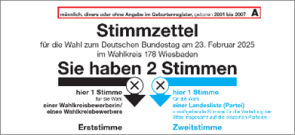
You’ve probably wondered at some point where the data comes from that categorizes voters by age group and/or gender in statistics. To compile these statistics, selected polling places or voting districts use special ballots marked with a letter indicating “male,” “female,” “no information provided,” or “diverse,” and covering different birth years. For example, “M” stands for women born in 1942 or earlier, and “G” stands for men born between 1960 and 1969. The assignment of letters to age groups is reassigned for each election. It is not possible to determine exactly which party or candidate a voter chose based on this coding.
If “your” polling place or voting district has been selected for statistical purposes, you will be asked for your year of birth before receiving your ballot. If you do not wish to provide this information, you will unfortunately not be able to vote, as there are no blank ballots available at the polling place.
Ballots with holes or a missing corner
Depending on the election, ballots are marked with a perforation or a cut-off corner so that blind and visually impaired people can vote independently. These markings are used to align a Braille template.
Visually impaired and blind voters
Stencils for the respective election can be ordered from the Association for the Blind and Visually Impaired of the Aachen Metropolitan Region. The ballot is secured in the stencil and can then be read in Braille.
In general, assistants may help voters cast their ballots at the polling place as long as the eligible voter is able to clearly express his or her choice.
In addition, there is usually a phone hotline where the respective ballots are read aloud to you.
For more information, click here.
Vote online or go to the polling place on behalf of someone else?
There is no option for online voting.
Every election in Germany must be conducted in person. It is also not possible to vote on behalf of someone else. If you do so anyway, you are committing a criminal offense.
Overview of polling stations
Find out here exactly where “your” polling place is located and whether you can cast your vote in an accessible location. If the polling place is not accessible, you generally have the option to cast your vote by mail.
Become a poll worker!

City of Aachen
Click here to learn more about the duties of an election worker and possible assignment locations. You can register as an election worker at any time. As soon as plans for an election or vote are underway, you will be contacted directly.
Further information
Download
Contact us
Search results are loaded
No departments found.