Of Swords, Bones, and Cold Walls: Aachen’s New Municipal Archaeology Department Celebrates Its 20th Anniversary
- Public lectures on December 3 and 4 at the Suermondt-Ludwig Museum will offer insights into historical research
- Whether Romans, Merovingians, or Carolingians: they all left their mark on Aachen in many different ways
- The exhibition “Rome in Bronze – Imperial Portraits by Wil van der Laan” at the Center complements the City Archaeology anniversary. The opening is on December 4 at 4 p.m.
The scene is reminiscent of the legendary Arthurian legend: An old sword—hidden for centuries—is stuck high up on a hill. A four-year-old child discovers the sword while playing, wraps his hands around the hilt, and pulls it out. What sounds like a fairy tale actually took place recently in the Aachen Forest. Linus, a preschooler, and his friends immediately reported the find to their teacher, Dominique Nait Limen—who in turn contacted city archaeologist Andreas Schaub. “It’s stories and experiences like these that make my job so exciting time and time again—and have done so for two decades now,” Schaub says today. Initial examinations revealed that the sword dates back to the early Middle Ages. Perhaps, in homage to its famous British counterpart, it will become known as “Aixcalibur” in the future. One thing is certain: the story surrounding this unusual sword discovery is part of the program celebrating the 20th anniversary of the new City Archaeology department in Aachen. Simply legendary!
A Thank-You from the Mayor
Since 2006, there have been several archaeological surprises in the Imperial City. Spectacular finds from the Roman, Merovingian, and Carolingian periods were among them, as were many new and supplementary insights that, like pieces of a puzzle, are piecing together Aachen’s history with ever-greater clarity. For that is what the city’s archaeological department does: it sharpens our understanding of Aachen’s history. Using state-of-the-art scientific methods, it reconstructs how people lived centuries and millennia ago, what structures they built, and much more. It substantiates with facts what really happened back then—and thus distinguishes professional historiography from the equally popular legends and myths. On Wednesday (October 18), Mayor Dr. Michael Ziemons was certainly delighted to personally welcome five-year-old Linus, along with his mother Jasmine Brück and Dominique Nait Limen, to the Centre Charlemagne—and to express his heartfelt thanks. “An incredible story that you can be very proud of!” said Aachen’s mayor during the sword’s first public presentation.
“Thorough urban archaeological work has been yielding many new insights for 20 years now. It helps us understand how the city was organized centuries ago and also dispels one or two misconceptions—for example, the idea that the Katschhof was empty when Charlemagne shaped the city,”, said City Planning Commissioner Frauke Burgdorff, emphasizing the value of urban archaeology for Aachen during the presentation of the conference program. To mark the anniversary—as was done ten years ago—a two-day event will take place. On Thursday and Friday, December 3 and 4, there will be numerous public lectures on archaeological excavations, finds, research, projects, and presentations in Aachen over the past ten years. The “Centre Charlemagne – Neues Stadtmuseum,” led by Prof. Dr. Frank Pohle, is once again a partner of the City Archaeology department, which is part of the Department of Urban Development, Construction, and Mobility. This time, the conference will be held at the Suermondt-Ludwig-Museum at Wilhelmstraße 18. This venue can accommodate even more people to listen to the interesting presentations. The previous event, held ten years ago, attracted a total of around 500 visitors.
“We have many partners,
” Pohle emphasizes, referring to the collaboration between his institution and the City Archaeology Department, which has grown over the past 20 years: “It is exclusively archaeology that enriches our understanding of Aachen’s prehistory and early history. In no other section of the Centre Charlemagne have we been able to incorporate such significant new discoveries into the exhibition tour. The City Archaeology Department is one of our most important partners.”
Mayor Dr. Michael Ziemons will deliver opening remarks at the start of the two-day forum, followed by speeches from Aachen’s City Planning Director Frauke Burgdorff and Dr. Erich Claßen of the Rhineland Regional Council. Afterward, the event will dive right into a packed program featuring a total of 33 presentations. Topics include Stone Age finds—notably on Kleinkölnstraße and in Kornelimünster—the Roman Burtscheid-Aachen aqueduct, and new insights into the castrum on what is now Markthügel. The Middle Ages—with traces of iron production from that era, bone finds at Kapuzinergraben and Münsterplatz—are also in focus, as are the diverse collaborations and partnerships of Aachen’s City Archaeology Department.
In addition to the many individual presentations, each lasting about 15 minutes, Andreas Schaub’s evening lecture, “Aachen Between Roman Times and the Middle Ages—New Archaeological Findings 2016–2026,” on Thursday, December 3, at 7:30 p.m., will provide an overview of the various activities and historical findings of the past decade. In addition, there will be presentations on medieval Aachen, as well as the archaeological finds in Franzstraße and Jakobstraße.
Once again, the presentations marking the 20th anniversary will be published in a collection with the assistance of the Aachen Historical Society. The previous volume, “Gläserne Grabungen: 10 Years of New Urban Archaeology in Aachen, 2006–2016,” was published as Volume 9 in the Aachen Contributions to Architectural History and Local Art. The second volume now being planned is intended, in a sense, as “Gläserne Grabungen 2.0” for the same series. The organizers expect the book to be published in 2027.
“Rome in Bronze” Exhibition at the Centre
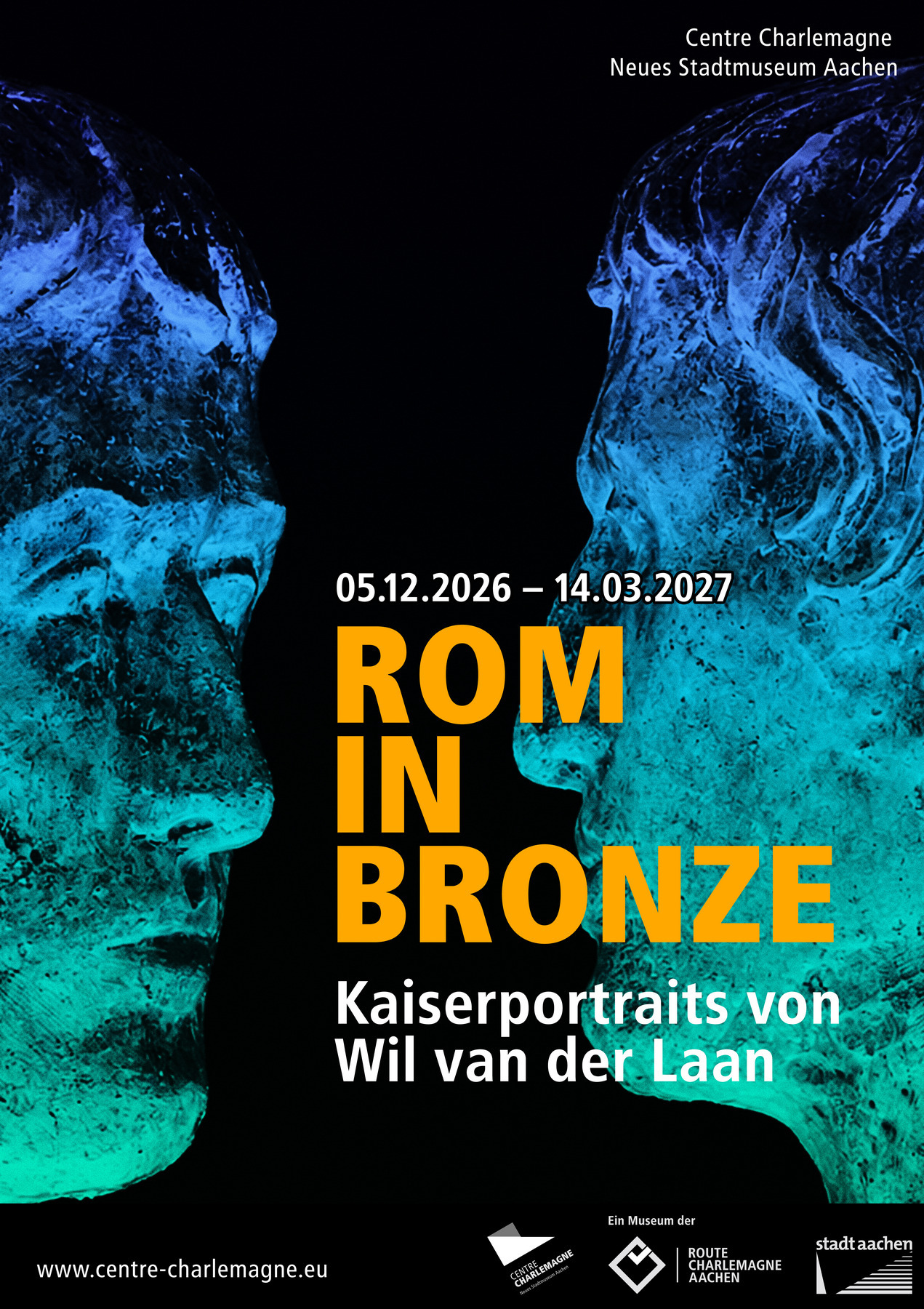
Frank Pohle and Andreas Schaub are also pleased to present the exhibition “Rome in Bronze—Imperial Portraits by Wil van der Laan” in celebration of the 20th anniversary of the City Archaeology Department. The exhibition will be on view from December 5, 2026, through March 14, 2027, at the Centre Charlemagne, Katschhof 1. The exhibition opening will take place immediately following the City Archaeology Conference on Friday, December 4, at 4:00 p.m. Visitors are warmly welcome!
The “Blickpunkt” exhibition at the Center features seven works by the Meerssen-based sculptor Wil van der Laan (b. 1950). Roughly modeled and left in their raw state by the heat of the casting process, van der Laan created several portraits of Roman emperors from antiquity, ranging from Caesar to Marcus Aurelius. The works are being presented at the start of the Centre Charlemagne’s permanent exhibition (Roman section). The exhibition was arranged through the Honorary Consulate of the Netherlands in Aachen; the pieces had previously been on display in the Netherlands, Italy, and at the LVR-RömerMuseum in Xanten.
Linus’s sword will also be on display free of charge in a display case in the foyer of the Centre Charlemagne as part of the City Archaeology anniversary, alongside other artifacts uncovered by City Archaeology over the past decade. From the forest to the museum—Linus and his family will surely never forget this story.
Key Research Findings: A Retrospective
A rich prehistory on the one hand, and the sometimes uncertain handling of important archaeological sites on the other, led to the decision in 2006 to establish a municipal archaeology department for the city of Aachen. Since then—as had been the case previously—numerous ground disturbances have been archaeologically monitored. Unlike in the past, efforts are now made to promptly identify the historical insights gained from each excavation and to disseminate them both locally and internationally. Historical research has, of course, been as much a part of Aachen for well over 20 years as Printen, Karl, and Streuselbrötchen. “Due to its great significance, the Aachen Palace in the center of the Old Town has been the focus of archaeological investigations and research for decades. Not least for this reason, a municipal archaeological preservation program—a city archaeology department—was reestablished in Aachen in 2006. Over the 20 years of its existence, archaeological excavations have been and continue to be carried out repeatedly, both by the city’s archaeological department itself and, above all, by various specialized archaeological firms,” explains Andreas Schaub. He took up the position in Aachen in 2006 as the city’s first archaeologist. Dr. Markus Pavlovic is now the second archaeologist working for the City of Aachen. Together with many other stakeholders—such as the volunteers of the Aachen Archaeological Working Group (AAA), the city’s historic preservation office, external excavation firms, academic partners, and many others—the City Archaeology Department ensures that Aachen’s history remains alive and well.
For more information about Aachen City Archaeology and the anniversary program, visit: www.zeitreise.ac.
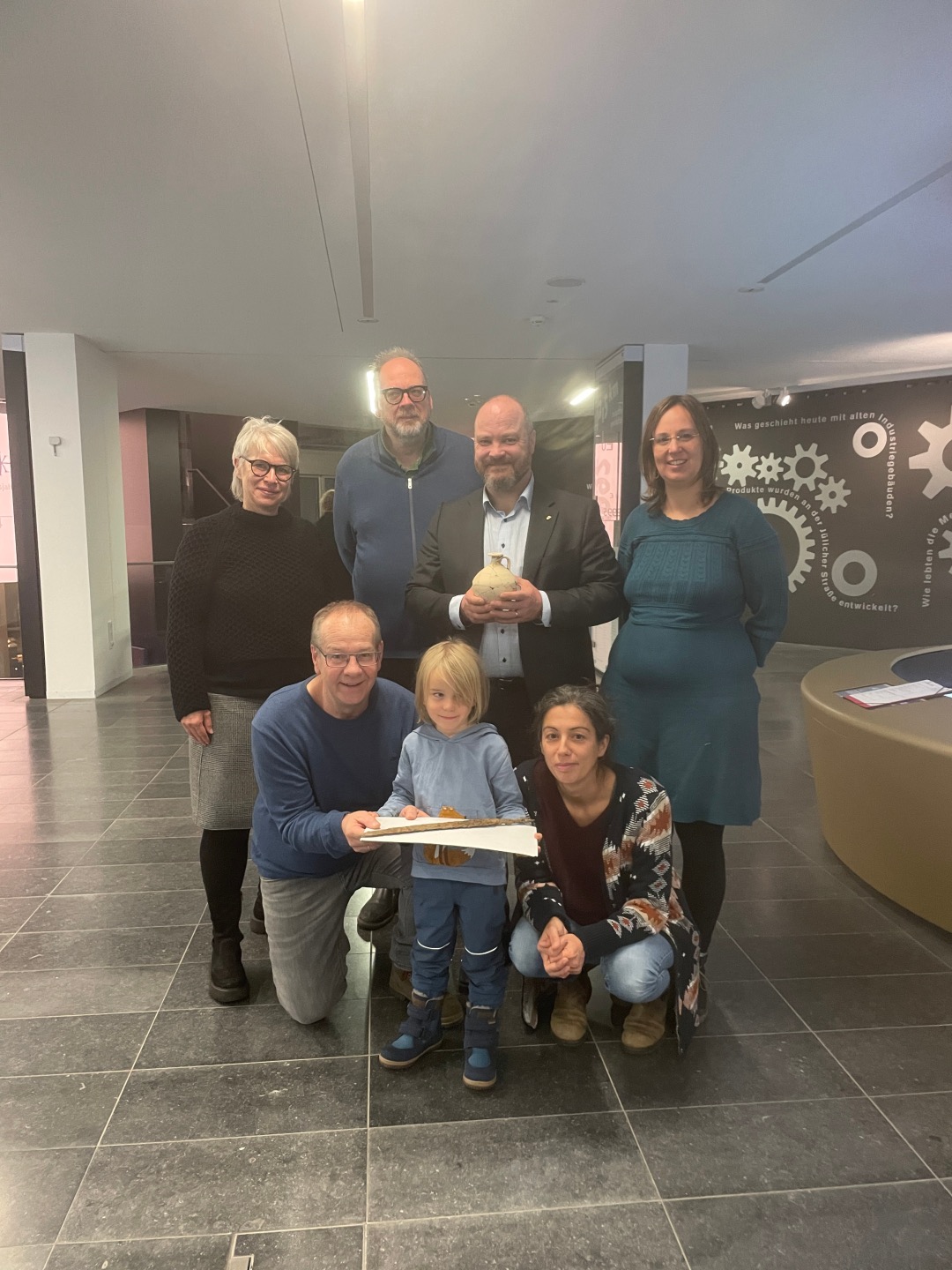
Looking forward to the two-day program celebrating the 20th anniversary of the City Archaeology Department: (from left, back row) City Planning Commissioner Frauke Burgdorff, Prof. Dr. Frank Pohle (Director of Route Charlemagne), Mayor Dr. Michael Ziemons, Jasmine Brück, (front row, from left) City Archaeologist Andreas, daycare child Linus Brück, and teacher Dominique Nait Limen.
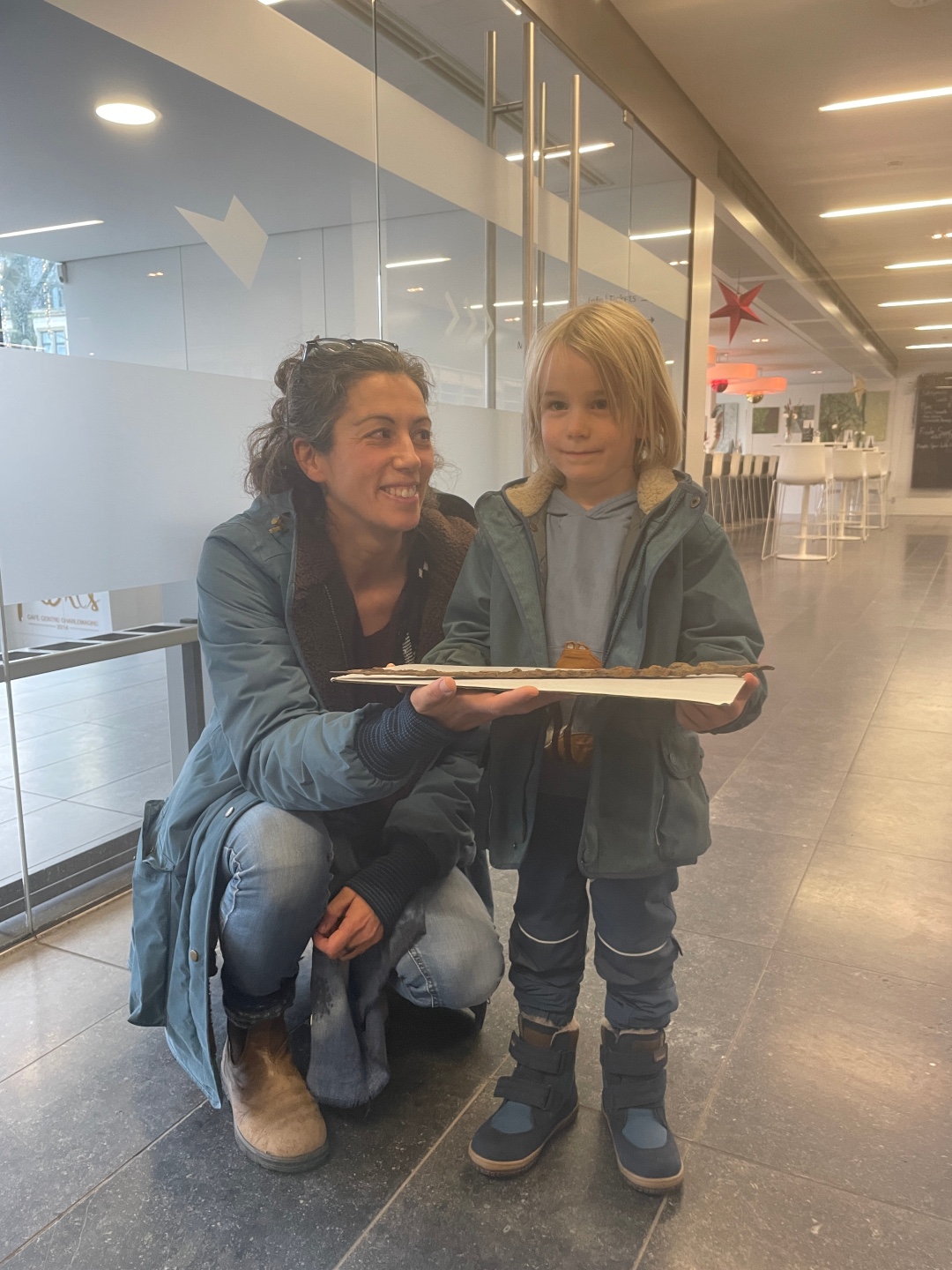
Proud Sword Finder: Linus, who was four years old at the time, made a spectacular medieval discovery; his teacher, Dominique Nait Limen, quickly called the city’s archaeological department.
You can subscribe to our RSS feed for our press releases here https://www.aachen.de/rss-feed-pressemitteilungen/rss.xml