In 2012, the process of transport development planning was established as a permanent task in Aachen. Objectives and measures are to be adapted to the challenges of society and the environment and the technical and financial possibilities, and trends are to be systematically monitored. Transport development planning is organized as a cooperative process in which associations, politicians, mobility stakeholders and the administration work together to find the most viable solutions.
A "Vision for Mobility 2050" was adopted in 2014, and the framework and goals of the Mobility Strategy 2030 were approved in 2019 and 2020.
The program for civil engineering + refurbishment is determined by planning the measures into the budget or the refurbishment program of Aachener Stadtbetrieb.
The cycling plan was adopted in 2022, and the electric mobility plan in 2025. The term "climate protection plan" refers to the mobility component of the integrated climate protection plan: The IKSK was adopted in 2024; a mobility action plan is currently being developed.
The Local Transit Plan outlines the strategy for public transportation and was adopted in 2025. The revision of this plan for the period 2027–2037 is a separate process requiring a separate resolution.
Since 2025, the concepts for pedestrian traffic, car traffic, mobility management and road safety have been drawn up in the same way.
All documents are discussed in specialist commissions, presented to the VEP steering group and then submitted to the City of Aachen's mobility committee for a decision.
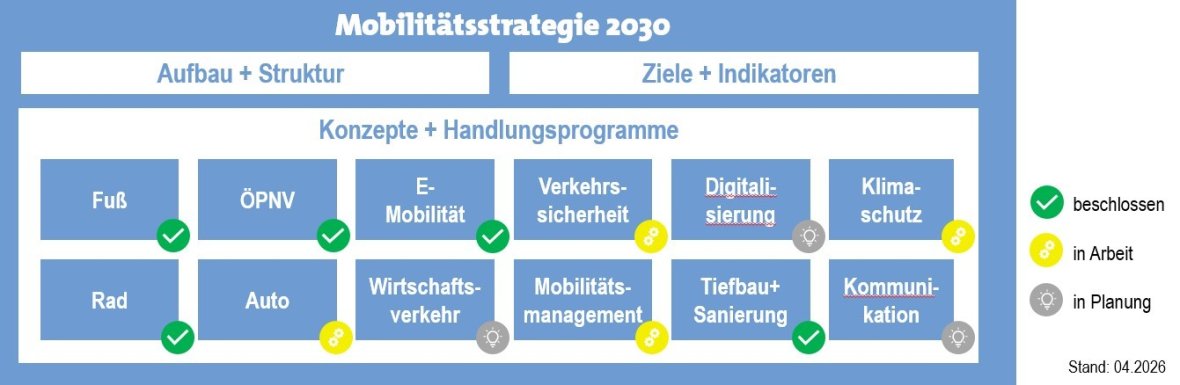
Mobility plans covering all modes of transportation are already in place or are being developed for specific areas of the city.
Building blocks of transport development planning
NEW: Mobility 2025 Status Report
August 31, 2026: The City of Aachen’s second mobility status report, prepared as part of its transportation development planning, is now available in digital format. Printed copies can be requested from the VEP team.
More
Vision Mobility 2050
The Mobility 2050 vision describes the model of sustainable mobility in a sustainable city: without accidents and emissions. Organized efficiently and affordably. It was politically adopted in 2014.
More
Mobility Strategy 2030
The Mobility Strategy 2030 substantiates the vision with goals, indicators, the organization of transport development planning and individual specialist strategies.
More
Mobility data Aachen
Representative mobility surveys were carried out in 2017 and 2023 throughout the Aachen city region. The results are the main basis for the mobility status report.
More
Management Report Mobility 2021
The 2021 Mobility Report uses 25 indicators to illustrate how the mobility situation in Aachen has evolved. It is based on the adoption of the Mobility Strategy 2030, which set out the goals for transportation development.
More
Processing structure and participation
The City of Aachen develops the building blocks of transport development planning itself. These are strategic documents that form the basis for the implementation of specific measures. When drawing up the VEP, the City of Aachen follows the guidelines for sustainable urban mobility planning (SUMP).
Specialist commissions are convened to coordinate specialist topics. The VEP steering group meets four times a year to discuss strategic issues. The City of Aachen invites representatives from politics and associations to both meetings.
Large-scale public participation events were held in 2013 and 2015 to obtain the public's opinion on objectives and strategies. The City of Aachen has held mobility forums on individual specialist topics with the Aachen Mobility Initiative.
Decisions on the concepts of traffic development planning are reserved for the Mobility Committee of the City of Aachen.
The transport development planning process was supported by Jens Stachowitz Kommunalberatung from 2012 to 2023 and by Rupprecht Consult from Cologne since 2024.
Templates
Search results are loaded
No templates found.
Contact us
Search results are loaded
No employees found.