
Whether investments, climate protection or digitalization - Aachen offers companies tailor-made funding opportunities and advice to make the most of future potential.
The Joint Program “Improvement of the Regional Economic Structure” (GRW)—formerly RWP—supports commercial enterprises in their growth initiatives by providing grants for investments in fixed assets or for labor costs. One of the requirements is an investment of at least 150,000 euros that secures existing jobs or creates new ones. This provides targeted support to companies that wish to increase their competitiveness and create jobs.
With the Integrated Climate Protection Concept (IKSK), Aachen is focusing on a climate-friendly economy. Companies benefit from subsidies for renovating old buildings, energy efficiency and sustainable technologies. This not only assumes environmental responsibility, but also reduces CO₂ emissions - an important measure for the sustainable development of the city and its companies.
The digitalization consultancy supports companies in their digital transformation, from smart process automation to the development of new business models. Aachen not only provides expertise, but also helps to secure suitable funding to efficiently and successfully shape the path to the future.
With these and other funding programs, Aachen offers ideal conditions for driving innovation and remaining competitive in the long term.
EcoFonds Aachen – 2026 Funding Pool Launched with New Guidelines
Secure funding now!
If you are interested in the EcoFund, please contact nachhaltige.wirtschaft@mail.aachen.de and you will receive all information on the 2026 funding period.
In order to achieve the city of Aachen's climate protection targets and ensure climate neutrality by 2030, investments in the sustainable development and orientation of companies are essential. However, persistent inflation and the resulting price increases are making it difficult for many companies to take these necessary steps. This is precisely where the City of Aachen's EcoFund comes in - with targeted funding to support companies on their path to sustainability.
With the "EcoFonds", the city promotes consulting services and specific investments by companies in the city area. Companies of all sectors and sizes, business associations and non-profit organizations with business operations are eligible to apply, provided they are based in Aachen.
The approved grant is de minimis aid on the basis of Commission Regulation (EU) No. 1407/2013 of December 18, 2013 on the application of Articles 107 and 108 of the Treaty on the Functioning of the European Union to de minimis aid (Official Journal of the EU L 352, p. 1).
How toapply for the EcoFund
Who can submit an application?
Companies of any sector and size are eligible to apply, with preference given to small and medium-sized enterprises (SMEs according to EU regulations). Funding for mandatory services and advice on mandatory measures is excluded.
What documents are required for the application and can several applications be submitted?
To apply for a grant from the EcoFund, an application form must be completed on the City of Aachen's service portal. In addition to general information about the company and the planned project, the form must include an initial cost calculation with associated quotations. In order for the grant to be paid out, it is mandatory to submit offers that show the exact costs of the project.
In principle, only one grant can be approved. An exception is made if implementation measures are carried out following a subsidized consultation. In this case, the investments must be demonstrably made on the basis of recommendations made as part of the consultancy services.How much funding is available?
Consulting services are subsidized at 90% of the incurred costs, up to a maximum grant of 5,000 €. The subsidy for investments is 30%, up to a maximum amount of 10,000 €.
Which consultations can be funded?
All consulting services from the three subject areas of sustainable business, energy and material efficiency and special systems for renewable energies can be funded. The costs for the consultancy should not exceed a daily rate of €800.
When will I receive feedback on my application?
The applications received are reviewed on an ongoing basis, shortly after receipt. Feedback is usually provided within 4 weeks. Due to high demand, there may be longer waiting times in some cases.
When do I have to make the eligible investment or carry out the eligible consultation?
The planned measure must be implemented within six months of the grant notification being issued. An extension of this deadline is only possible in justified exceptions and must be applied for individually.
What supporting documents must be submitted?
In order to receive a grant, a binding offer must be submitted. After completion of the measure, a project report and an invoice or comparable proof of the actual costs incurred must be submitted. The template for the project report can be found here.
What criteria are used to evaluate the applications received?
The applications received are classified using an evaluation matrix. Applications are evaluated according to the following criteria:
- Contribution of the project to increasing energy efficiency, sustainability or the expansion of renewable energies
- Plausibility of the project
- Profitability of the project
- Size of the company
- Feasibility within the implementation period
- Degree of innovation of the project
- Additionality of the project (i.e. going beyond normal business operations)
- Impact of the project on the environment/climate
- Consideration of the applicable regulations (including NFSR & CSRD reporting obligation)
The money from the fund is disbursed to the applicants whose projects best meet the above criteria.
When is the grant paid out?
After approval, the grant will be paid cashless to the bank account specified in the application form on the basis of the submitted offer. Payment will be made as soon as possible after successful review of the submitted application.
What happens if the actual costs differ from the costs stated in the offer?
Should you discover after completion of the measure that your actual costs were lower than stated in the submitted offer, the City of Aachen is entitled to reclaim a proportionate share of the subsidy paid out. However, if the costs turn out to be higher than assumed, the City of Aachen is expressly not obliged to make an additional payment.
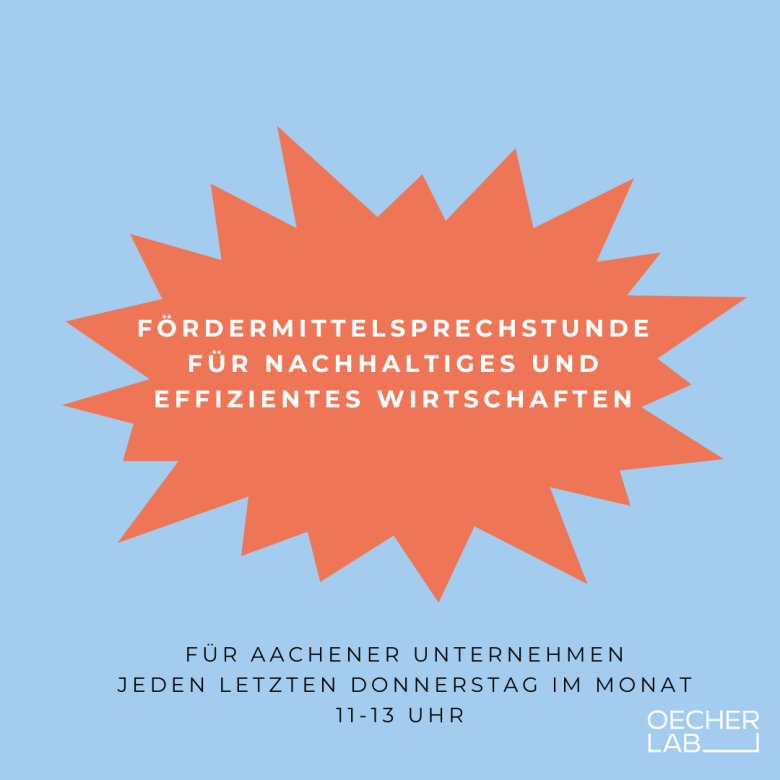
Funding consultation for sustainable and efficient management (IKSK)
Wifoe_Aachen
Wirtschaftsförderung Aachen offers companies a comprehensive funding consultation service to support sustainable and efficient business practices. With programs such as the EcoFonds, the city provides targeted advice on funding opportunities that promote sustainable development, increase energy efficiency and reduce the ecological footprint. The aim is to enable companies to benefit not only financially but also strategically from funding and to transform their business models sustainably and efficiently.
Come to our consultation hour to get initial information, address your questions and get a low-threshold start on developing your company towards sustainability.
Every last Thursday of the month between 11 a.m. and 1 p.m. in the OecherLab.
New Rules Against Greenwashing
As of September 27, 2026, stricter rules regarding environmental and sustainability claims made to consumers have been in effect in Germany. These rules are based on the European EmpCo Directive (“Empowering Consumers for the Green Transition,” EU Directive 2024/825), which Germany transposed into national law in February 2026. The goal is to better protect consumers from misleading environmental claims and to promote reliable, transparent information about the environmental characteristics of products and services.
It is crucial that environmental benefits are presented in a reliable, transparent, and verifiable manner. Under the new regulations, blanket or misleading statements may be classified as unfair business practices.
What will change for businesses?
The new regulations specifically address environmental and sustainability communications in the B2C sector. Companies should therefore review, among other things, statements on websites, in online stores, on social media, in product descriptions, on packaging, and in promotional materials.
General environmental claims such as “green,” “eco,” “environmentally friendly,” or “sustainable” are particularly affected. Such blanket statements are generally subject to stricter restrictions. They may still be used under certain conditions if they are specified in detail and appropriately substantiated. A statement must not give the impression that an entire product is particularly environmentally friendly if the environmental benefit actually applies only to a part of the product.Sustainability labels and environmental labels are also subject to new requirements. Sustainability labels must, as a general rule, be based on a transparent certification system with corresponding criteria and independent third-party certification, or have been established by government agencies. In the future, proprietary labels or markings that are not properly validated in this way may no longer be used as sustainability labels. Recognized environmental labels, such as the Blue Angel or the EU Ecolabel, are explicitly highlighted as guidelines.
New Guidelines for Climate Statements
Stricter requirements also apply to product-related climate claims. Claims that a product is carbon-neutral, reduces greenhouse gas emissions, or has a positive environmental impact are prohibited, particularly if they are based on offsetting emissions outside the value chain. This applies, for example, to certain claims regarding a product’s “climate neutrality” that are intended to be achieved exclusively through offset measures.
Furthermore, statements about future environmental performance must be transparent and verifiable. Companies that, for example, promote a future environmental performance or a specific climate goal must be able to present this in a way that is transparent and reliable. Comparative environmental claims are also subject to requirements regarding objectivity, as well as a consistent methodology and consistent assumptions.
Durability and repairability also play a role
The new regulations go beyond traditional cases of greenwashing. Information regarding the durability, repairability, and recyclability of products must also not be misleading. For example, products may not be advertised as repairable if such repairs are in fact not possible. In addition, certain misleading statements or the withholding of relevant information regarding durability and repairability are restricted.
What should companies keep in mind right now?
Companies that advertise to consumers using environmental or sustainability claims should review their existing communication strategies. Particular attention should be paid to:
- general statements on the environment and sustainability,
- Statements on climate and CO₂,
- Sustainability certifications and proprietary eco-labels,
- Product packaging and product descriptions,
- Information on recyclability, durability, and repairability, as well as
- Statements Regarding Future Environmental and Climate Performance
Joint Program "Improvement of the Regional Economic Structure" (GRW) – Funding Opportunities for Growing Businesses in North Rhine-Westphalia
The GRW funding program supports businesses in designated economic development areas of North Rhine-Westphalia with financial grants for business investments.
The goal of the funding is to create new permanent jobs or secure existing ones. Small and medium-sized enterprises (SMEs) headquartered in an eligible area that are planning investments to further develop or expand the capacity of their operations are eligible to apply.
Applications must be submitted through NRW.BANK. Work on the project may not begin until confirmation of receipt of the grant application has been received.
We will be happy to check the funding options for your project and assist you with the application process. If you have any questions about this or other support options, please do not hesitate to contact us.
Further information and the option to submit a digital application
The research allowance: tax incentives for research and development
The research allowance is a tax incentive for companies that invest in research and development (R&D). It was introduced in 2020 by the Research Allowance Act (FZulG) and was extended by the Growth Opportunities Act. Companies of all sizes and sectors are eligible to apply, regardless of their profit situation. Funding is provided in particular for personnel costs for research projects and contract research. Since the Growth Opportunities Act came into force on March 28, 2024, investments in depreciable movable assets used for R&D projects can also be taken into account. The research allowance amounts to 25% of eligible expenditure; for small and medium-sized enterprises (SMEs), this rate increases by an additional 10 percentage points to a total of 35%.
The application for certification of the eligibility of an R&D project can be submitted to the Research Allowance Certification Office (BSFZ) before, during or after completion of the project. This certificate is a prerequisite for the subsequent application for research allowance at the tax office.
Through these adjustments, the research allowance offers companies an attractive opportunity to financially support their innovation projects and thus strengthens Germany as a research and development location.
Digitization consulting
Digital skills are the key to success today. Wirtschaftsförderung Aachen supports companies on their way into the digital future - individually and practically. Whether in the use of artificial intelligence, the introduction of CRM or ERP systems or the modernization of production processes in the sense of Industry 4.0: We help to identify digital potential and implement innovative projects effectively. This is how we make your company fit for the challenges of tomorrow.
Our services at a glance:
1. promotion of digitalization and implementation of innovations
Companies receive support in identifying and implementing digital solutions. Innovation projects are successfully realized with targeted funding and a strong partner network.
2. support in the implementation of digitization projects
Companies are supported from concept development to practical application. Experts and consultants help with implementation and contribute the necessary specialist knowledge to carry out projects efficiently and successfully.
3. offer training courses and workshops
Practice-oriented workshops and training courses provide companies and their employees with the knowledge they need to master the digital transformation and prepare for the future.
Would you like to make your company fit for the digital future? Get in touch with us!