The Suermondt-Ludwig Museum in Aachen Honors Albert Sous
Finder's Reward – Jewelry. Sculpture. Space.
Special Exhibition
: December 1, 2026, through February 7, 2027
Opening on Sunday, November 29, 2026 (First Sunday of Advent) at 11 a.m. in the lecture hall of the Suermondt-Ludwig Museum
With the exhibition “Finder’s Reward – Jewelry. Sculpture. Space,” the Suermondt-Ludwig Museum will honor the multifaceted work of Albert Sous (1935–2026) from December 1, 2026, through February 7, 2027. To mark his passing in the spring of 2026, the museum is presenting a selection of the artist’s works and projects. Sous transcended the boundaries between goldsmithing, arts and crafts, and free sculpture, and—through his fountains, among other works—had a lasting impact on the cityscape of Aachen and the surrounding region. Heinrich Brötz, Head of the Cultural Affairs Department, emphasizes: “For many residents of Aachen, Albert Sous and some of his works are household names. I am very pleased that the exhibition now offers the opportunity to experience Albert Sous—a defining figure in the regional cultural landscape—in all his artistic complexity and breadth.” Till-Holger Borchert, director of the Suermondt-Ludwig Museum, adds: “The Suermondt-Ludwig Museum sees itself as a place where artists from the region are always welcome.”
As a goldsmith and metal sculptor, Albert Sous developed a distinctive artistic style. He collected, dismantled, combined, and transformed found objects and everyday materials into jewelry, sacred objects, small sculptures, and large-scale sculptures. With a love of experimentation, wit, and a keen sense of materials, construction, and proportion, he discovered new creative possibilities in the seemingly ordinary. The exhibition title “Finderlohn” refers to this special ability to recognize artistic potential in the unremarkable and to give it a new form.
From Jewelry to Large-Scale Sculpture
The exhibition guides visitors through various aspects of Albert Sous’s body of work and reveals how closely his small-scale goldsmith pieces are connected to his monumental projects. Necklaces, bangles, brooches, and other pieces of jewelry enter into a dialogue with sacred works, metal objects, designs, and working models for public spaces. It becomes clear that, regardless of scale, Sous adhered to a consistent artistic approach: he experimented with materials, questioned familiar forms, and developed unique works from unusual combinations.
His sacred works also demonstrate how masterfully Sous combined technical precision with a modern, experimental design language. Church furnishings and a monstrance illustrate how he transformed functional objects into forms of artistic expression without losing sight of their original purpose.
Just how closely his work is connected to public spaces is evident in well-known works that remain part of the cityscape to this day. These include the spherical fountain on Aachen’s Adalbertstraße, the locomotive at Aachen’s Westbahnhof, and the fountain on Morlaixplatz in Würselen. Curator Wibke Birth explains: “For me, the unique tension in Albert Sous’s work arises from the shift in scales: a piece of jewelry, a sacred object, and a large sculpture in public space may seem very different at first glance. Yet they are all united by his unmistakable artistic signature—his sensibility for material, construction, and form, as well as his passion for experimentation. The exhibition aims to reveal these surprising connections.”
Albert Sous and Peter and Irene Ludwig
A particular focus of the exhibition is the long-standing relationship between Albert Sous and the collector couple Peter and Irene Ludwig. Peter Ludwig was a prominent collector and patron of the artist. In addition to jewelry, he also acquired church furnishings and a monumental hanging cross. The relationship between the artist and the collectors was shaped not only by the acquisition of artworks, but also by personal exchanges and an openness to unconventional artistic solutions.
Tanja Wessolowski, Advisor to the Board of the Peter and Irene Ludwig Foundation: “The relationship between Peter and Irene Ludwig and Albert Sous was characterized by great appreciation and an openness to the unusual. They recognized in his work a distinctive artistic vision that transcended the boundaries between jewelry, arts and crafts, and sculpture. The fact that these works are now reunited at the Suermondt-Ludwig Museum and in this exhibition brings to light a special chapter in Aachen’s art and collection history.”
The 1977 donation by Peter and Irene Ludwig plays an important role in this context, as it brought works by Albert Sous into the Suermondt-Ludwig Museum’s collection. Building on these works, the exhibition combines pieces from the museum’s collection with selected works from the Sous family estate. The presentation will also feature jewelry from the Ludwig Collection, which is on permanent loan to the Museum of Applied Arts in Cologne.
Historical photographs from the archives of the Peter and Irene Ludwig Foundation are intended to show the pieces of jewelry in their original personal and social context. Photographs of Irene Ludwig taken on the occasion of her 50th birthday in 1977 document the jewelry she wore by Albert Sous. The juxtaposition of goldsmith works and photographic records offers a unique perspective on the artist’s oeuvre and vividly illustrates the connection between artistic creation, private collecting, and personal appreciation. The seven-piece set of silver pitchers and jars created by Sous in 1990 also attests to his exploration of aesthetic form and function.
The Artist and the City
Albert Sous had close ties to Aachen and the region for decades. People encounter his art not only in museums but also in everyday life—in public squares, on the streets, and in churches. At the same time, he saw himself—well into his later years—as an active part of Aachen’s cultural landscape. He championed the revitalization of the city center and the visibility of regional art, and regularly donated works to support social causes. His studio and home were places of exchange and encounter. The exhibition at the Suermondt-Ludwig-Museum explores this close connection while also recounting a chapter in Aachen’s art and collection history. It presents Albert Sous as an artist whose work extends far beyond individual materials and genres and whose creations continue to shape the relationship between art, architecture, and public space to this day.
The exhibition brings together works from the Suermondt-Ludwig Museum’s collection with selected pieces from the Sous family estate. Loans from the Peter and Irene Ludwig Foundation and the Museum of Applied Arts in Cologne round out the exhibition.
“What fascinates me about Albert Sous is his unadulterated perspective on things,” says curator Wibke Birth. “He saw possibilities in materials and objects that others might have overlooked, and transformed them into something completely new with a great zest for experimentation. In his work, there is no rigid boundary between jewelry, crafts, and sculpture. That is exactly what we want to bring to life with this exhibition: the intellectual freedom of an artist who never ceases to surprise and whose works invite us to take a closer look.”
“Finder’s Reward – Jewelry. Sculpture. Space” is not a comprehensive retrospective, but rather a focused tribute to an artist of great significance to Aachen. It opens up new perspectives on his multifaceted body of work and, at the same time, highlights the special connection between Albert Sous, Peter and Irene Ludwig, and the Suermondt-Ludwig Museum.
The Suermondt-Ludwig Museum extends its heartfelt thanks to Susi Sous, Vera Sous, and the entire Sous family for their trust, support, and generous assistance with the exhibition. Special thanks also go to the Peter and Irene Ludwig Foundation.
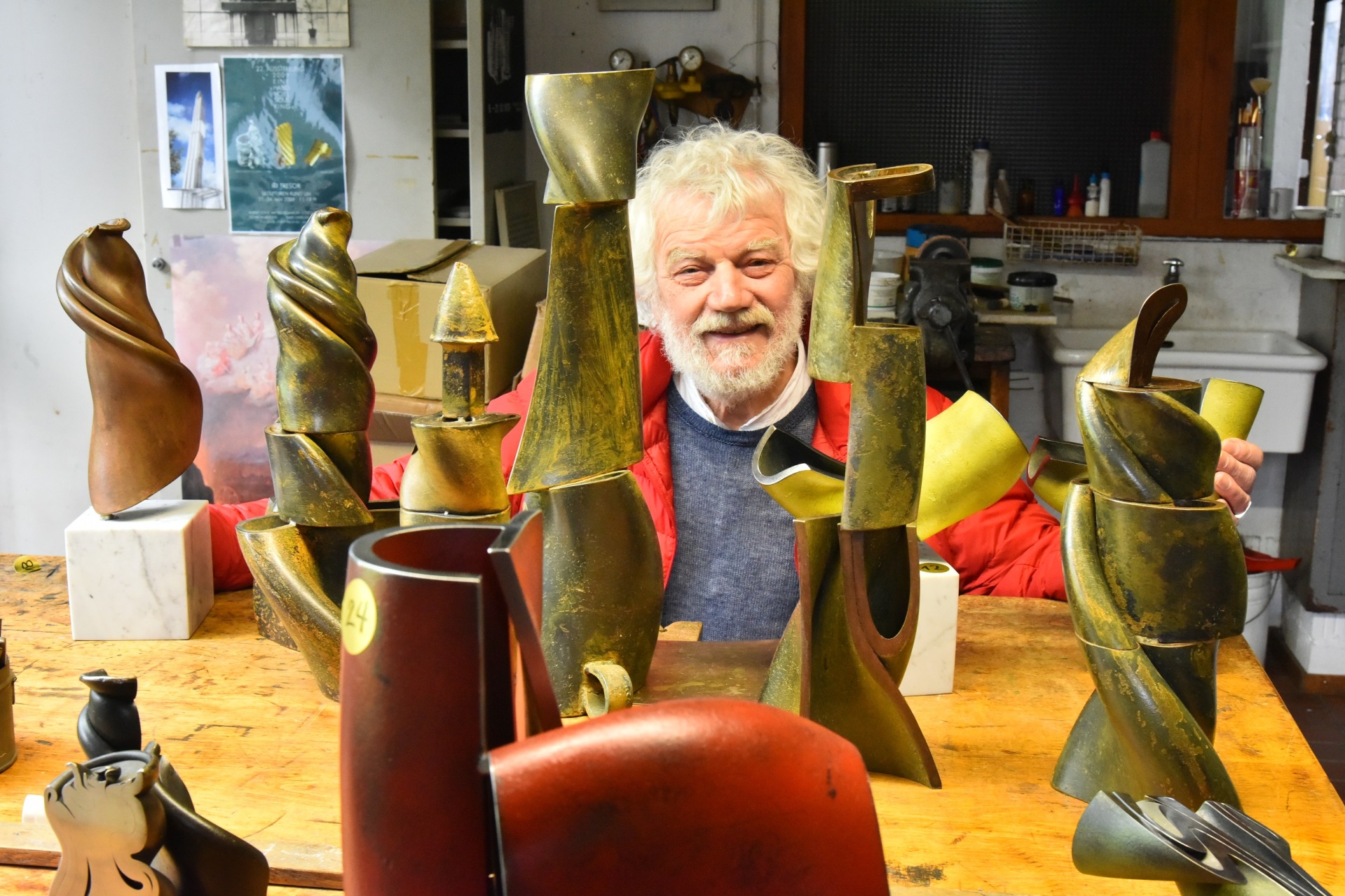
Albert Sous
You can subscribe to our RSS feed for our press releases here https://www.aachen.de/rss-feed-pressemitteilungen/rss.xml